
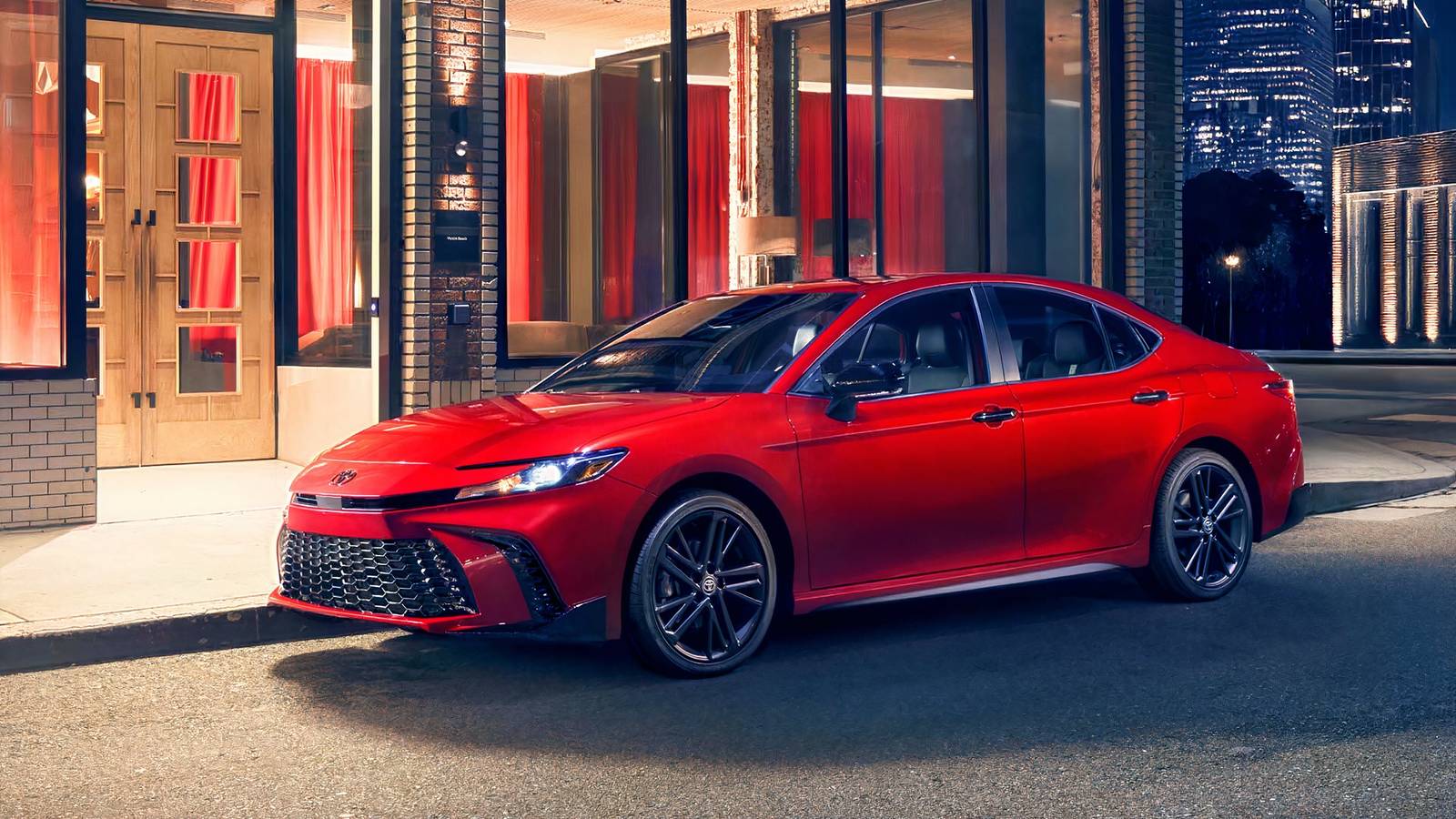
The Toyota Camry has quickly risen to be the Japanese brand’s most popular hybridized model since its introduction to the catalog last year, which comes as quite a surprise considering how in-demand the RAV4 has been. This showcases that a lot of consumers still place a lot of value on sedan ownership, despite there being so many impressive crossover and SUV alternatives. A big reason for the Toyota Camry’s immense success is thanks to its longstanding reputation for offering owners impressive reliability and fuel efficiency. It’s a decently sized car that works perfectly as a family vehicle, while still returning low running costs without compromising on standard equipment, particularly on the higher trims.
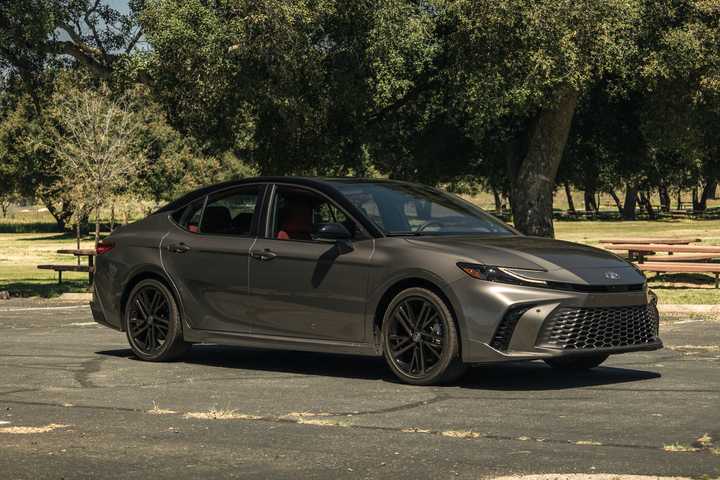

- Base Trim Engine
-
2.5L Dynamic Force I4 Hybrid
- Base Trim Transmission
-
CVT
- Base Trim Drivetrain
-
Front-Wheel Drive
- Base Trim Horsepower
-
184 HP @6000 RPM
- Base Trim Torque
-
163 lb.-ft. @ 5200 RPM
- Fuel Economy
-
53/50/51 mpg (best: LE FWD)
- Base Trim Fuel Economy (city/highway/combined)
-
53/50/51 MPG
- Make
-
Toyota
- Model
-
Camry
Hybrids continue to grow in popularity in the U.S. as gasoline prices rise. Toyota has been at the forefront of gasoline-electric hybrid drivetrain technology, with more than 30 years of development experience, resulting in it offering the most comprehensive electrified vehicle catalog in the U.S. by a massive margin. The Toyota Camry made a surprise switch to a hybrid-only offering when it was introduced last year, reflecting a decision that has since worked in the brand’s favor, just based on sales alone.
The 2026 Toyota Camry Aces Reliability

The 2026 Toyota Camry is the best option you can consider if you want a hybrid sedan that prioritizes long-term reliability. Its position as the champion in its segment is based on several consumer and in-depth reviews that focus on its overall mechanical integrity, while also sourcing data from the previous model, which features a near-identical drivetrain layout.
The Toyota Camry has been a longstanding reliability champion in the American market, which is why it remains such a relevant force, despite the market showing a clear preference for crossovers and SUVs.

iSeeCars issues the Toyota Camry with an 8.6/10 overall score, which includes 8.0/10 for reliability, 9.0 for safety, and 8.8 for retained value. Adding to this is an average lifespan of 13.1 years or 171,785 miles with a 31.7 percent probability of reaching 200,000 miles. Where depreciation is concerned, you can expect the model to lose $10,829 or 37.7 percent of its value over five years or 60,000 miles, which is well under the segment average.
J.D. Power issues the 2026 Toyota Camry with an 82/100 consumer-verified overall score, consisting of 80/100 for quality and reliability, 82/100 for driving experience, 92/100 for resale, and 76/100 for the dealership experience.
2026 Toyota Camry True Ownership Cost
|
Year 1 |
Year 2 |
Year 3 |
Year 4 |
Year 5 |
Total |
|
|---|---|---|---|---|---|---|
|
Insurance |
$1,423 |
$1,473 |
$1,524 |
$1,578 |
$1,633 |
$7,631 |
|
Maintenance |
$36 |
$482 |
$350 |
$904 |
$1,441 |
$3,213 |
|
Repairs |
$0 |
$0 |
$111 |
$269 |
$393 |
$773 |
|
Taxes & Fees |
$2,724 |
$245 |
$232 |
$220 |
$206 |
$3,627 |
|
Financing |
$1,948 |
$1,572 |
$1,168 |
$733 |
$266 |
$5,687 |
|
Depreciation |
$2,587 |
$1,998 |
$1,891 |
$2,218 |
$2,101 |
$10,795 |
|
Fuel |
$1,361 |
$1,402 |
$1,444 |
$1,487 |
$1,532 |
$7,226 |
|
True Cost to Own |
$10,079 |
$7,172 |
$6,720 |
$7,409 |
$7,572 |
$38,952 |
According to Edmunds‘ True Cost To Own calculator, you can expect a new base front-wheel-drive 2025 Toyota Camry LE to cost you $38,952 over the course of five years. This includes $10,795 worth of depreciation, but excludes the $29,000 MSRP. You’ll also find yourself spending $7,631 on insurance, $3,213 on maintenance, and just $773 on repairs. Your taxes and fees will also be incredibly low, with the calculator showing that you’re only likely to spend $3,627. If you opt to finance the base 2025 Camry, this will add $5,687 to your ownership costs, while fuel will cost you $7,226, based on average driving distances in the U.S.

CarEdge highlights that the Toyota Camry will cost $36,432 to own over the same period, with $14,274 accounting for depreciation, $10,060 for insurance, $4,530 for fuel, $6,056 for interest, and $1,512 for maintenance. Kelley Blue Book indicates that you can expect to pay $4,437 on maintaining a 2026 Toyota Camry, which includes routine oil changes, tire rotations, and filter replacements at the recommended intervals.

Ranking The Top 10 Toyota Camry Hybrid Models Years For Reliability
While many Camry years are known for their reliability, these model years stand out with the most reliable hybrid variants.
Equally Impressive Efficiency Returns

As per the EPA’s official fuel consumption estimates for the 2025 Toyota Camry, you’ll find that Edmunds‘ estimates are pretty much on par. The front-wheel-drive LE is the most attractive model, with it set to cost you $950 in fuel every year. The flagship all-wheel-drive XSE is just a bit more expensive to run, with its $1,050 annual fuel cost.
The front-wheel-drive LE is the most efficient model, returning a 52/49/51 MPG consumption result on the city/highway/combined cycle with a 663-mile range claim from the 13-gallon tank. It also indicates that this will save you up to $4,000 in fuel costs every five years and costs $1.59 to drive every 25 miles.
The all-wheel-drive XSE is the least frugal model, but this is only by a fractional amount. The EPA indicates that it returns a 43/43/43 MPG result with a 572-mile range claim and suggests that this will save you up to $3,250 in fuel costs every five years and cost $1.84 to drive every 25 miles. Expect to pay $41 to refill the 13-gallon tank, featured in all derivatives.

The Highest Mileage Toyota Camry Hybrid In The World
This Toyota Camry Hybrid has been doing taxi duties in Dubai without any major issues.
A Highly Appointed Cabin Experience Across The Range

Toyota kicks the range off at $29,000 for the base LE front-wheel drive model, making it the most competitively priced hybrid vehicle in the segment. A lower starting price point for a newer car is always going to be a strong strategy, which is a factor that is clearly evident in its sales results.
The most expensive Camry option is the XSE, which starts at $35,200. Toyota offers the all-wheel drive system across all trims for an additional $1,525. All of these prices exclude the brand’s $1,195 destination fee. There are some optional extras available across all trims, but they are relatively far and few, as the brand prefers to take a more defined five-trim pricing strategy.

The Toyota Camry has always been a value proposition product that caters to those wanting a decently sized family car that doesn’t compromise on build quality or reliability. The lower trim models may not be the most prestigious options that you can consider, but the new-generation examples are much more comprehensively kitted out compared to previous generations.
With that being said, we do have to point out that the 2026 model year’s starting MSRP is about $5,000 more than the 2021 model year’s starting price, reflecting quite a steep price increase rate. This is not exclusive to Toyota, as a lot of brands have been struggling to maintain competitive pricing in the modern era of vehicle production, which is constantly being affected by rising costs across the board.
Up To 232 Horses At Your Disposal

The current-generation Camry range carries over the previous-generation model’s trusty naturally aspirated 2.5-liter four-cylinder Atkinson-cycle engine, which produces 184 horsepower and 163 pound-feet of torque in isolation.
The front-wheel drive model features a pair of electric motors that generate a combined 134 horsepower and 153 pound-feet. Toyota doesn’t give us a combined torque figure, but it confirms that it limits peak power to 225 horsepower. The all-wheel drive model adds a third electric motor to the rear axle, producing 40 horsepower, 62 pound-feet, which increases the peak output to 232 horsepower.
2026 Toyota Camry Specifications
Toyota doesn’t declare any of this car’s performance specifications, so we can’t tell you how fast it is, but Edmunds reveals that the front-wheel drive model sprints from 0 to 60 MPH in around 7.8 seconds, making it slightly faster than its rivals, while MotorTrend confirms a 6.8-second 0 to 60 MPH sprint result for the all-wheel drive model.
Sources: iSeeCars, J.D. Power, Edmunds, CarEdge, and the EPA