
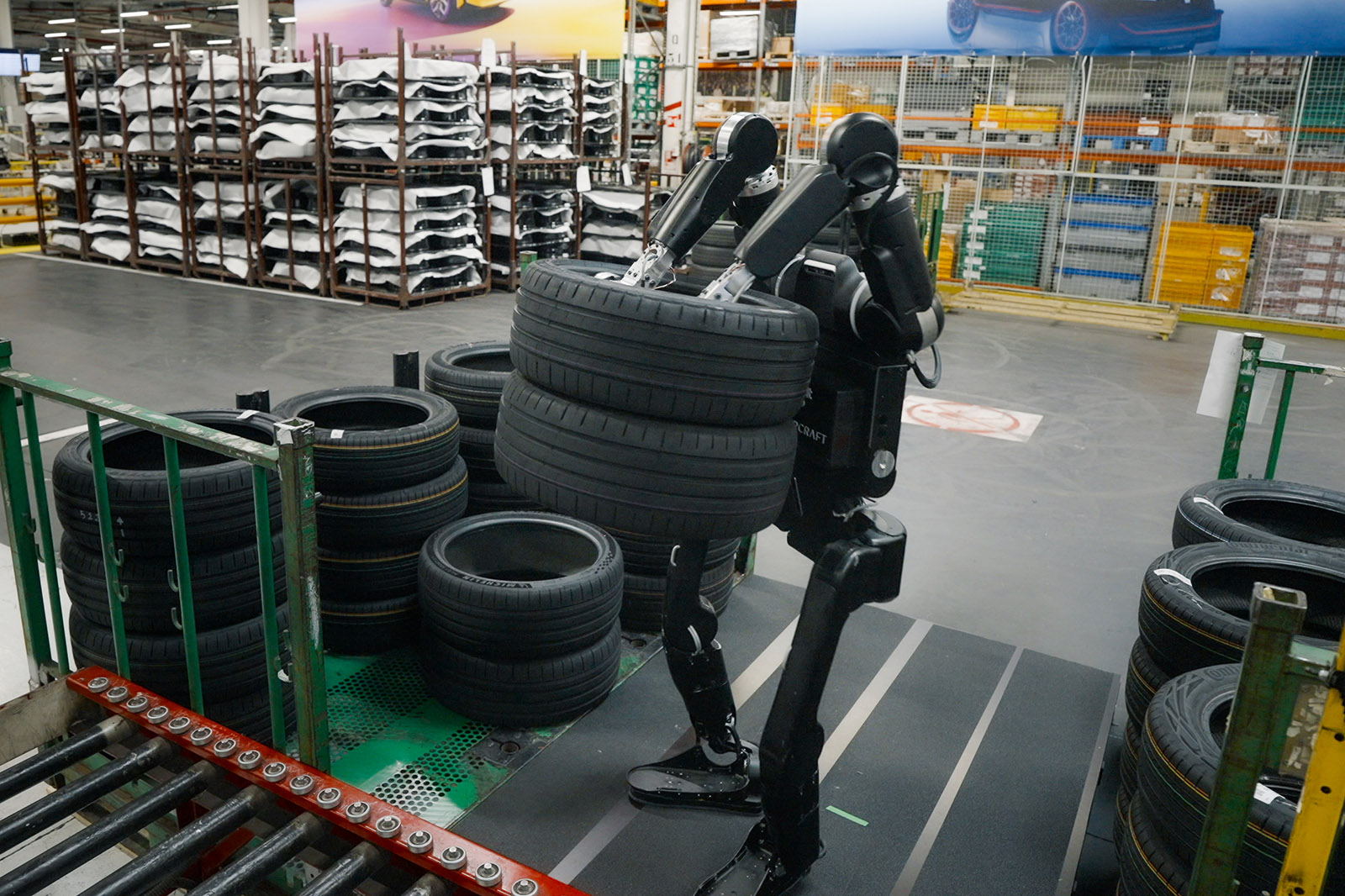
Renault is trialling an autonomous robot on the production line at its Douai factory. We meet it
Imagine for a moment – and stick with me here – picking up a baby seal. Not the BYD saloon but the aquatic mammal. At 40kg, he’s a big feller, isn’t he?
Now imagine your job is to collect a juvenile example of the pinniped from a box and sling it onto a conveyor belt. You’ll be shovelling the adorably chubby things onto the line for hours at a time, with little rest, and you might well be doing it through the night. Being so rotund and pliable, it’s tricky to get a good grip on a baby seal. And the weight – my goodness, the weight – makes this exhausting work. Almost inhuman.
This is, of course, hypothetical. But it’s not far from the truth for a group of workers at Renault’s Douai factory, where the 5, Scenic, Megane, Alpine A290, Nissan Micra and Mitsubishi Eclipse Cross are churned out in rapid succession. Its newest employee, Calvin, toils away transferring tyres from a carrier to the production line. From there, they are mated with wheels and bolted to cars.
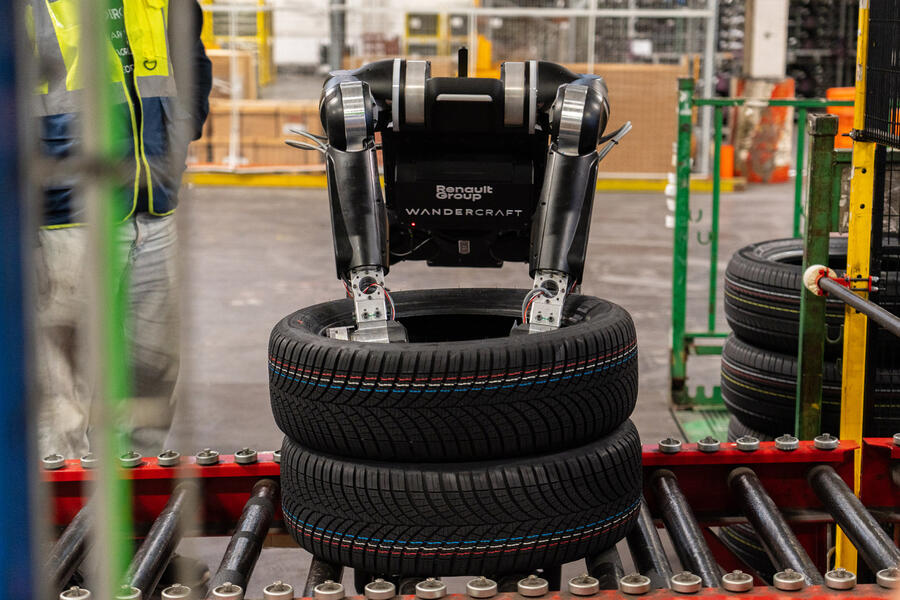
A pair of tyres weighing about as much as a baby seal, you see, and being round, they are bloody difficult to pick up in multiples. To do it four times a minute for eight hours – or to lift nearly 4000 tyres per shift – is surely among the world’s toughest workplace workouts; to make a career of it is all but impossible.
Renault, being well aware of the toll inflicted by such torrid work, looked for ways of reducing the strain. The simple answer would be to remove the human element entirely. But traditional factory machinery would have been too tricky to integrate into such a small corner of the tightly packed plant – and possibly not as effective as actual humans.
The next best thing, then, is a robot. But rather than buying from Tesla or any manner of Chinese firms, Renault went to an unlikely source. A year ago, it signed a deal with Wandercraft, a start-up manufacturing powered exoskeletons for the paraplegic. A little like a toned-down version of that worn by Sigourney Weaver in Aliens, they are intended to give independence back to those who would otherwise rely on a wheelchair or carers. Yet being designed for people, they also make a canny facsimile of one.
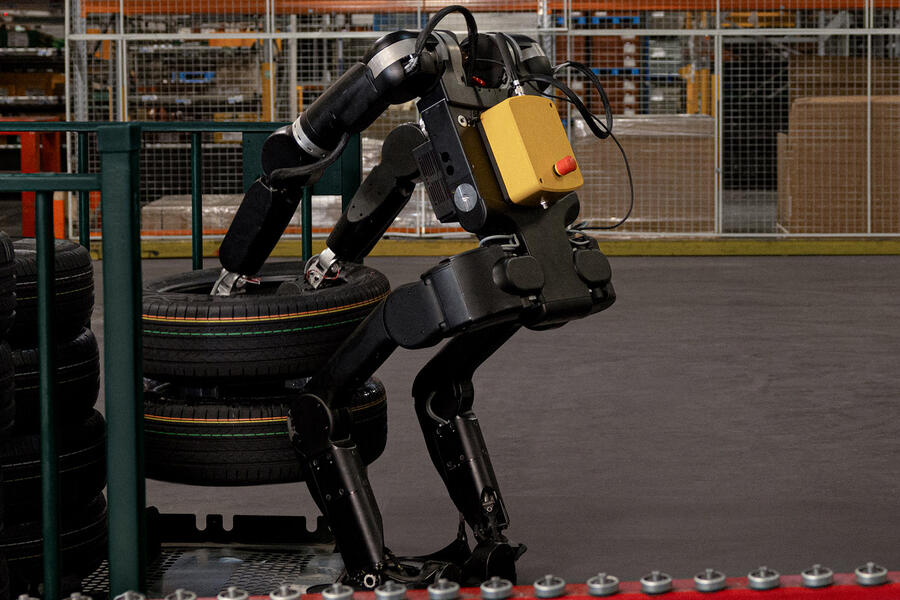
Having tested four different designs over the past year, the machine was finally ready. Enter Calvin, so named in reference to Isaac Asimov’s character Susan Calvin. It – or should that be she? – was pressed into service just days before we travelled to Douai to witness it in action.
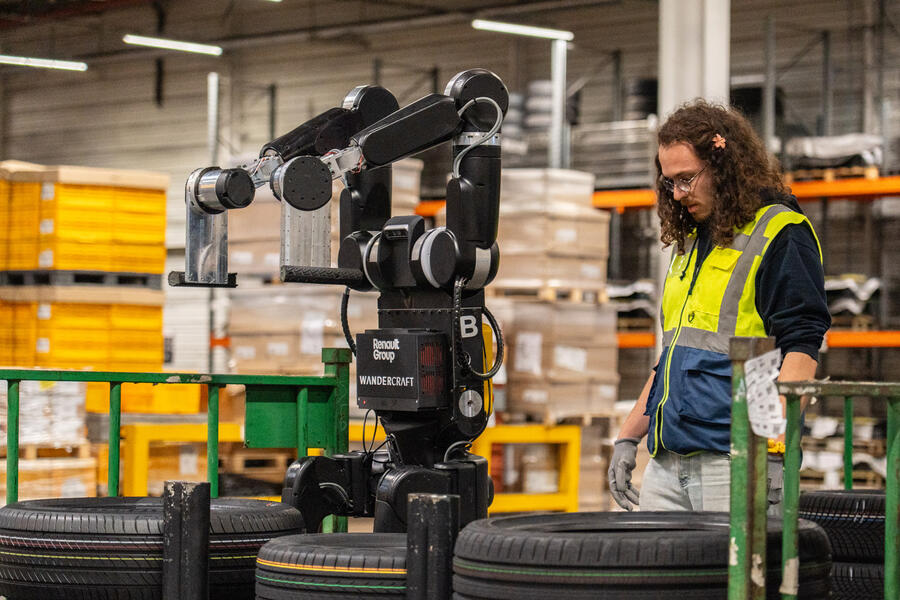
Disconcertingly humanoid in form, Calvin weighs 90kg and can carry up to 40kg, roughly equivalent to a baby seal or a really fat golden retriever. Two cameras and 45 sensors feed information to an artificial intelligence that takes free rein over 22 high-torque motors, doing whatever is required to complete a predetermined mission.
Unlike the automated vehicles that are a familiar sight in factories around the globe, Calvin does not follow a predetermined path through the plant but blazes its own trail. Wandercraft co-founder Jean-Louis Constanza explains that instead of instructing Calvin to go to points A, B and C and coming back, you simply tell it: “This is your job, go here and here, and manage yourself.”
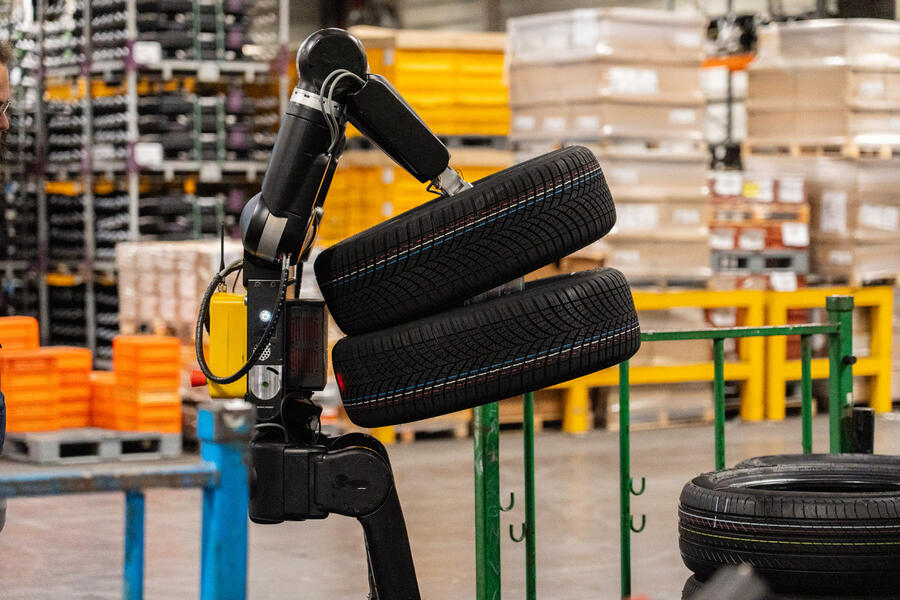
The jobs are simple – pick up that box and move it here, sling those tyres onto the line and so on – but variable, with the precious cargo prone to sliding off-kilter or being dropped. As such, Calvin doesn’t have conventional five-fingered hands. Those are quite useful for doing a lot of jobs – one might say handy – but not the best for more specialised work such as this. Instead, Calvin has a pair of trays designed to grasp the inner lip of a tyre or box, with plenty of wiggle room for the cargo to move around without being dropped.
It all sounds rather impressive on paper, and the excitement builds as we enter the plant. Calvin is nocturnal, so it’s now 11pm. Despite the time, it’s a bustling place; Douai more than doubled its output last year, so the night shift is in full swing. We’re warned not even to think about interrupting any line workers for a chat, in case we distract them and force a costly error. Delirium sets in as doors, bodies and wheels fly overhead, while drones zoom across the floor, delivering screws, fixings and the like at the precise moment they’re needed for any particular car.
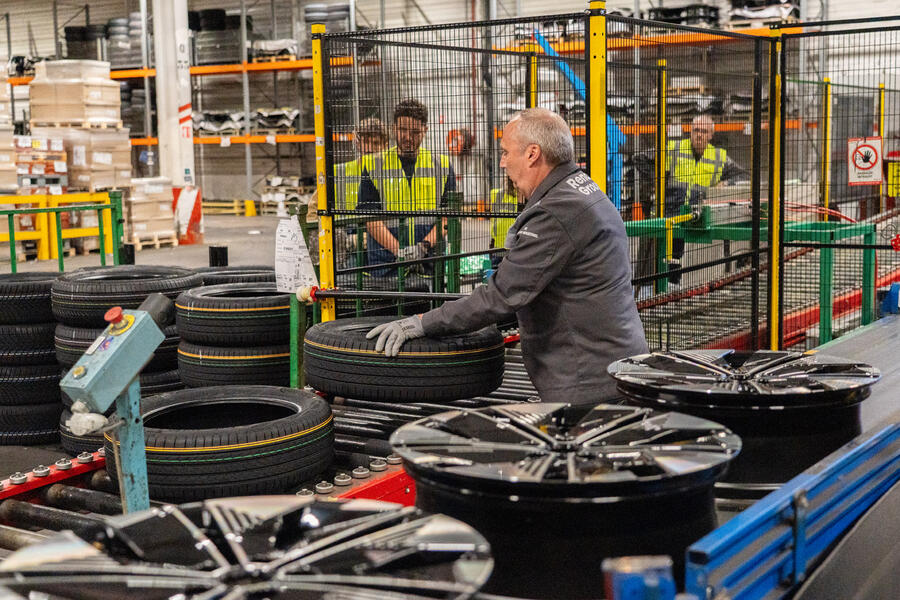
So imagine my surprise when we reach the main event and I discover Calvin has the gait of a university fresher after one too many Buzzballs. It steps deliberately, with wide and slow legs whirring and clicking it over to a rack. It then collects a pair of tyres, wobbles over to the adjacent conveyor, battles a case of the shakes not seen since England supporters last witnessed Harry Kane step up to the penalty spot, and plonks the tyres down on the line. A slightly bored-looking man of middle age separates the pair and sends them on their way.
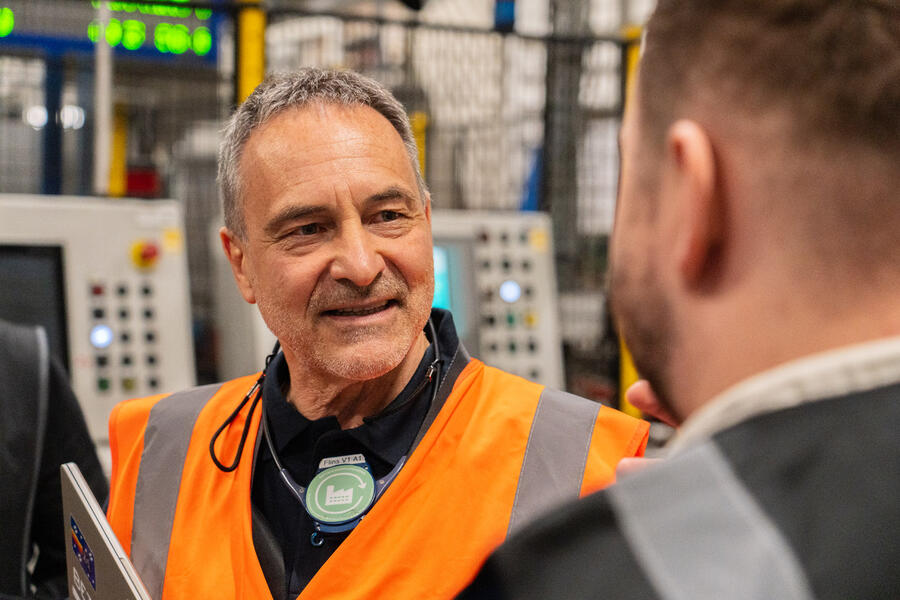
I posit that it doesn’t look all that polished. The immediate reply from Calvin’s supervisor is an incredulous look – one of near disgust. I’m briskly informed that this is actually completely normal, and by design: the shakes are in part because the tyres are so heavy and tricky to grasp, but that they – and the sloshed stride – are exactly as intended. They’re simply the optimal movements for both balance and efficiency – no energy is wasted on making Calvin’s operation any slicker.
The original premise of my visit was actually to participate in a man-versus-machine showdown with Calvin, but it turns out that he’s a little too valuable and I too unproven to risk any tomfoolery. No bother. In a straight race to stack just one set of tyres on the line, I reckon I could trounce the clanker.
While true, says Constanza, that is to miss the point entirely. “The quality and strength of a human is still better,” he says, but “the fact is that humans can’t keep doing these tasks for long because it hurts them. You can imagine it’s really strenuous: four times a minute for eight hours. There are two million strenuous jobs in France today, plus 400,000 that are vacant; in Europe, there are 15 million. It’s a long way to go, and that is our priority.”
In other words, were there more than one set of tyres in question, I’d prove the hare to Calvin’s tortoise – or collapse in a fit of pain.
The strangest thing of all, I think, is that I feel pity for Calvin. It’s human nature to anthropomorphise, but it feels like there’s a genuine kinship between man and machine here. Constanza compares supervision of Calvin to that of looking after a toddler. And, if you’ll excuse my being meta, I’ve repeatedly edited references to ‘her’ and ‘she’ as I write this, because Calvin feels surprisingly organic.
You almost wonder what would happen if Calvin broke free. Her brain is an artificial intelligence, after all, so she could in theory make her own decisions about what she would actually like to do. Would she make a break for the countryside – do a Pinocchio and try to live as a real boy? Sorry, a girl. Am I going mad?
Constanza offers reassurance: “This is one of the least, least silly questions of the year, because it’s exactly that. The problem is if you rely on neural networks like LLMs [large language model AIs], you have the same high probability of success, but it’s not high enough.”
Calvin’s artificial intelligence is, for now, constrained by how many mistakes Renault and Wandercraft can afford for her to make. Constanza explains: “We’re looking for [an error rate of] one or two per 1000 tasks – humans make one over 1000. If you want to work in this factory, it’s one per 2000 as a maximum, and that’s way [better than] LLMs.”
It’s then that Constanza breaks the news that Calvin is soon to be decommissioned and replaced by a more advanced model. I can’t help feeling a little bad, but so it goes.
The Calvin that is currently in action is only the ’40’ model, and a more advanced iteration is on the way. It has been designed by Renault’s in-house team, and I wonder if, fresh off penning the 4, 5 and Twingo, it will be something like a Tom Baker-era Doctor Who Cyberman or Dalek.
Not quite: it’s said to be evolutionary of today’s model, with narrower hips and different feet, optimised for carrying heavier weights. Constanza says it looks a bit like a Terminator – “in the version when he’s nice, not the version when he’s trying to kill everyone”.
Calvin’s replacement will be rolled out in factories across France and Spain in the coming months; 10 will be in action by the end of the year, scaling up to 350 by the end of 2027.
On the evidence I’ve seen, it is difficult to imagine a plant staffed entirely by Calvins in the near future. But given how quickly the ‘bot is being rolled out and iterated on, it could prove vital in protecting the future of European manufacturing. After all, it doesn’t need a month’s holiday in August; it can’t fall ill; it can’t – or at least shouldn’t – rise up against its bosses and go on strike. That may well be the shot in the arm that firms need in order to match the industrial might of China, which doesn’t play to the same ethical or financial rulebook as Europe.
What of the jobs? Renault suggests it will retrain workers displaced by robots, but how feasible will that be as the ‘bots become ever more useful? Time will tell. For now, dramatic upheaval is coming, and this feeble-looking, drunken-walking machine is at the fore.
| CALVIN 40: SPecifications | |
|---|---|
| Price | Tens of millions (est) |
| Engine | 22 electric motors, 45 sensors, two cameras |
| Power | More than a child but less than an adult |
| Kerb weight | 90kg |
| 0-62 tyres | 7.8min |
| Top speed | 480 tyres per hour |
| Range | A couple of square miles (software-limited) |
| Rivals | Tesla Optimus, Xpeng Iron, Wall-E |