
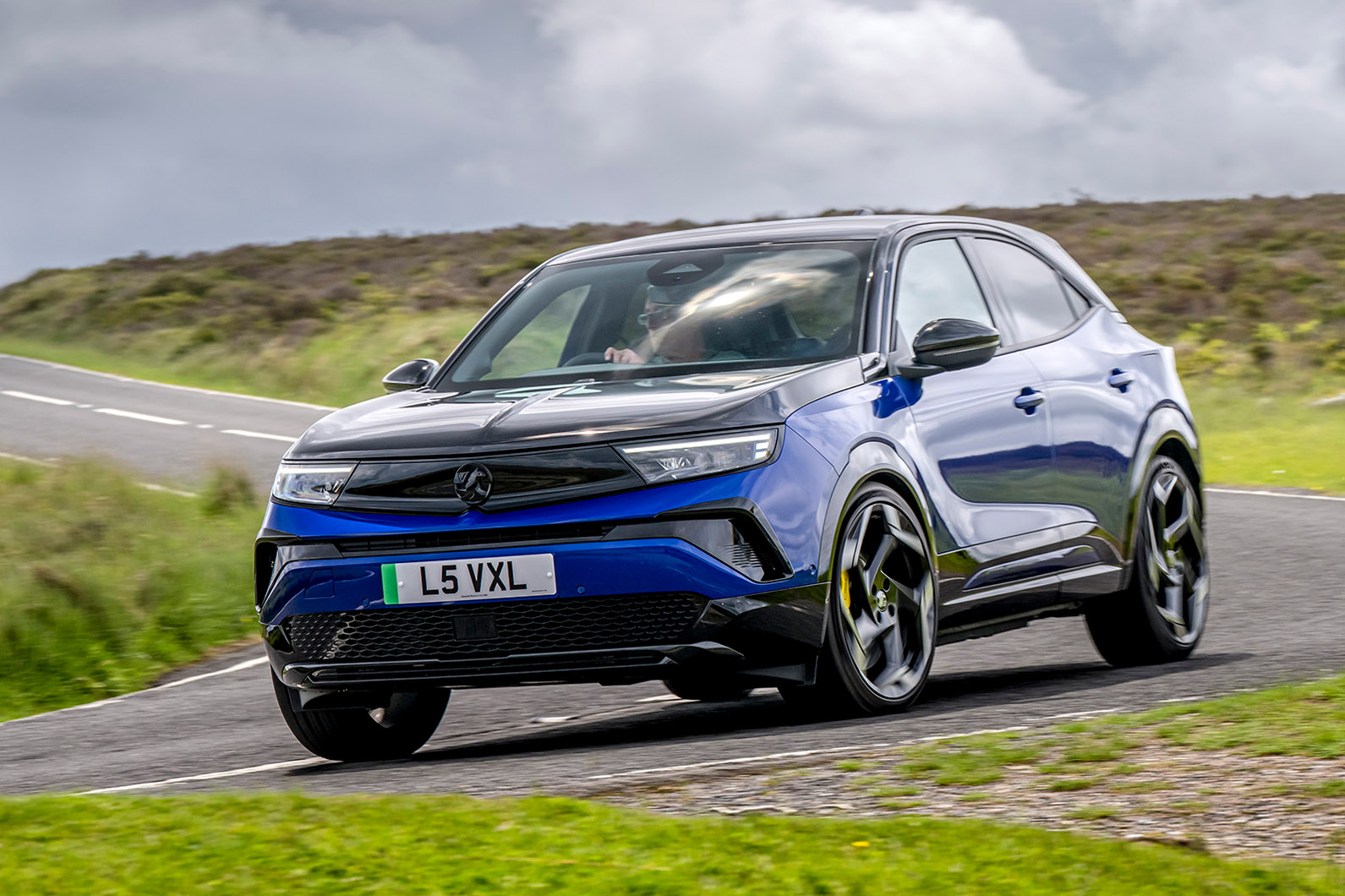
The Mokka GSE is essentially your regular electric Mokka given a makeover, and while it’s far more for handling than being strictly about appearance, meaning it potentially qualifies as a Q-car, there are some telling design changes that those in the know can’t miss.
On the outside there are fatter bumpers, new grilles and some 20in alloy wheels, which sit with a healthy amount of negative camber for proper hot hatch (or crossover) stance.
You will also see some yellow flashes and GSE lettering, plus there’s a standard black roof (a no-cost option to delete) and an optional black bonnet, like on old Opel and Vauxhall rally cars, for £250.
The significant changes are under the skin. The GSE runs on bigger wheels and 10mm-lower suspension than the standard Mokka.
Spring rates are up 49% front and 35% rear; there’s a Torsen locking front differential (with 36% lock-up under acceleration and 34% under braking); and there’s a new 30.8mm anti-roll bar for the torsion-beam rear suspension, increasing rear roll stiffness by 189% and, combined with the front stiffening, increasing overall roll stiffness by 48%.
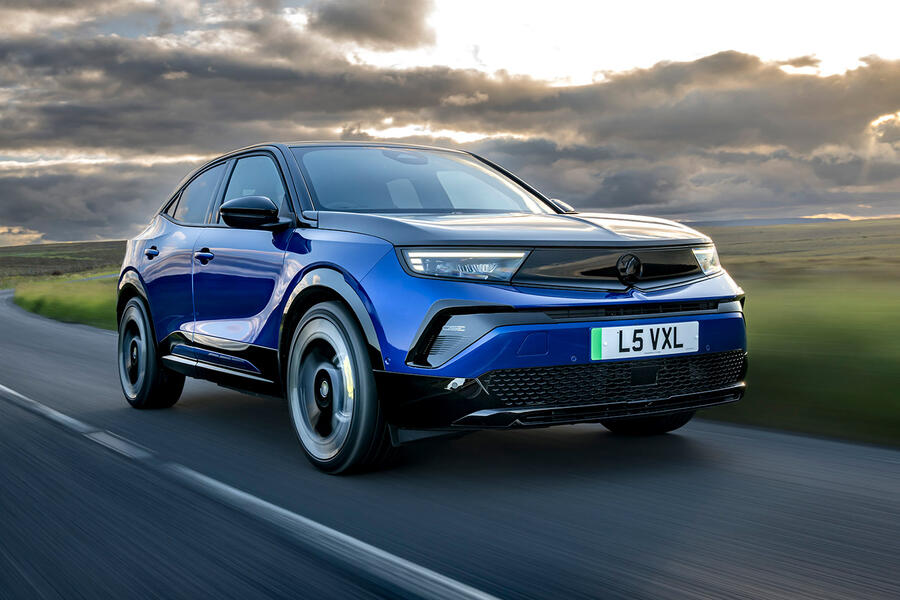
There are new knuckles on the MacPherson-strut front suspension too, albeit not like those ‘Hiperstrut’ ones the old Astra VXR had to reduce torque steer. They’re just designed to be a bit lighter and create enough space for the big wheels to clear the lowered body, while increasing Ackermann angle and letting the wheels turn far enough to retain a 10.41m turning circle.
Gosh, all this suspension nerd talk: it’s like 2005 all over again.
There’s more. The steering rack is new and has a 14.5:1 ratio, increased from 16.2:1 on the standard Mokka. Steering is 2.7 turns between locks.
Braking is by 380mm ventilated front discs (and 268mm rear discs) and, if you drive in the sportiest of three drive modes, it does no regenerative braking, to improve brake pedal feel – a trait it shares with the Lotus Evija hypercar.
Tyres are 225/40 Michelin Pilot Sport EVs, with Goodyear Eagle F1s a £100 option. They extend the WLTP range from 201 to 209 miles… and we’re back in 2026.
There are a couple of other EV numbers to knock off too: the battery is 54kWh (total) and can charge at a rate of 100kW. While less than a third of what the market’s best can achieve these days, that is actually competitive, even when you consider alternative hot EVs from outside the stable, like the Alpine A290. A 10-80% charge will take about half an hour.