Why are the British so good at making sports cars?
It’s a question put to me in an interview recently, to which a previous interviewee had said that, in times gone by (maybe even now), only the British would be barmy enough to stand in a small, cold shed and decide that a world-class small sports or racing car might roll out of the doorway.
I think there’s a bit more to it than that, and that in creating what is today a world-leading array of companies, from niche sports car or component makers employing a handful of people to top-level racing conglomerates (10 of the 11 Formula 1 teams have their headquarters or significant operations in Britain), opportunities played their part too.
Weather is one of those opportunities. It’s not so cold here in winter that standing in a shed with a little heater in the corner is beyond us; if it snowed consistently for six months of the year, we would go skiing. And it’s not so warm that in summer you can’t stand or drive around a disused airfield without melting; if it were, we would nap more.
Then there are those airfields. Since an Australian friend of mine once noted that “you guys are obsessed with the war” and I thought she might have had a point, I’m wary about how often I bring it up. But when it comes to the question ‘what makes Britain a leading car racing nation?’, World War II is impossible to ignore. Britain liked motorsport and sports cars before 1939, but it was afterwards that our global dominance became really established, because the war left plenty of facilities for use.
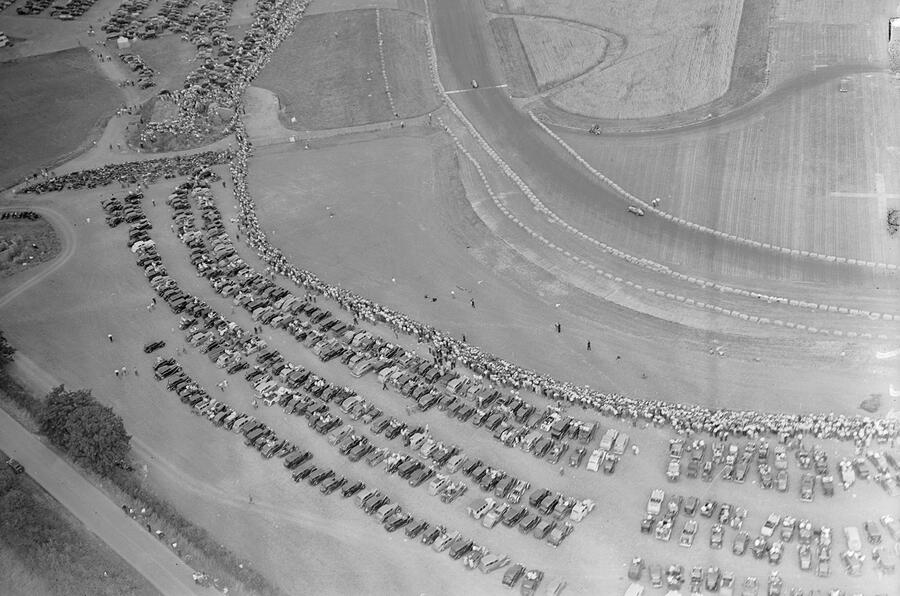
Pick a British race circuit or test track and I’d say there is as good a chance as not that it was once a wartime RAF base, later turned into a motorsport centre. As the launch site for the liberation of Europe, Britain had dozens of airfields which, when later disused, had inviting runways and perimeter roads.
In 2020, I wrote a feature about former RAF bases that could have become race circuits but didn’t – and barely scratched the surface of it. In the late ’40s, it wasn’t always easy to get ministry permission to go racing but airfield perimeter roads and runways weren’t in short supply.
When prospective racers first arrived at RAF Silverstone in 1947, having gained the land-owning farmer’s permission for a weekend race meet, a man from the Air Ministry, which still technically ran the place, came and turfed them off. They quickly arranged to go to nearby Towcester race course instead, but within touching distance they could have also tried their luck at RAFs Bicester, Finmere, Upper Heyford, Croughton and more – and since then, three of those have hosted car testing. The racers returned to Silverstone – permission in hand – in 1948, and by 1950 it was hosting an F1 grand prix.