
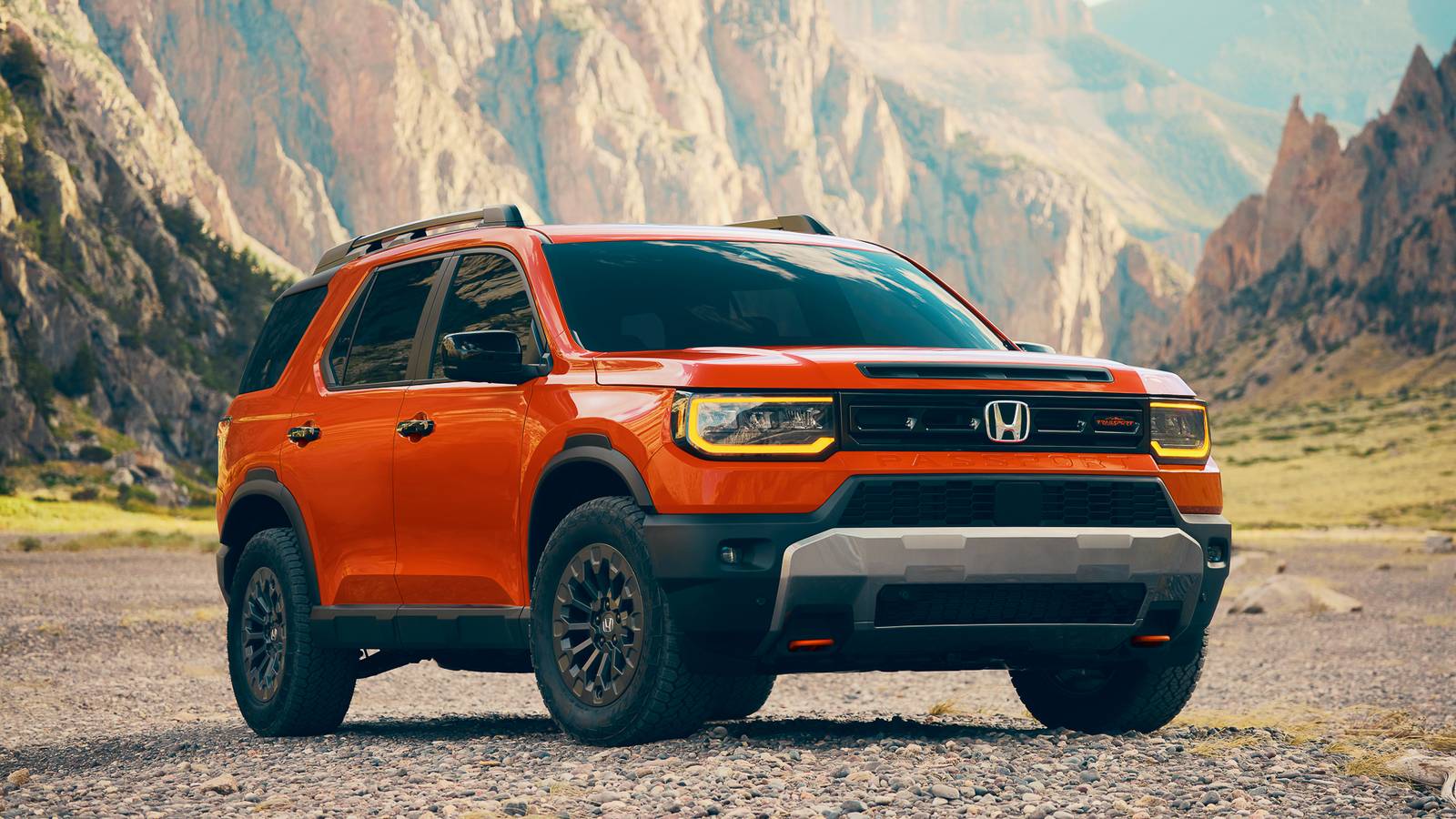
In today’s competitive SUV market, spec sheets often tell a story of downsized turbocharged engines, electrified drivetrains, and increasingly complex technology suites designed to impress in short bursts. But beneath the marketing noise, many buyers are still searching for something more fundamental: usable space, dependable performance, and long-term durability. That’s precisely where the Honda Passport carves out its niche.
Slotting between the compact CR-V and three-row Pilot, the Passport occupies a segment that should represent the ideal balance of size and capability. It offers 114.9 cubic feet of passenger volume, up to 100.8 cubic feet of cargo space, and a robust 3.5-liter V6 engine producing 280 horsepower, figures that immediately position it as more substantial than compact rivals, yet more manageable than full-size alternatives.
More importantly, it achieves this balance without resorting to excessive complexity. There’s no hybrid system adding weight or cost, no undersized turbo engine working under strain, and no compromised third-row packaging. Instead, the Passport delivers a well-engineered blend of power, space, and usability, making a compelling case as the SUV most buyers should be paying closer attention to.
The Overlooked SUV In Honda’s Lineup That Nails The Basics

The 2026 Honda Passport’s positioning is both its greatest strength and its biggest challenge. Sitting between the Honda CR-V and the Honda Pilot, it targets buyers who need more than a compact but don’t require a third row. From a packaging standpoint, the numbers tell the story. The Passport’s 114.9 cubic feet of passenger volume exceeds many compact SUVs by a significant margin, while its maximum cargo capacity of 100.8 cubic feet rivals or even surpasses some three-row competitors with their seats folded. Behind the second row alone, it offers approximately 50.5 cubic feet of cargo space, meaning it delivers genuine usability without requiring constant seat reconfiguration.

Its 113.8-inch wheelbase contributes to a stable ride and generous rear legroom (around 39.6 inches), while the absence of a third row allows for a deeper cargo well and underfloor storage solutions. This translates into a more practical loading area, particularly for bulky or irregularly shaped items. Dimensionally, it strikes an ideal balance. At roughly 189 inches in length, it’s noticeably easier to maneuver and park than larger three-row SUVs, yet still offers the presence and interior volume expected of a midsize vehicle. For many buyers, this “in-between” is the optimal solution. But impressive packaging alone doesn’t explain why the Passport stands apart from similarly-sized rivals—that advantage lies in what’s under the hood.
Naturally Aspirated V6: Power Without Complexity

While much of the segment has shifted toward turbocharged four-cylinder engines, the Honda Passport retains a naturally aspirated 3.5-liter V6, an increasingly rare configuration that offers tangible benefits. Producing 285 horsepower at 6,100 rpm and 262 pound-feet of torque at 5,000 rpm, the V6 delivers consistent, linear power across the rev range. Unlike smaller turbocharged engines, which often concentrate torque at lower RPMs before tapering off, the Passport’s engine provides a more predictable powerband. This results in smoother acceleration and more consistent performance under load.
Paired with a 9-speed automatic transmission, the Passport achieves a 0–60 mph time in the mid-6-second range, competitive within its class, particularly given its naturally aspirated design. More importantly, it maintains performance when fully loaded with passengers or cargo, without the thermal stress or increased boost pressure associated with smaller turbo engines.

The available i-VTM4 all-wheel-drive system further enhances performance by actively distributing torque between the rear wheels. Unlike basic AWD systems, this setup can send up to 70% of torque to the rear axle and 100% of that torque to either the left or right rear wheel, improving traction and cornering stability. With a maximum towing capacity of 5,000 pounds when properly equipped, the Passport also demonstrates its capability as a practical utility vehicle, something many smaller turbocharged rivals struggle to match consistently.
Honda-Grade Reliability That Still Sets The Benchmark In The Midsize SUV Class

Reliability is often discussed in abstract terms, but the Passport’s engineering choices provide concrete reasons for its strong reputation. The naturally aspirated V6 avoids the high cylinder pressures and additional heat associated with turbocharging, which can contribute to long-term wear in downsized engines. Its 9-speed automatic transmission, while refined over time, is based on a widely used architecture, benefiting from years of real-world data and incremental improvements.
Additionally, the Passport shares its Global Light Truck Platform with the Pilot and Ridgeline, a platform that has been extensively tested and refined. This reduces the likelihood of early lifecycle issues often associated with entirely new architectures.

From a maintenance perspective, the absence of hybrid components, such as high-voltage battery packs or electric motors, simplifies long-term ownership. Routine service intervals remain straightforward, and parts availability is strong due to shared components across multiple Honda models.
Fuel economy, rated at approximately 19 mpg city and 24 mpg highway for AWD models, may not lead the segment, but it reflects a trade-off for durability and consistent performance. Importantly, these figures remain stable under varying driving conditions, whereas smaller turbo engines can see significant efficiency drops when pushed harder. In real-world ownership scenarios, these factors combine to create a vehicle that is not only reliable but predictably so, a key distinction for long-term buyers.
The Japanese Hybrid SUV With The Highest Driving Range In 2026
As SUV owners seek to put off gas pump visits as long as possible, this Japanese hybrid shines for its ability to go 600+ miles between fill-ups.
Why the Passport Prioritizes Real-World Usability

Beyond its powertrain and packaging, the Honda Passport’s design emphasizes measurable usability advantages. Ground clearance stands at 8.1 inches, allowing it to handle uneven terrain, gravel roads, and light off-road conditions with confidence. Approach and departure angles, while not extreme, are sufficient for moderate trail use, particularly when combined with its torque-vectoring AWD system and selectable drive modes for snow, mud, and sand.
Interior ergonomics are equally practical. The cabin layout prioritizes physical controls for key functions, reducing driver distraction. Storage capacity is substantial, with a large center console, wide door pockets, and underfloor cargo compartments that add functional versatility.

The cargo area itself is a standout feature. With over 50 cubic feet of space behind the second row and a wide, low load floor, it accommodates large items without the need for complex seat folding. Fold the rear seats, and the nearly flat load surface expands to over 100 cubic feet, making it competitive with significantly larger SUVs.
Ride quality is supported by a fully independent suspension setup, including a MacPherson strut front and multi-link rear configuration. This allows for a balance between comfort and handling, with enough compliance to absorb road imperfections while maintaining stability at highway speeds. These are not headline-grabbing features, but they directly impact how the vehicle performs in daily use, where it ultimately matters most.
The Long-Lasting Japanese SUV That Rarely Needs Repairs
A new update successfully brings this outdated but rock-solid SUV into the world of modern design and advanced technology.
The Sensible Choice In A Segment Obsessed With Screens

As many competitors push toward increasingly digitized interiors, the Passport takes a more measured approach, one that prioritizes usability over novelty. Its infotainment system, while not the largest in the segment, is supported by physical buttons and knobs for frequently used functions. This reduces reliance on touchscreen inputs, improving ease of use while driving.
From a technical standpoint, this also minimizes the risk of software-related issues that can affect more complex systems. Driver-assistance features are integrated through the Honda Sensing suite, which includes adaptive cruise control, lane-keeping assist, collision mitigation braking, and road departure mitigation. These systems operate using a combination of radar and camera inputs, providing a layer of safety without overwhelming the driver with constant alerts or interventions.

The interior materials and construction further reinforce its long-term usability. Hard-wearing surfaces in high-contact areas, combined with well-fitted panels and durable upholstery, contribute to a cabin that maintains its integrity over time. From a lifecycle perspective, simpler technology can translate to lower repair costs and fewer obsolescence concerns. While some rivals may offer larger screens or more advanced interfaces, these features often come with increased complexity and potential long-term drawbacks. The Passport’s approach may seem conservative, but it’s grounded in practicality, delivering technology that supports the driving experience rather than complicating it.
Sources: Honda U.S.