
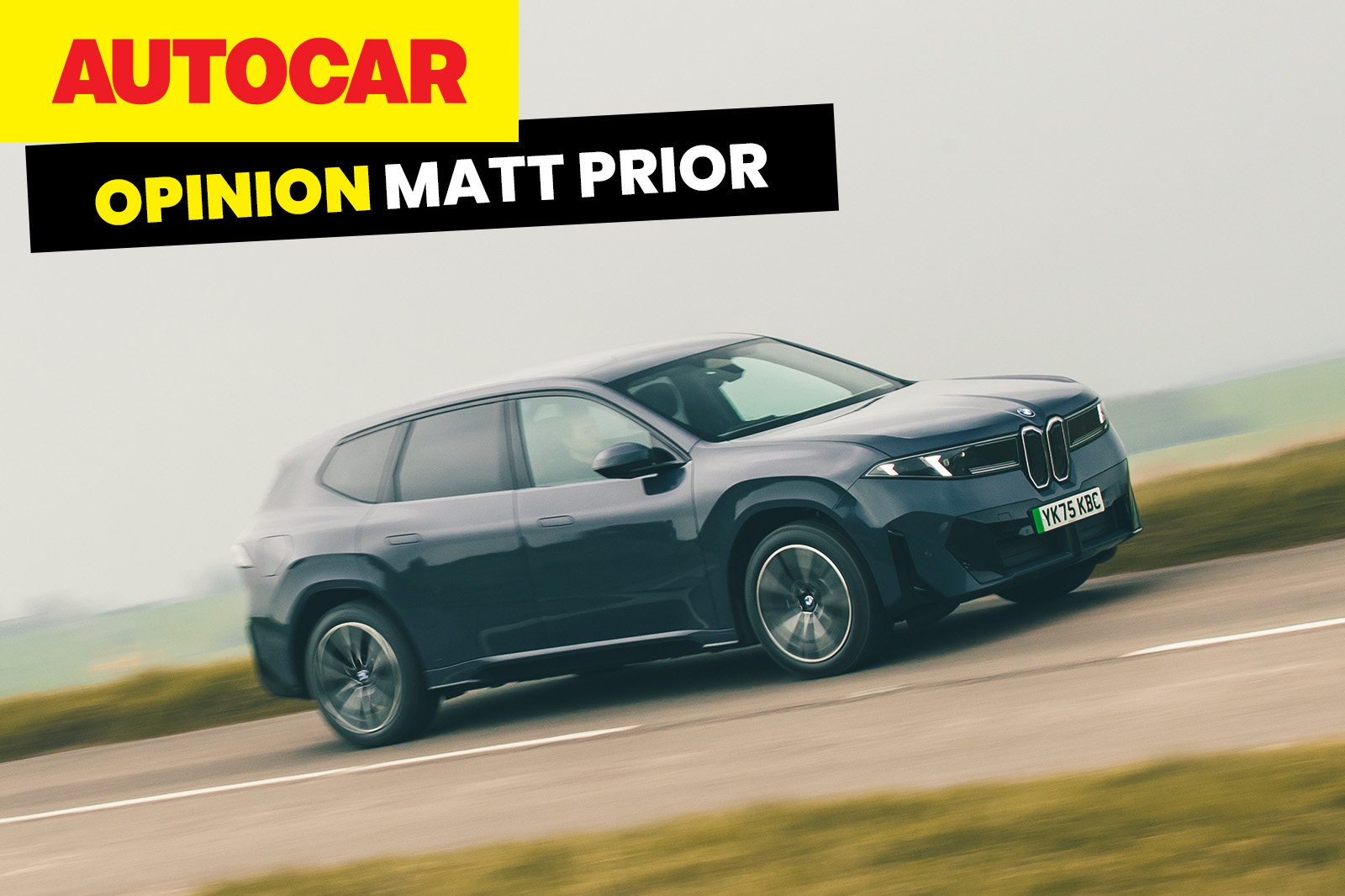
The question “is this new car a software-defined vehicle?” gets a response for which the clichéd term ‘Gallic shrug’ could have been invented.
It would only have been bettered if the engineer had a Gauloises hanging nonchalantly from her mouth as she did it, but even in France I suppose that’s frowned upon indoors these days.
Glances are exchanged between engineers and executives and designers while they consider the answer. They’re aware that other companies – most notably BMW with its Neue Klasse EVs – have used the term ‘software-defined’ recently. And I think they feel as I do about it. What does it even mean? No idea, mate. It is, as they put it, “an industry buzzword”, so they put it back to the interviewer: what would make it software-defined? He’s not entirely sure either.
Nor am I. And our friends at the Car Design Research agency share some of this scepticism. “Understanding what this tangibly is and how it actually adds value is at best murky,” they say.
My best understanding of ‘software-defined’ is that it is a vague concept. There are two aspects to a vehicle, I suppose, and both are in some ways influenced by software.
First, there are the vehicle dynamics, or the driving experience, and in all new cars software plays some kind of part here. Even in the Ariel Atom, which has entirely mechanical brakes and steering and gearshift and clutch, the throttle response is still to a degree defined by software: the engine responds as fast as it can while remaining within emissions compliance.
By the time you have a car with by-wire throttle, brakes and perhaps even steering, and if it has adaptive suspension, most of the driving experience is controlled, if not exactly defined, by software. As a driver, you’re only ever interacting with software, while it’s interpreting what you want and telling the hardware. Does that make your car software-defined? It could.
Second, there are a vehicle’s other systems – anything not involved in controlling its driving. Such as the fan blower on my 23-year-old Audi A2, which steadfastly refuses to do what I tell it, because there’s a circuit board or some lines of code telling it to do something else. It’s 100% software-controlled at that point, but I don’t think you would hear engineers or marketers saying it’s software-defined, even though its behaviour is certainly (and infuriatingly) not defined by me.
And the more of this interaction with software rather than hardware you have, the closer a car is to becoming fully software-defined, presumably.
One industry executive recently wrote to me to, er, define ‘software-defined’: “[It] refers to a paradigm shift where the vehicle’s core functions and features are no longer hardwired into physical components but are instead controlled, enhanced and updated through software.
“This approach decouples hardware from functionality, enabling continuous innovation, over-the-air updates and rapid deployment of new services throughout the vehicle’s life cycle.