
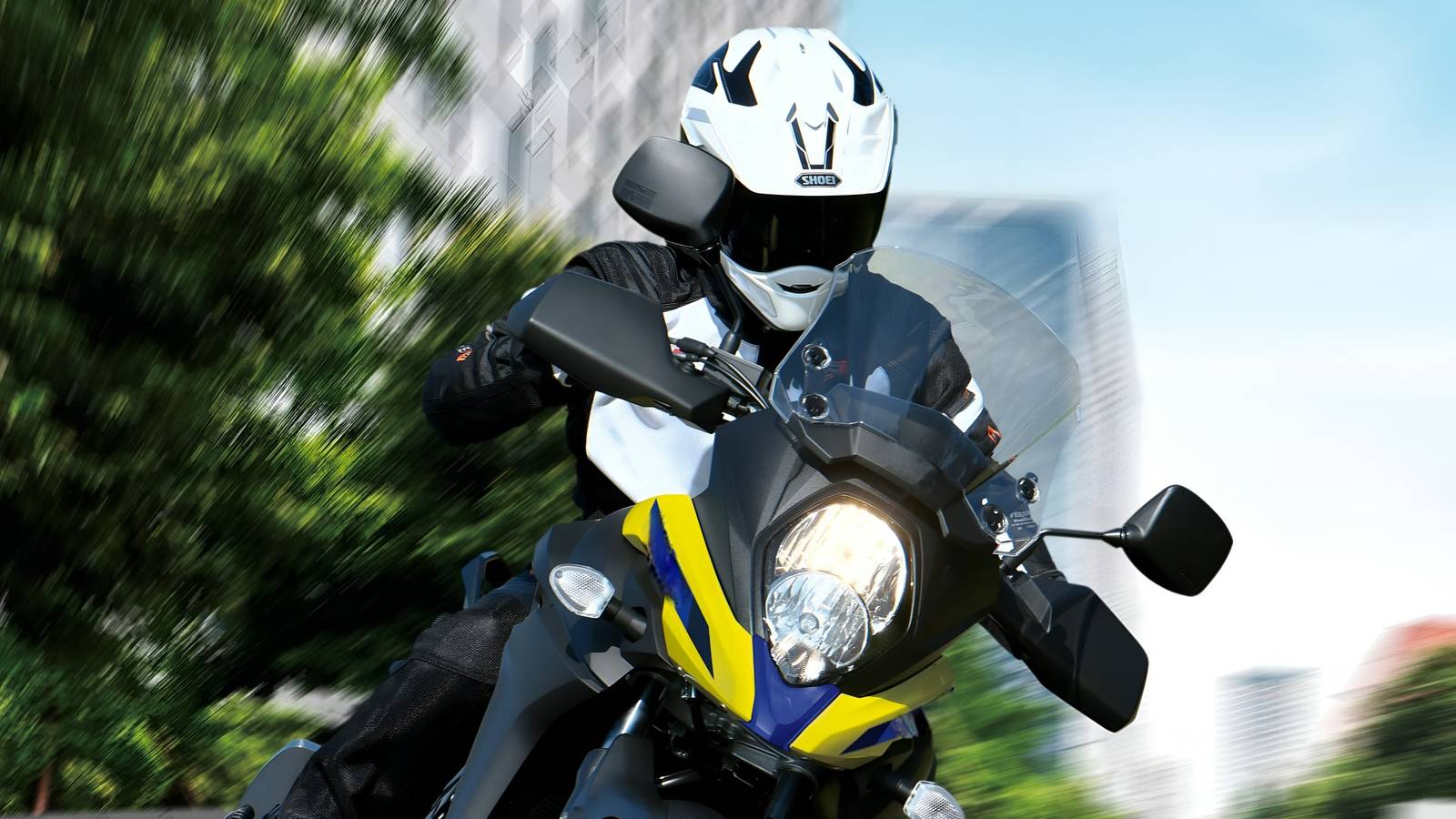
Adventure bikes are among the most popular motorcycle styles. This is mainly because of the practicality, performance, comfort, and convenience on offer. The well-rounded appeal is consistent with everything from the entry-level likes of Royal Enfield Himalayan 450 and KTM 390 Adventure X to the top-spec likes of the BMW R 1300 GS and the Honda Africa Twin.
However, long-standing reliability and durability are hard to find in this mix, even in a do-it-all ADV. The Japanese likes of Honda, Suzuki, Kawasaki, and Yamaha excel here because of their “If it ain’t broke, don’t fix it” mantra. Hence, the adventure bike that takes the spotlight in terms of reliability is a seasoned middleweight Suzuki that has been in production since 2004.
Adventure Bikes Are The “SUV On Two Wheels”

ADVs are called the SUVs of the two-wheeled world because they blend rugged, off-road styling and capabilities with comfortable, long-distance touring practicality. Versatility is key here. Their tall riding stance and high ground clearance make off-roading easier. Additionally, a relaxed rider triangle helps keep the occupants comfortable. Features such as a large fuel tank, elevated wind protection, and support for additional luggage, protection, and comfort further expand an ADV’s flexible nature.
Durability And Ruggedness Are Key Factors

An ADV also needs to excel both on and off-road. Accordingly, durable underpinnings and rugged appeal are present as standard. You’ll find long-travel suspension, tall ground clearance, and spoke wheels to aid in this regard. At the same time, to remain rideable on tarmac, ADVs cannot be overly rugged and durable like dedicated dirt bikes. Heavier components and high-performance parts designed for highway speeds are more susceptible to damage from extreme off-roading conditions. Hence, there is always a tussle between an ADV’s on-road and off-road capabilities, with sacrifices made to balance things out.

The Adventure Bike Built For Riders Who Push Limits
The quickest way to live out your rally raid dreams.
A ‘Lifetime’ Adventure Bike Is Possible

Aside from all that, the key factors that make a ‘lifetime’ adventure bike are reliable, proven components. One can offer the most capable off-roading ADV out there. But crucial components like the suspension setup and chassis are compromised within a few runs, then their quality and reliability go for a toss.
A prime example is the relatively new Kove 800X Rally ADV, which offers an impressive middleweight package, highlighted by itsweight management. However, there were clear compromises in quality, as evidenced by numerous reliability issues, including cracks in the linkages, inability to tighten the spokes on the wheels properly, and throttle issues. Kove has since addressed most of the issues with recalls and other methods.

This brings us to the one factor that ultimately decides if an ADV is a lifelong machine—age. The still-standing old-school offerings are a testament to an almost-immortal ADV. Examples include the Kawasaki KLR650 and the Suzuki V-Strom 650. Timely maintenance is the other side of this coin that helps these ADVs offer a stress-free riding experience for a long time.
The Suzuki V-Strom 650XT Can Take A Lot Of Abuse

The Suzuki V-Strom 650, in its current guise, has been largely unchanged since 2017. Its chassis and powertrain go even further and are still related to the OG V-Strom 650 from the early 2000s. Over the years, the engine and gearbox have been refined to their maximum potential.

Furthermore, the chassis is designed for simplicity and durability. This is what helps the V-Strom 650 take a lot of abuse without breaking a sweat. Over two decades, the V-Strom 650 has become a very popular and familiar ADV worldwide. It also has a very strong aftermarket and service support.
The “XT” Adds Rugged Appeal To The Mix

The V-Strom 650XT adds a few simple features over the standard model. But these are enough to dial up its durability. The XT gets wire-spoked wheels (as opposed to the standard model’s cast-aluminum wheels), which are more flexible and better able to handle abuse on uneven terrain, especially off-road runs. Suzuki also adds more protection to the XT with features like standard hand guards and a lower engine cowl.
Powered By A Long-Production V-Twin Engine

The V-Strom 650XT’s engine might seem familiar because the 90-degree 645cc V-twin is the same mill that powers the much-proven, gorgeous-looking SV650. So, tractability is a no-brainer. This engine has a short-stroke design, liquid-cooling, and an 11.2:1 compression ratio. As for output, you get 69 horsepower at 8,000 RPM and 50.9 pound-feet of torque at 6,400 RPM.
While these numbers sound humble, this V-twin has proven to be a fun engine with meaty low-down torque and a tractable performance curve. Furthermore, this V-twin doesn’t need counterbalancer shafts, which also helps keep engine heft low. There is an analog connection here with the engine having a cable throttle.

It also flaunts “Suzuki Dual Throttle Valve” technology, which has a secondary set of computer-controlled throttle butterflies in line with the primary ones. These help with smoother on/off throttle transitions. Power is sent to the rear wheel via a simple yet robust six-speed manual gearbox, with its sixth gear being tall for comfortable highway cruising. There are no fancies like a quickshifter or an assist-and-slipper clutch here.
Famed For Its High-Mileage Reliability

Many owners have reported 100,000+ miles of stress-free ownership experiences with stock V-Strom 650 V-twin engines. In fact, there are instances of consumers breaching the 160,000-mile mark with just proper and timely maintenance. Part of the credit goes to the V-twin engine’s 90-degree layout, which offers a natural balance and reduces vibrations that can cause fatigue to engine components. Furthermore, its decades of testing and iterative improvements have helped make things “bulletproof”.

10 Suzukis Known For Bulletproof Durability
Suzuki doesn’t chase headlines, but if you’re the kind to chase horizons, these are the Suzukis you should look at very closely.
Simple And Robust Underpinnings

Keeping things simple is a robust aluminum twin-spar frame. The engine is used as a stressed member, helping keep weight and dimensions in check without compromising rigidity. A bolt-on steel subframe is there for added strength to handle the load of a pillion and additional luggage. The swingarm is made of aluminum, like the chassis.

The chassis is suspended on a simple yet robust suspension setup. It comprises regular 43 mm telescopic forks up front with 5.9 inches of travel. The rear gets a linkage-type monoshock with 6.3 inches of travel. Both ends come with preload and rebound adjustability. As for brakes, twin 310 mm discs are there up front, coupled to axial two-piston floating calipers. The rear gets a 260 mm disc coupled to a single piston caliper. Catering to its occasional trail-going capabilities are its 110-section front and 150-section rear tubeless tires wrapped around 19-inch front and 17-inch rear spoked wheels.
Ergonomics For All-Day Comfort

With a seat height of 32.9 inches, the V-Strom 650XT is one of the most accessible adventure bikes in its class. Suzuki has also designed the V-Strom 650XT to be an all-day motorcycle with a relaxed rider triangle. Highway comfort is taken care of with features like a manually three-way adjustable windscreen. However, it results in a modest ground clearance of 6.7 inches.

10 Suzuki Bikes That Deliver Real Adventure For Real Riders
The rarest Suzuki motorcycle that packs real adventure is the 1980s DR750S, featuring one of the biggest single-cylinder engines ever made.
Simple Electronics Help The Cause

The electronics on the V-Strom 650XT are as barebones as they can get for a 2026 middleweight. Despite its outdated visual appeal, this part-LCD unit offers a lot of information at a glance. A large analog tachometer is present to the left, with warning lamps housed within the dial. In terms of assistive electronic features, the 650XT offers three levels of traction control that can be switched off, as well as a dual-channel ABS.
Source: Suzuki Cycles