
However you feel about the modern family unibody SUV, whether it’s positive or negative, they have fully saturated the market. Gone are the days of piling everyone into the Ford Taurus or the Chrysler Sebring. Today, everyone’s piling into either full-size, mid-size, or, in this case, compact SUVs. Automakers have responded by flooding every segment with options, making it easier than ever for buyers to prioritize practicality, ride height, and perceived safety over traditional sedan dynamics.
To touch back on the previous Ford Taurus and Chrysler Sebring shout-out, people also aren’t buying domestic as much. Imported compact SUVs, even with the ongoing tariffs, still rule the roost when it comes to family haulers. There’s one Japanese SUV in particular that rules them all, and you should probably consider its three-year-old counterpart as opposed to its new one. Depreciation hits hardest in those first few years, meaning lightly used examples often deliver nearly identical features, safety tech, and efficiency for thousands less, making them a far smarter value proposition overall.
The U.S. Loves A Family SUV

An SUV has become quite literally the default in the American automotive market. Data from Good Car Bad Car shows that over 52 percent of all new vehicles in the US are SUVs. Even more telling, the compact SUV segment makes up for 21 percent of that overly significant margin. The bottom line is, families want utility, space, and comfort.
Safety Is A Top Priority

It’s not about the size of the wave; it’s about the safety of the vehicle. Most consumers believe that buying an SUV is going to guarantee them safety. While that isn’t always the case, it truly depends on how the vehicle is constructed and how the vehicle reacts on impact; it does play a factor. With all cars getting larger and larger, you might not want to be in a 2 Series when a Silverado 3500 t-bones you.
Technology Overload, In A Good Way

SUVs come with more family-forward tech compared to modern sedans as well. Although not in the compact segment, staples like the Kia Telluride and Hyundai Palisade come with nifty features like passenger talk systems that allow the driver to focus on the road while speaking to passengers in the back rows.
Tariffs And The Used Market

Tariffs are a hot-button issue in today’s auto market. A range of tariffs was introduced on imported goods, including steel, aluminum, and certain auto-related components, subsequently costing automakers a massive amount of money. While some legal challenges and policy adjustments have reshaped how these tariffs are applied, they haven’t disappeared.
Buying Used In 2026 Is A Savvy Way To Shop

The pandemic brought on a lot of challenges when it comes to buying a new car. Buying a gently used vehicle that you know the history of is often a better financial decision. Plus, getting three years old is always a safe bet when it comes to buying a used car. Oftentimes, these vehicles are within the same generation as the new ones (depending, of course).
Buying New In 2026 Is A Big Investment

Did you know that Kelley Blue Book recently ran a story that stated the average cost of a new vehicle in the United States is around $47,000? If anything shows that the US is currently in an “affordability” crisis, it’s the new car market. Therefore, your best bet might be to finance a three-year-old family SUV.

10 Dependable SUVs With Great Gas Mileage For Long Commutes
SUVs can get good gas mileage too. Here are ten that do.
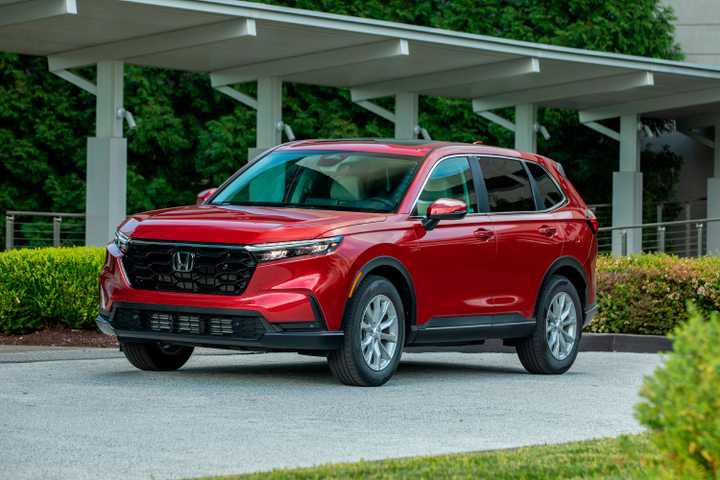
The 2023 Honda CR-V Is The 3-Year-Old Japanese SUV You Should Buy Instead Of A New One
The Honda CR-V has consistently been one of the best-selling compact SUVs in the US, and we’re not getting paid to say that. The numbers don’t lie. Honda sold exactly 403,768 units in 2025 and has already sold over 31,000 units this year alone. It has a class-leading back seat legroom as well as cargo space with 41 inches of legroom and up to 76 cubic feet of cargo space.

- Base Trim Engine
-
1.5L Turbo Inline-4 Gas
- Base Trim Transmission
-
Continuously Variable Automatic (CVT)
- Base Trim Drivetrain
-
Front-Wheel Drive
- Base Trim Horsepower
-
190 hp
- Base Trim Torque
-
179 lb-ft @ 1700 rpm
- Fuel Economy
-
28/34 MPG
- Make
-
Honda
- Model
-
CR-V
- Segment
-
Compact SUV
A Sensible Powertrain

While it might not be winning any lap time records any time soon, the Honda CR-V will certainly take you where you need to go. There are two powertrains to speak of: either the gas-powered one or the hybrid one. The hybrid powertrain has one of the best MPGs on the market, with 40 MPG combined.
2023 Honda CR-V Performance Specs
|
Powertrain |
Turbocharged 1.5-liter inline 4-cylinder |
NA 2.0-liter inline 4-cylinder + electric motors |
|
Horsepower |
190 hp |
204 hp |
|
Torque |
179 lb-ft |
247 lb-ft |
|
Fuel Economy |
30 MPG Combined |
40 MPG Combined |
A Strong Case For The Used CR-V

The Honda CR-V also benefits from how well it’s positioned within the compact SUV segment. It doesn’t try to chase extremes like some competitors that prioritize sportiness or luxury features. That balance is a big reason it consistently outsells many rivals, even those with flashier designs or more aggressive performance tuning. Instead, it focuses on everyday usability, with a spacious interior, strong fuel economy, and a reputation for long-term reliability that resonates with practical buyers looking for dependable transportation.

Toyota’s Fastest-Growing Compact SUV Isn’t A RAV4
The Toyota Corolla Cross is outpacing the RAV4 with fast-growing sales, hybrid options, and everyday versatility in 2026.
Pricing And Overall Value

A brand new 2026 Honda CR-V, with destination, has a starting MSRP of $32,370. That’s honestly not all that pricey, especially considering the previous point about the average cost of a car in the US right now. However, a standard LX from 2023, with the same body style, costs almost $10,000 less at $23,900 according to KBB’s fair purchase pricing. That price gap becomes even more compelling when you consider how little has changed mechanically, meaning most buyers won’t sacrifice performance, efficiency, or core features by opting for the lightly used model instead.
2023 Honda CR-V Average Used Prices
|
Trim |
Price |
|
LX |
$23,900 |
|
EX |
$27,100 |
|
EX-L |
$27,600 |
|
Sport (Hybrid) |
$26,800 |
|
Sport Touring (Hybrid) |
$31,600 |
Reliability Is Another Honda Benefit

The 2023 Honda CR-V has an overall score of 81 out of 100 according to J.D. Power. It has a quality and reliability score of 80, a driving experience score of 83, and a resale value of 81. According to CarEdge, the first ten years of maintenance will only cost you around $7,636. Unfortunately, it did fall victim to the fuel pump recall, among three others. However, this is a fairly low number and should have been fixed by now.
Safety Remains State-Of-The-Art

This generation of CR-V has been tested by the IIHS, and according to them, it’s the IIHS Top Safety Pick+ of 2023. The only crashworthiness score it failed to meet “good” under was the updated front moderate overlap (it originally scored “good”). Honda employs the Honda Sensing suite, which uses emergency braking, adaptive cruise control, lane keep assist, and the like. Together, these systems create a strong baseline of active and passive safety, helping drivers avoid accidents in the first place while also protecting occupants effectively if a collision does occur.
Sources: Honda, J.D. Power, Consumer Reports, Business Insider, RepairPal