
Across the globe, Kawasaki sports bikes are known for their engineering marvels that have shattered speed records. The main reason the brand pulls that off is due to unique in-house collaboration across its versatile portfolio. You see, it is a global conglomerate with its fingers in aerospace, gas turbines, shipbuilding, robotics, and heavy industrial machinery.
So when Kawasaki decides to push a boundary, it does not have to reach outside for expert technology. Instead, you can see that very engineering quality in every machine bearing the Team Green logo. This brings us to one such marvel, a machine that represents Kawasaki’s absolute peak that others are still chasing.
History Of Kawasaki’s Excellence That Pushed Boundaries

While Kawasaki Heavy Industries has been around for ages, the motorcycle division really took off in the mid-20th century. However, Kawasaki Motorcycles entered the American market in 1966 with two‑stroke models, followed by the landmark W1 650. It was the largest-displacement Japanese bike of its time, packing a 624cc four-stroke parallel-twin. Soon after, in 1969, the H1 Mach III arrived with a two-stroke three-cylinder engine delivering raw acceleration, making it among the fastest of its era.
Long List Of Iconic Super Bikes

Sure, the Honda CB750 pioneered the Universal Japanese Motorcycle era, but Kawasaki’s Z1 900 was the true epitome of the early 70s. It set the modern superbike blueprint by introducing double overhead camshafts (DOHC) to a four-cylinder engine. Then came the GPZ900R in 1984, which famously introduced liquid cooling and the iconic Ninja moniker to the world.

By the 1990s, Kawasaki was leading the speed wars and brought Ram Air induction on the ZX-11 (ZZR-1100), allowing it to hold the world’s fastest production motorcycle title for years. They followed it up with the first mass-produced aluminum monocoque frame on the ZX-12R in the early 2000s. By integrating the airbox and frame, they shaved off weight and gave it a narrow and aerodynamic design.
Exploring Alternative Propulsion Engines

Even as the industry is moving toward a green future, Kawasaki is advancing its engineering on multiple fronts. You can see it in the Ninja 7 Hybrid and Z 7 Hybrid, the world’s first mass-produced strong hybrid that pairs a parallel-twin with an electric motor and a lithium-ion battery pack. Moreover, Kawasaki has also stepped into the pure electric space with the Ninja e-1 and Z e-1. You get swappable batteries, a lightweight design, and they are aimed at urban commuting.

For the future, the brand showcased a hydrogen‑powered internal combustion motorcycle prototype, which runs on hydrogen fuel and emits nothing but water vapor. Above all, the most incredible feat of modern times is the development of the supercharged engine on a production motorcycle. Let’s dig deeper into the details of why it is the absolute peak of Kawasaki’s engineering.

The Kawasaki Engine So Reliable It’s Still In Production After Decades
The Kawasaki Ninja ZX-6R is a supersport motorcycle with an engine so reliable, it’s been in production for decades.
Ninja H2 And H2R Are Kawasaki’s Pinnacle Of Engineering

You could say Kawasaki came full circle from the first turbocharged Z1R-TC of the late 1970s to the first supercharged production superbikes, the Ninja H2 and H2R. Team Green rolled them out in 2015, and still, after over a decade, no other manufacturer has managed to follow suit. On top of that, Kawasaki Heavy Industries’ full engineering precision came together to deliver something truly futuristic. And the centerpiece, of course, is the supercharged inline four.
Supercharged Hypersport Platform At Premium Price

Given Kawasaki Ninja lineup halo models, you pay a premium price. The street-legal Ninja H2 sits at $34,400, and the track-only Ninja H2R will set you back $62,100. That easily makes them some of the most expensive exotics you could ride on the streets or reach unbelievable speeds on racetracks. Now, there are no other supercharged bikes to line up against, but in the price bracket, you do have other exotic options. For example, the Ducati Panigale V4 S is priced at $37,695, and the BMW M 1000 RR comes in at $35,395. While these bring lighter and sharper performance, the brute forced induction shove of the Kawasaki is hard to beat.

10 Kawasakis That Deliver Serious Performance For The Money
From entry-level confidence to quarter-mile kings, Kawasaki gives us machines that prove performance and value can ride together.
Kawasaki’s Forced Induction Inline‑Four That Breaks Limits

Here’s where Kawasaki’s engineering brilliance truly shows. Both the H2 and H2R are powered by the same supercharged inline four engines. Like the bikes, this liquid-cooled 998cc engine was designed in-house and built from the ground up to handle twice the stress of a naturally aspirated engine. Because of that, it gets forged pistons and reinforced components to cope with the immense boost.

The motor features a 76mm bore and 55mm stroke to keep things reliable and withstand brutal pressures. In addition, the low 8.5:1 compression ratio on the H2 and even lower 8.3:1 on the H2R ensures the engine swallows massive pressurized air without the risk of pre-ignition. Then, to keep up with the intense airflow, the fuel system uses dual injectors per cylinder and massive 50mm throttle bodies.
Aerospace Designed Centrifugal Supercharger

Of course, the star of the show is the centrifugal supercharger, driven by a planetary gear train off the crankshaft, tech straight from Kawasaki’s aerospace and gas turbine division. This unit is so efficient that it can spin up to nearly 130,000 rpm, creating air pressure that allows the engine to breathe far beyond its physical displacement. Unlike a turbocharger, which often suffers from lag, this delivers a consistent linear surge of power.

Moreover, the engineering is so precise that it avoids the need for an intercooler. Instead, Kawasaki equips the system with larger coolant passageways and an oil capacity of 1.32 gallons to keep temperatures in check. Even the intake system is unique, using stainless steel nets over the funnels to create a uniform fuel‑air mixture.
Mind-Bending Power And Boost

Coming to the output numbers, the road-going H2 delivers 228 horsepower and 104.9 pound-feet of torque. When ram air is fully pressurized at high speeds, that number jumps to a staggering 240 horsepower. And, those numbers skyrocket to 310 horsepower and 121.5 pound-feet of torque on the H2R, and an unbelievable 322 horsepower with a ram-air intake.

Meanwhile, Kawasaki gave a high-performance six-speed dog-ring transmission, straight from the MotoGP paddock. Here, the dog-ring system uses lightweight rings to engage the gears for much faster and smoother shifts. Plus, the setup is paired with a high-quality hydraulic assist and slipper clutch, and a two-way quickshifter.

The Most Expensive New Kawasaki Motorcycle You Can Buy Today
This Ninja is out of reach for most buyers with its over $50,000 MSRP
Futuristic Aerodynamic Design With Robust Underpinnings

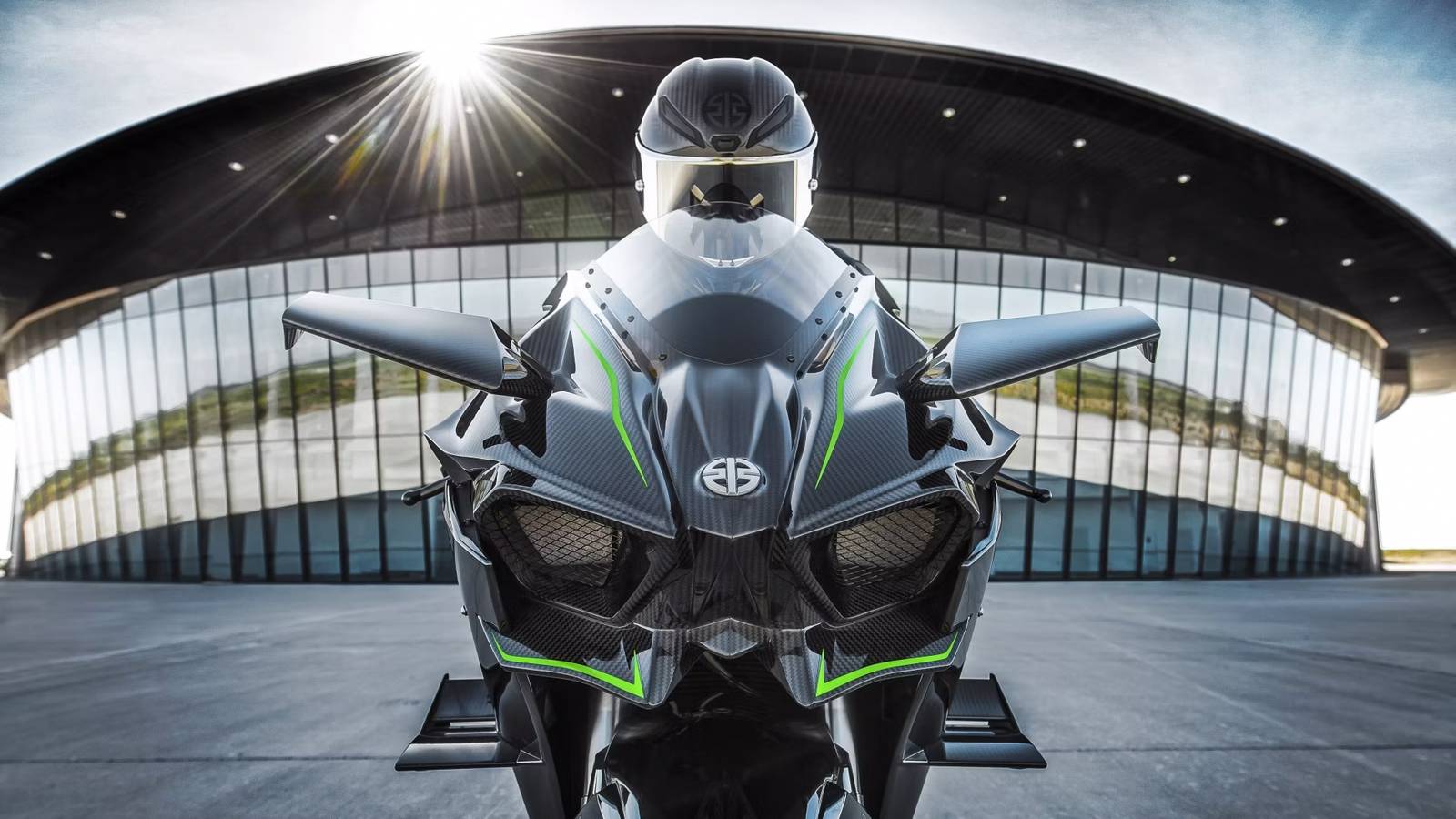
When you look at both H2 and H2R, the first thing you notice is their fighter‑jet‑inspired aerodynamics, designed by Kawasaki’s Aerospace Division. To back that up, the fairing is packed with strakes and slots similar to those on a stealth fighter to manage airflow. While that’s impressive enough, the H2 uses its airfoil-shaped mirrors to stay planted, whereas the H2R goes even further by swapping those mirrors for dual-layer carbon fiber wings to generate massive downforce.

Beyond the style, swinging a leg over, you will be surprised at how compact and lightweight they feel. That being said, the wheelbase on both models is nearly identical, but the H2R gets about 50 pounds of weight advantage. Meanwhile, even the paintwork is engineered to look alien with a unique mirror-like finish that leans more towards a black undercoat, followed by a silver film and a self-healing and resilient top layer.
High-end Specs And Advanced Technology

To ensure the H2 or H2R wouldn’t sacrifice handling for pure speed, Kawasaki went with a steel trellis frame specifically engineered to handle the massive power output. It is supported by a fully adjustable 43mm KYB AOS-II forks up front and a premium Ohlins TTX36 monoshock at the rear. For stopping power, the H2 comes with Brembo Stylema calipers on dual 330mm discs, while the H2R gets top-tier Brembo M50 calipers to match its aggressive racetrack performance.

Additionally, Kawasaki packs a full suite of rider aids backed by a six-axis IMU to keep you secure when you’re pushing the limits. You get traction control, launch control, cornering ABS, multiple ride modes, and engine braking management, all manageable through a TFT display. So when you stack all this up, even after over a decade, the Ninja H2 and the Ninja H2R are in a league of their own, representing the undisputed peak of Kawasaki’s engineering prowess.
Sources: Kawasaki Motorcycles