
Most riders like the idea of a forever touring bike. Only a few actually buy one. It is easy to get pulled in by style, specs, or what feels right in the moment, only to realize a few seasons later that the bike does not quite keep up with how you ride. Longer trips expose comfort limits. Two-up riding exposes issues with space and support. Time reveals reliability patterns you cannot see at purchase, and that is when rides get shorter, less frequent, or quietly stop happening. That gap between expectation and ownership is where most bikes lose their place in the garage.
If the goal is to keep a touring bike for years, even decades, the criteria have to change. It is no longer about what impresses on a test ride. It is about what holds up over distance, over time, and across real-world use without becoming something you have to work around.
This article draws on manufacturer data, service documentation, maintenance schedules, and recall records across Honda, Kawasaki, Yamaha, Suzuki, and Harley-Davidson to establish a factual baseline for real-world ownership. That data is reinforced by hands-on experience as a certified motorcycle mechanic trained across the Big Four and Harley-Davidson, including work with high-mileage bikes and common failure patterns. The result is an evaluation grounded in both verified information and what consistently proves durable over time.

10 Most Practical Touring Motorcycles For 2025
These tourers are top of the hill when it comes to practicality, whether it is gas mileage, tank range, or luggage capacity
Spec It Like You’ll Still Own It In 20 Years
The mistake that turns a “forever” tourer into a compromise

Here’s where most long-term ownership plans quietly fall apart. The bike feels good enough at purchase, good enough on short rides, and then slowly reveals its limits when the miles stack up. Storage runs out first. Then weather protection becomes a fatigue problem. Add a passenger, and what used to feel comfortable starts to feel compromised. By the time you realize it, you are adapting your trips to the bike instead of the other way around. That is the trap: buying for now instead of buying for forever.

If this is the tourer you plan to keep, it has to be built around worst-case use, not best-case days. Two-up riding with full luggage. Long highway stretches in mixed weather. Back-to-back days when comfort is not optional. That means a real top case for both cargo and passenger support, integrated backrest comfort, and the kind of wind and leg protection that reduces fatigue instead of just deflecting air.
Features are easy to compare; proven durability is not

On paper, bikes like the Harley Street Glide Limited, Road Glide Limited, and Indian Pursuit check those boxes. The capability is there. The uncertainty is not in the features; it is in the timeline. Harley’s Milwaukee Eight VVT and Indian’s PowerPlus 112 simply have less long-term data available than other decades-old platforms for mapping long-term failure patterns, recall trends, or known weak points. Thus, if forever is the goal, spec sheets are not enough. Proven durability over real mileage is what separates a bike you keep from one you eventually work around.

10 Touring Bikes With The Longest Riding Range
If you want go the farthest on a single tank of fuel, look no further than these 10 touring bikes
Honda Gold Wing: The One That’s Already Proven Itself

There are a few bikes that look right on paper: big engines, full touring kit, strong feature lists. But when you filter for what actually holds up over 50,000 to 100,000 miles and beyond, the list gets very short, very quickly. That is where the answer stops being subjective.

My pick is the Honda Gold Wing Tour because it isn’t trying to prove anything new. It has already done it, repeatedly, across decades of real-world use. High-mileage owners, long-distance riders, and cross-country tourers have all stress-tested this platform, and the pattern is consistent. Low drama, low failure rates, and fewer surprises over time. That is what “forever” looks like in practice.
Built to solve real touring fatigue, not just impress on paper

More importantly, it directly answers the pressure points. Two-up comfort is not an afterthought; it is built in. The top case, passenger accommodations, and wind protection are designed for long days, not short rides. The flat-six engine keeps its mass low, which makes the bike feel far more manageable than its size suggests, especially at slow speeds or when fully loaded. Its smooth, even power delivery reduces fatigue in a way that matters after hours in the saddle, not minutes.

The chassis reinforces that ease. The double wishbone front suspension separates braking forces from steering input, so the bike stays composed instead of pitching forward and loading the bars. It tracks cleanly, requires fewer corrections, and lets you settle into a rhythm on the highway. The shaft drive, sealed and protected, removes an entire category of maintenance and vulnerability that chain and belt systems carry over time.
Ownership ease is what turns a long-term bike into a forever bike

Then there is the ownership experience. The standard six-speed is solid, but Honda’s DCT option changes how you live with the bike. Seamless shifts, twist-and-go simplicity, and a built-in walking mode take the effort out of the very situations where big usually demand the most from the rider. This is not the most exciting choice on paper. It is the one with the fewest question marks after years of real use, and that is exactly why it earns the title.
2026 Honda Gold Wing Tour Engine And Performance Specifications
|
Engine |
6-cylinder boxer, liquid-cooled |
|
Displacement |
1,833 cc |
|
Power |
125 hp @ 5,500 rpm |
|
Torque |
125 lb-ft @ 4,500 rpm |
|
Transmission |
6-speed manual, 7-speed automatic |
|
Top Speed |
112 mph |

The Time Japan Made A Better Touring Motorcycle Than The Rest Of The World
Here’s the touring bike that has always set the pace for other tourers to follow.
The Details That Make You Keep Riding
Why most tourers get used less over time, and the Gold Wing one doesn’t

The difference between a bike you admire and one you actually keep shows up after three hours, not 10 minutes. This is where small shortcomings stop being small. Cold creeps in, wind fatigue builds, and distractions add up until you start cutting rides short or avoiding certain conditions altogether. Over time, that is what quietly limits how much you use the bike you thought you would keep forever.

The Gold Wing Tour is built to remove those limits. Heated grips and seats are standard, so cold mornings and late returns are no longer a reason to turn around early. Wind protection is not partial; it is comprehensive. The mirrors double as handguards; the fairing and adjustable windscreen manage upper airflow; and lower deflectors, with engine mass, shield your legs. Instead of fighting the elements, you ride through them with less effort and less fatigue.
Safety and usability that actually matter after thousands of miles
The electronics follow the same philosophy. Ride modes, traction control, ABS, and Hill Start Assist are not there to impress; they are there to prevent small mistakes from becoming big problems, especially when the bike is fully loaded. The optional airbag is where Honda goes further than anyone else in this segment. It is one of the only systems designed specifically for a head-on impact scenario, which aligns directly with the idea of keeping a bike long term and managing real-world risk, not just performance.

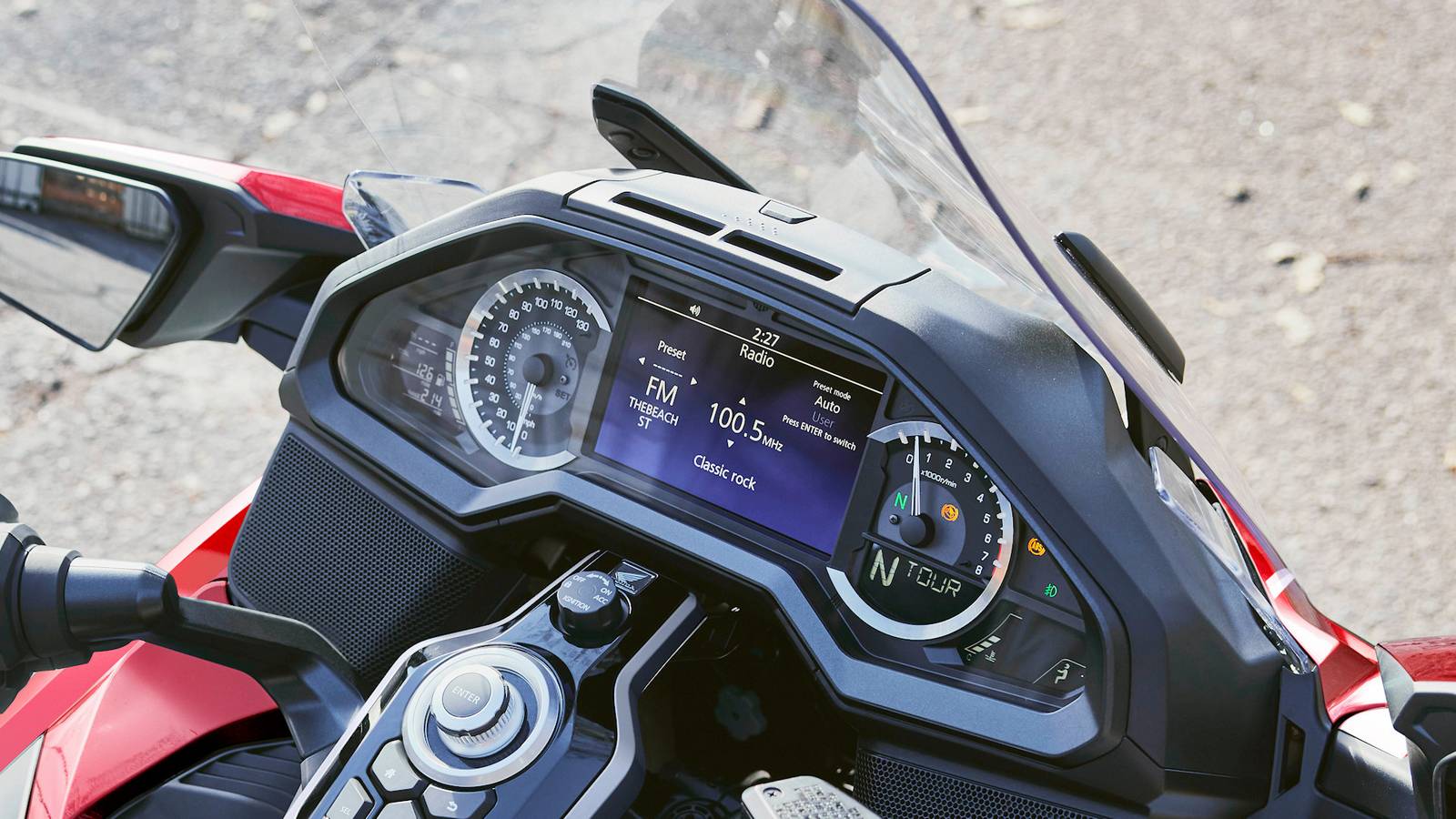
Day-to-day usability matters just as much over the years of ownership. The large, readable dashboard presents both essential and deeper ride data without clutter, and it stays usable at speed. Apple CarPlay and Android Auto integration, built-in navigation, weather info, and Bluetooth connectivity mean fewer add-ons, fewer mounts, and less distraction over time. Everything you need is already integrated and works as part of the bike, not as an afterthought.

The Legendary Touring Motorcycle That Refuses To Die
There are very few touring motorcycles that have lasted half a century. This one will go on for another without breaking into a sweat.
Why The Gold Wing Stays In The Garage
The reason this is the last touring bike you’ll ever need

Most riders do not replace a bike because it failed. They replaced it because it slowly stopped fitting the way they actually ride. The storage falls short, comfort fades on longer days, or small annoyances add up until the idea of something better creeps in. That is the underbuying trap, and it is exactly what this bike avoids.

The Gold Wing Tour holds up because it addresses those problems before they arise. It is not just capable on paper; it is proven over real-world mileage, with a track record that removes uncertainty rather than adding to it. It delivers the full touring experience without compromise, while reducing fatigue, simplifying ownership, and keeping the ride enjoyable year after year.
The difference between a bike you own and one you stick with

Plenty of bikes can get you through a trip. Far fewer can carry you through years of riding without making you second-guess the decision. This is one of the rare machines that continues to justify itself long after the purchase, which is why it is not just a bike you can keep forever, but one you actually will.