
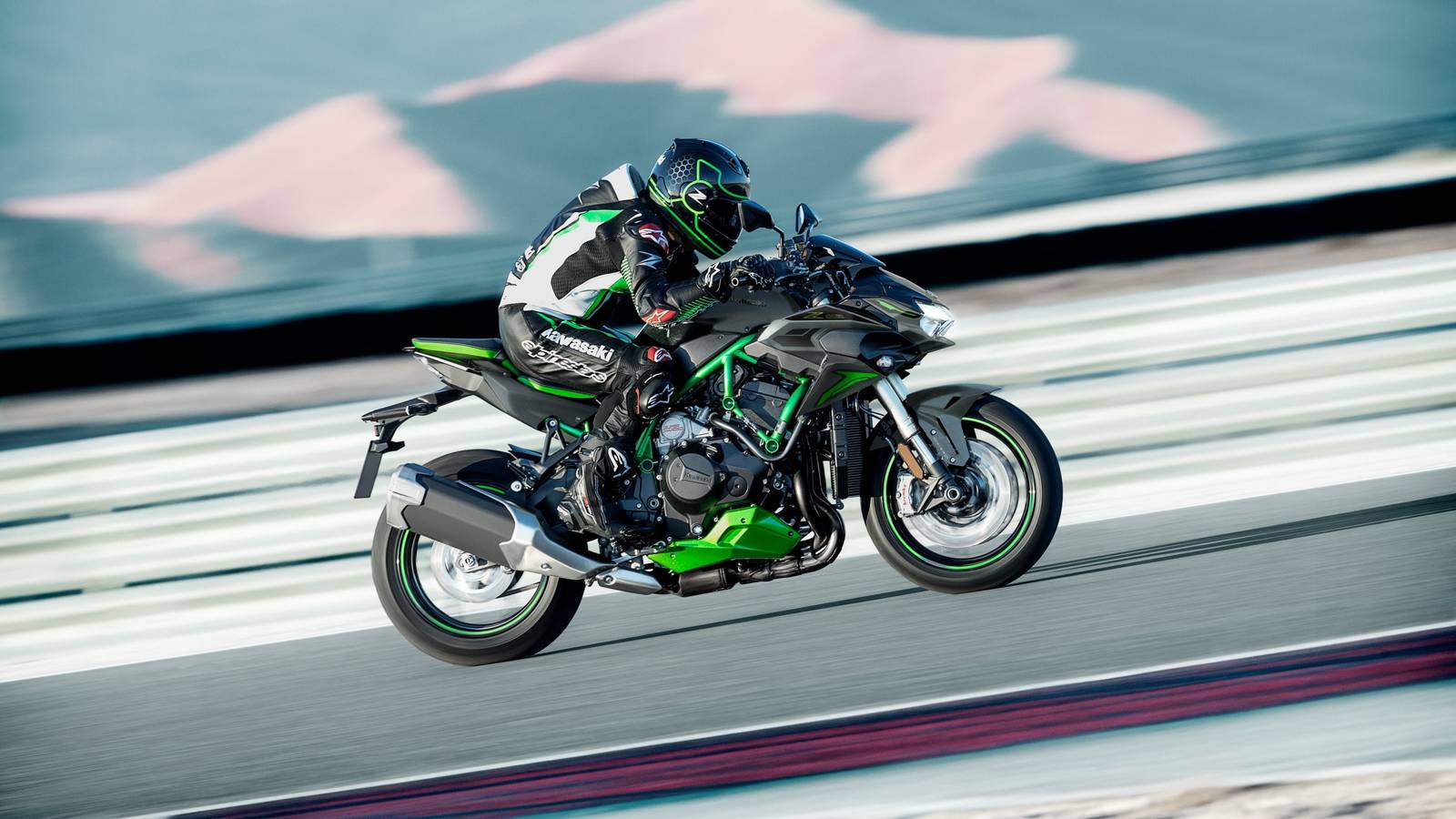
One of the biggest draws of a motorcycle is its performance. It gets its performance through light weight more than brute power, which is why electric and hybrid motorcycles haven’t caught on the way they have with cars. The weight penalty is a much bigger hurdle due to battery sizes. Another thing to consider is that motorcycles tend to generate their best performance high in the rev range. This focus on performance has made motorcycles the biggest examples of spec-sheet wars, with higher and higher outputs grabbing headlines. A key player in this game has been Kawasaki. It has a handful of rampan speed machines on sale today, one of which truly shoves you in the seat with its mighty acceleration.
Most Performance Comes From Torque, Not Horsepower

However, horsepower is the figure by which we tend to measure performance, but it is torque that makes the world go round, at least in the real world. The more torque you can provide on demand, the quicker you’ll be in most situations. Oh, and the less fatigued you’ll be as well, because you won’t have to keep banging through the gears.
This is where electric motorcycles shine — they have maximum torque across their entire rev range, but they have their fair share of issues, including a small ‘tank range’. So, different segments of the auto industry have come up with different solutions to the demands of torque. Some have made hybrids, others have developed EVs with battery-swapping capabilities, and the throwback purists have turned to that ol’ favorite of the tuner (and now emissions) brigade: forced induction.
The Case For Forced Induction

Just like with EVs and hybrids, forced induction adds weight and complexity. This might not be the right formula for a large swath of the two-wheeler market, because when you say ‘forced induction’, you automatically think ‘intercooler’. And that involves a lot of plumbing. In turn, that needs a lot of space. So if someone could engineer an engine that uses forced induction but doesn’t require a heat exchanger, it would offer ferocious acceleration through a good combination of horsepower and torque. And there is one Kawasaki that actually managed it!
The Z H2 Is The Kawasaki Built For Riders Who Crave Acceleration

If you are talking about pure acceleration, then we have to look at the powerful streetfighter segment. Sports bikes might be quicker overall, but they are geared to be their best on a racetrack, where speeds are higher, unlike the street. In Kawasaki’s range, there is just one engine that generates enough power and torque to give you the best possible acceleration, and that is its supercharged H2 engine. Luckily for us, Kawasaki does have a streetfighter powered by the H2 engine. With its short gearing, hooligan attitude, and ability to rip arms from sockets, the Z H2 is the Kawasaki built for riders who crave acceleration.
A Price That Delivers Value In Spades

A $21,999 price tag puts it in the same general area as other premium streetfighters, but not with the exotics. For that, it would need to get the price up by another 20-50 percent. And that makes it an incredible value for money. Not only does it deliver one of the highest power figures, but it also delivers almost V-twin-like maximum torque thanks to its supercharger. That is a combination that you will not get anywhere else. Like most Japanese products, this is the base price, but it also doesn’t need a single upgrade for you to feel like this is a complete, premium product.

10 Kawasakis That Deliver Serious Performance For The Money
From entry-level confidence to quarter-mile kings, Kawasaki gives us machines that prove performance and value can ride together.
Powered By The World’s Only Supercharged Motorcycle Engine

A decade on, the H2 engine is still the world’s only production supercharged engine in a motorcycle, and Kawasaki has used it to great effect in the Z H2. It has detuned it to produce only 197 horsepower, but the trade-off is torque (101 pound-feet of torque). These figures arrive at 10,500 RPM and 8,500 RPM, respectively. What cannot be seen in just the maximum figures is how much torque is available across the range, thanks to the blower. Give it gas in any gear at any revs, and you are rewarded with an instant hit of torque thanks to the supercharger. A bonus is the sounds of forced induction when you get on and off the gas.
Keeping It Cool Without An Intercooler

There is no intercooler in the interest of keeping the engine compact, but Kawasaki has managed to keep the cooling effective thanks to aerospace-grade materials, quite literally developed by Kawasaki’s aerospace division. All this power and torque is fed through a six-speed gearbox with a standard two-way quick shifter and a chain to the rear wheel. Since this is a street bike, the gearing is short, and coupled with the torque, this should be the fastest-accelerating H2 in the real world. All you need to worry about is keeping the front end down.
Simple Chassis Is A Counterpoint To The Engine

For all the technology that is there in the Z H2’s engine, the chassis is quite simple. This is a relatively plain steel trellis frame, with a double-sided swingarm. This is very interesting because all the other Kawasaki motorcycles powered by the H2 engine get a single-sided swingarm. However, the Z is supposed to be a street bike, so we can understand why Kawasaki went with lightweight and better usability over a premium feel here.

The rest of the chassis is premium enough; there is electronic suspension from Showa. This EERA system offers manual preload adjustment at both ends, but the compression and rebound damping are electronically adjusted automatically. The front SFF-BP inverted fork has a 43 mm diameter and 4.7 inches of travel. The rear linkage-type single shock offers 5.3 inches of travel. Superbike-spec Brembo Stylema radial four-piston calipers are present on the front brakes, paired with 320 mm dual discs. A 260 mm disc and a single-piston caliper are at the rear.
This Is Little Heavy For The Class
Premium street fighters don’t get their performance only from high horsepower figures; they also focus a lot on cutting weight wherever they can. This is the only place where the ZH 2 falls a little short, but given the kind of performance its engine offers, we can forgive it for that. The actual weight figure is 531.4 pounds, but the rest of its dimensions are absolutely normal. It is 82 inches long, nearly 32 inches wide, and has a 57.3-inch wheelbase. The seat height is normal for a street bike at 32.7 inches, and it has a ground clearance of 5.5 inches.

10 Powerful Inline-Four Motorcycles That Are Not Sports Bikes
The most powerful inline-4 motorcycle here is a gorgeous-looking Italian naked bike with 208 horsepower.
All The Necessary Safety Aids You Need

This is where the Z H2 age shows. It has a 4.2-inch TFT display with Bluetooth and navigation. But even smaller Kawasaki street bikes like the Z900 have a larger display. However, the functionality of this display is not in question, especially when it is paired with the Kawasaki Rideology smartphone application. All LED lighting is present, and unique to the Z H2 in its class is its self-healing paint.
The electronics package is still a very strong one and offers things like launch control, which are not present on other street bikes in the class. Of course, it has a by-wire throttle and six-axis IMU, so you get ride modes, cornering ABS, cornering traction control, cornering engine brake control, and cruise control.

10 Powerful Naked Bikes Too Scary For Beginners
Don’t consider these as your first motorcycle. Or even your second one. They’re way too scary!
No Real In-House Competition

If you’re going to look at other bikes that have great acceleration in Kawasaki’s portfolio, we could look at the Ninja H2 with its launch control and the same engine with more power. However, sport bikes are geared taller, so they will not have the initial rush of the Z. There is no other motorcycle, including the Z1100, that comes close to the Z H2’s acceleration from the Kawasaki stable.

If you look further afield, however, there are quite a few options. The KTM 1390 Super Duke R Evo and Aprilia Tuono V4 Factory 1100 both can give the Z H2 a run for its money, both on the street and on the racetrack. We could consider the Ducati Streetfighter V4 S as well, but its $30,000+ price excludes it from this conversation.

There is also the Triumph Speed Triple 1200 RS. It has a large displacement three-cylinder engine, which should also offer a lot of torque, just like the Kawasaki. The actual figure is 94.4 pound-feet, not too far from the Kawasaki’s figure.

But given a choice, we’d pick the BMW M 1000 R. This has a base price that is around $700 more than the Kawasaki at $22,695, and it offers similar levels of power (205 horsepower vs 197 horsepower) with much less weight (438.7 pounds vs 531.4 pounds – a difference of nearly 93 pounds!), which means that you will not only accelerate quickly, you will also brake and turn much quicker.
Source: Kawasaki USA