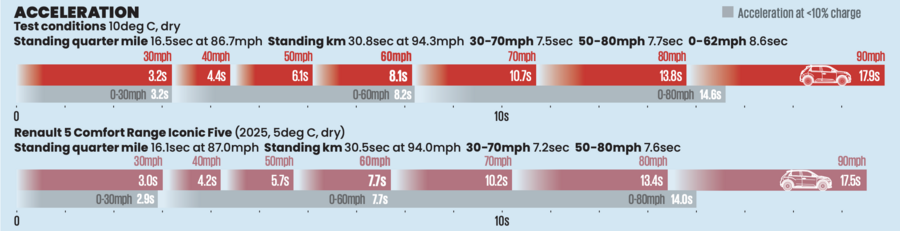
The Micra weighed about 20kg heavier on the proving ground scales than the equivalent Renault 5 did a little under 12 months ago. That, a different fitted tyre (the Micra uses Hankook iOn Evo EV-specific rubber, while the 5 wore Continental EcoContact 6s), and whatever particular motor calibration and drivability tuning preferences Nissan decided on, all contributed to making our test car a little slower-accelerating than its lozenge-badged cousin (8.1sec to 60mph versus 7.7-).
You would be hard-pressed to say it felt that way without the satellite timing data to tell you, though. That’s because, by electric supermini standards, 8.1sec from rest to 60mph is fairly quick. A Mini Cooper E or SE may show this car a clean pair of heels in a traffic-light sprint, but few other comparable cars that we have tested would. It makes for plenty of response and athleticism around town and up to the national speed limit, and a likeable sense of sprightliness too.
Indeed, if Nissan has aimed for a particular sensation for the Micra’s style of delivery, you wouldn’t know it. The car picks up from stationary under full power smoothly and progressively, without breaking traction at the front wheels or needing help from its traction control. It then ramps up the torque, and hits 50mph in little over six seconds, which is the sort of pace that hot hatchbacks of the same size were producing a couple of decades ago.
The Micra’s brake pedal wouldn’t really have passed muster on, say, a Citroën C2 VTS or Seat Ibiza Cupra, because it’s a bit too soft to be suited to quicker motoring and harder pressures, and doesn’t let you feel when the friction brakes are biting too clearly. It’s progressive enough in normal motoring, though, and brings the Micra to rest smoothly, which is really what matters most. There’s paddle-based control of motor regen too, which often tends to give the brake pedal less to do in any case.
In line with expectations based on our acceleration tests, the Hankook tyres did make for poorer stopping distances than the Renault recorded, however. The Micra needed a little under a metre longer than the 5 to stop from 70mph in the dry but 7.5m longer from the same speed in wet conditions.
You wouldn’t call the Micra’s braking result desperately poor in a broader sense, though (aptly enough, the BYD Dolphin Surf needed more than 61m to stop in the wet). We will find out shortly if those tyres also deliver the Micra less rolling resistance than the 5, and better associated range and efficiency – but it’s certainly at least some empirical evidence that the Nissan grips the road a little less keenly than its Renault sibling.