
In 2026, the American sedan industry remains a specialized segment dominated by a few resilient nameplates. This sharply contrasts with the European market, which maintains a much broader diversity of compact and executive sedans despite its own shift toward electrification. While European manufacturers are aggressively transitioning to battery-electric sedans to meet strict regulatory targets, the U.S. market has seen a plateau in EV adoption, leading domestic and foreign brands to refocus on high-margin internal combustion and hybrid crossovers and SUVs.
This shift is increasingly driven by American consumers who, burdened by rising living costs and elevated interest rates, are prioritizing long-term reliability and total cost of ownership over trendy technology. According to the 2026 J.D. Power Vehicle Dependability Study, this economic pressure has pushed buyers toward mass-market brands that offer proven durability, as the financial risk of frequent repairs or rapid depreciation has become a primary barrier for the average household.
The Current State Of Sedans In The U.S.

Despite the overwhelming market shift toward crossovers, midsize sedans in 2026 maintain a strong foothold in the U.S. by offering a superior balance of efficiency, aerodynamics, and driving dynamics that SUVs simply cannot replicate at the same price point. Modern pillars of the segment, such as the Toyota Camry and Honda Accord, have evolved into one-car ownership solutions by maximizing interior volume to rival midsize SUVs while delivering significantly better fuel economy and lower insurance premiums.
This value proposition is further bolstered by a lower center of gravity, which provides a more composed and agile highway experience. This is a trait increasingly valued by commuters looking to minimize daily fatigue. European exotic sedans are experiencing the opposite trend, as buyers in this category typically appreciate their higher-riding counterparts. These premium brands have also shifted their business model to lower volume and higher profit margins.
Chevrolet’s Discontinuation Of Its Sedan Lineup

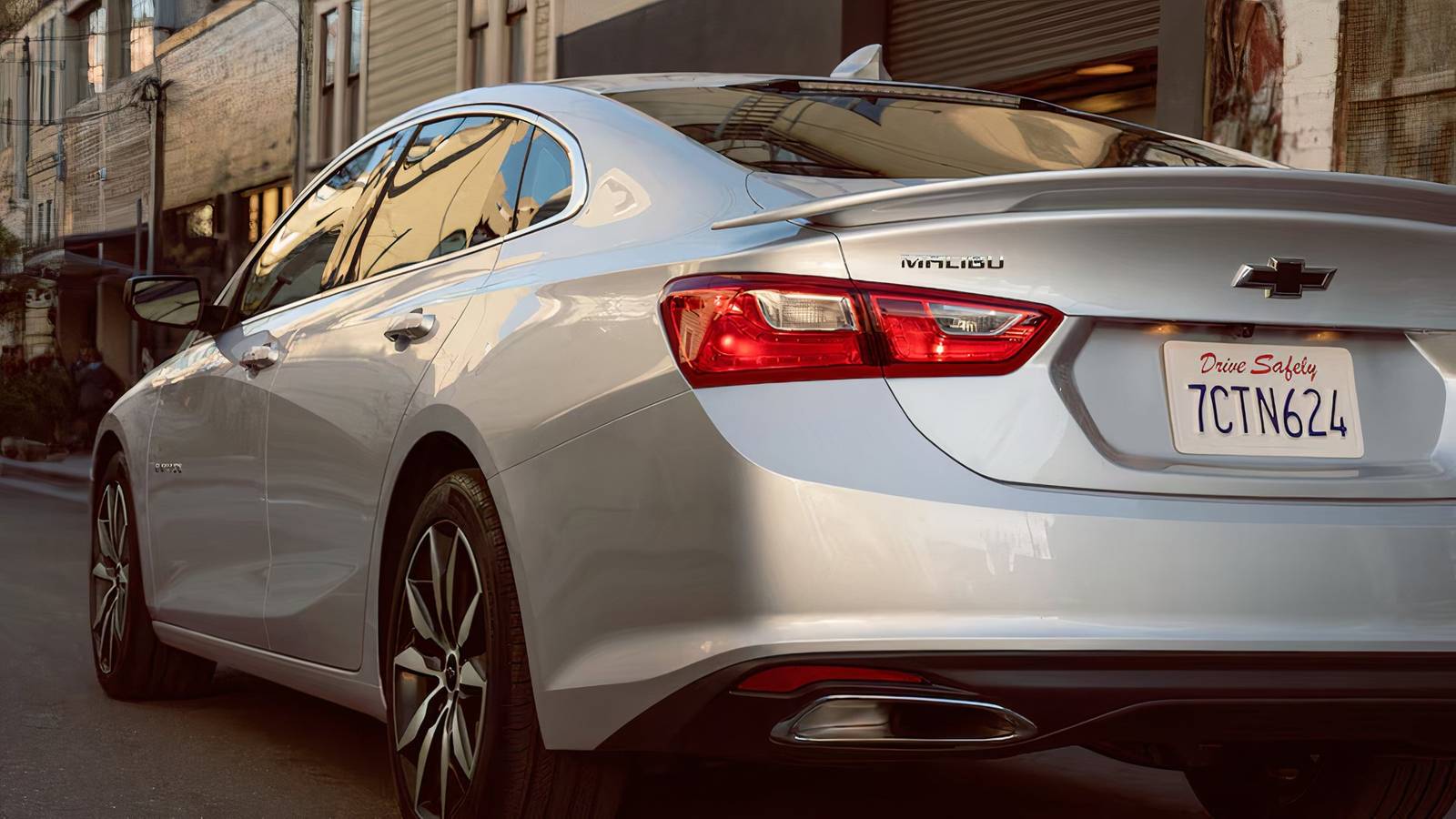
Over the last five years, Chevrolet’s sedan presence in the U.S. has transitioned from a multimodel lineup to a complete exit from the segment. Between 2021 and 2024, the midsize Malibu served as the brand’s sole traditional four-door offering following the discontinuation of the Impala, Cruze, and Sonic. While the Malibu experienced a brief sales resurgence in 2022 and 2023, occasionally outselling several of the brand’s own SUVs due to its strong value proposition and fleet demand, General Motors ultimately prioritized its all-electric future and higher-margin light trucks.
Consequently, production of the Malibu for the U.S. market concluded in late 2025 to reallocate manufacturing resources toward electric vehicle platforms like the Equinox EV. Entering the 2026 model year, Chevrolet no longer offers a single sedan in the U.S. Its non-crossover passenger car portfolio is now limited exclusively to the Corvette, leaving the brand’s former sedan customers to choose between its expanding range of crossovers and competitors who have remained in the midsize segment.

The Chevrolet Malibu Succumbs To The EV-olution And Makes Way For The Next-Gen Bolt
The Malibu’s production will end this year and the upcoming Bolt EV will take its place at GM’s Kansas factory.
America’s Most Reliable Sedan

The 2025 Chevrolet Malibu holds one of the most impressive reliability ratings in its segment, making its demise all the more unfortunate. J.D. Power gives the model an 80/100 consumer-verified overall rating, including 86/100 for quality and reliability, 73/100 for the driving experience, 69/100 for resale, and 84/100 for the dealership experience. iSeeCars backs this with an 8.1/10 reliability score, indicating that the model covers an average lifespan of 8.8 years or 133,220 miles, with a 7.6 percent probability of reaching 200,000 miles.
Edmunds owner reviews further support this longevity, with many drivers praising the turbocharged engine’s straightforward maintenance and the vehicle’s low five-year total cost of ownership. RepairPal gives the Malibu an excellent reliability rating of 4.0 out of 5.0, ranking it ninth out of 24 midsize cars for its low frequency and severity of repairs. The average annual repair cost for the Malibu range is approximately $532, which is significantly lower than the $652 average across all vehicle models, reinforcing its position as a budget-friendly option for long-term ownership.
Value Retention Could Be Better

While reliable, the Malibu doesn’t hold up too well when it comes to value retention. iSeeCars suggests the model will lose $11,302 or 45.8 percent of its value after five years and 60,000 miles. For reference, pricing for the base LS model started at $25,800. Edmunds reveals that the same model will cost $46,998 to own over the same period, including $4,077 on maintenance, $1,022 on repairs, $14,723 on depreciation, and $11,949 on fuel. CarEdge backs this with a $41,517 five-year cost estimate, including $14,814 worth of depreciation, $7,450 on fuel, $4,622 on financing, and $2,166 on maintenance.
The 2025 Chevrolet Malibu follows a straightforward maintenance schedule centered on 7,500-mile intervals. Beyond the standard oil and filter replacement, the schedule calls for a tire rotation and a multipoint inspection of the braking and suspension systems. Major milestones occur at 22,500 miles for cabin air filter replacement, 45,000 miles for a transmission fluid exchange and engine air filter change, and approximately 90,000 miles for spark plug replacement. Regarding its safety record in the final years of production, the Malibu has remained relatively stable, though it was subject to a notable December 2022 recall for 2022 and 2023 models involving improperly welded front impact bars that could compromise structural integrity.

The Most Underrated Chevy Of 2024
Explore Chevy’s 2024 lineup to discover a hidden gem offering exceptional performance, advanced features, and outstanding value.
Chevy’s Efficiency-Focused Engine

The 2025 Chevrolet Malibu is powered by a standard turbocharged 1.5-liter four-cylinder engine that produces 163 horsepower at 5,700 RPM and 184 pound-feet of torque between 2,500 and 3,000 RPM. This powertrain is paired exclusively with a continuously variable transmission and a front-wheel-drive configuration, prioritizing fuel efficiency and smooth power delivery over aggressive performance. In terms of speed, the Malibu reaches 0 to 60 MPH in a claimed 7.8 seconds and is electronically limited to a top speed of 130 MPH.
Both the cylinder block and the dual-overhead-cam cylinder head are cast from lightweight aluminum, a material choice that sheds 44 pounds compared to previous iron-block designs, thereby improving front-to-rear weight distribution and fuel economy. The engine features a relatively conservative 10.0:1 compression ratio and a single-scroll Mitsubishi-sourced turbocharger and spark ignition direct injection.
Appealing EPA Fuel Consumption Estimates

On the efficiency front, the EPA estimates that this model will consume 28/36/31 MPG on the city/highway/combined cycle, while covering a total of 490 miles from its 15.8-gallon gasoline tank. Based on this, you can expect to save $750 on fuel over the course of five years compared to the average new vehicle sold in the U.S. You can also expect to spend $1,400 on fuel every year and $2.35 to drive 25 miles. A full tank of gas will cost $46.

Here’s How Much A 1968 Chevrolet Chevelle Malibu Is Worth Today
The ’68 Chevelle is the first in the iconic second generation, and here’s how the luxury Malibu trim holds up in today’s market.
What Comes Standard With Each Trim

The 2025 Chevrolet Malibu range starts with the LS trim, including an 8.0-inch infotainment touchscreen, wireless Apple CarPlay and Android Auto, a 4G LTE Wi-Fi hotspot, and the convenience of standard remote start. Moving to the RS derivative, the focus shifts toward a sportier aesthetic with blacked-out exterior accents and 18-inch wheels, while the interior is upgraded with a leather-wrapped steering wheel and an eight-way power-adjustable driver’s seat for enhanced ergonomics.
The 1LT trim includes dual-zone automatic climate control, heated front seats, and LED daytime running lights. Finally, the top-tier 2LT crowns the lineup by transitioning into near-luxury territory, offering ventilated front seats, a heated steering wheel, and a power sunroof, alongside significant entertainment upgrades such as a nine-speaker Bose premium audio system, a high-definition 8.0-inch driver information system, and integrated navigation.
How The Malibu Has Changed Over The Years

The Chevrolet Malibu debuted in 1964 as a premier, rear-wheel-drive trim of the mid-sized Chevelle, eventually evolving into a standalone model in 1978 that offered both V-6 and V-8 power before being discontinued in 1983. After a 14-year hiatus, the nameplate was revived in 1997 as a modern, front-wheel-drive sedan, transitioning the Malibu from its muscle-car-era roots to a pragmatic family cruiser focused on efficiency and safety.
This front-drive architecture defined its second life through five distinct generations, culminating in the ninth-generation model that introduced advanced features like standard stop-start technology and a turbocharged small-displacement engine. Ultimately, the Malibu’s 60-year history concluded in late 2025 as Chevrolet phased out its last traditional sedan to reallocate resources toward an all-electric future, marking the end of one of the most enduring nameplates in American automotive history.
Sources: J.D. Power, iSeeCars, CarEdge, Edmunds, RepairPal, Kelley Blue Book, and EPA.