
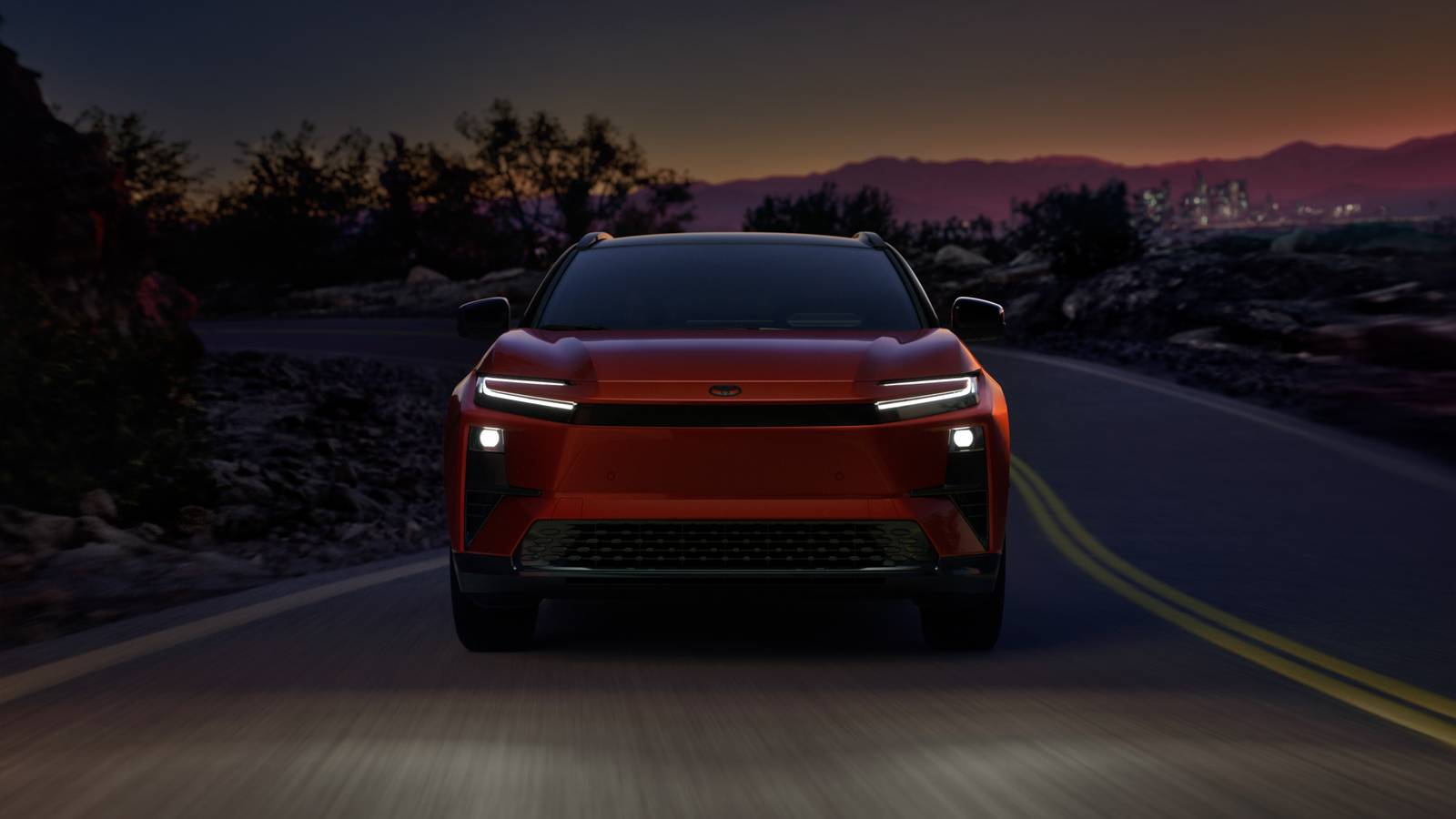
Toyota, for the longest time, has been a brand that has taken the electric vehicle (EV) market slowly. They are a brand that has committed wholeheartedly to hybrids, which is why models like the RAV4 and Camry are now all-hybrid. EVs, on the other hand, though they exist, were never really competitive—at least until 2026 came.
The global EV market grew particularly in Europe, China, and most of Asia, while American market demand for EVs cooled due to the removal of the Federal Tax Credit last year. Toyota, as a brand, operates globally, so it needs competitive EVs in the markets where EV sales are growing.


- Base Trim Engine
-
Electric
- Base Trim Transmission
-
Single-speed Automatic
- Base Trim Drivetrain
-
All-Wheel Drive
- Base Trim Horsepower
-
338 hp
- Make
-
Toyota
- Model
-
C-HR
- Segment
-
Subcompact SUV
This has led to the rebirth of the C-HR in the United States, which was last discontinued in 2022. The C-HR is also sold in Europe as the C-HR+, while a Subaru version called the Uncharted also exists—blasphemously in an available front-wheel drive (FWD) version from a brand that built its identity around all-wheel drive (AWD). Anyway, that’s a story for another day. The new, fully electric C-HR is priced similarly to the Tesla Model Y, and as the best-selling EV in the United States, does the new C-HR have what it takes to compete?

The Quirky Toyota SUV You Forgot About, But Shouldn’t Have
Amid a sea of lookalike small SUVs, the Toyota C-HR stood out with its bold, coupe-like shape. But was that a strength or a drawback?
What The C-HR Is Facing Up Against

For 2026, the Tesla Model Y is available in a broad number of variants. There are now five in total, consisting of the Standard in rear-wheel drive (RWD) and AWD, a Premium in RWD and AWD, and a Performance AWD. Its base price of $39,990 is also very close to the C-HR’s $38,450.
More Range As Standard

For those who already have experience with EV ownership, they know that home charging is key when it comes to vehicle range. Besides, data from the Federal Highway Administration highlights that the average American drives 37 miles per day. For those who are still dipping their toes into the EV realm, a huge range is always a primary selling point.
With that in mind, the Model Y is already at an advantage, as it offers 321 miles of EPA-estimated range in its base Standard RWD form, while the Standard AWD is good for 294 miles. The Model Y with the highest range is the Model Y Premium RWD. Its slightly larger battery allows an EPA-estimated range of 357 miles. For speed junkies, even the Model Y Performance is impressive, as it offers 306 miles of range.
Bespoke EV Platform Advantage

There’s also the fact that Tesla is inherently an EV company with no need to cater to internal combustion engine (ICE) customers. As such, the Model Y is built on a bespoke EV platform, which enables this vehicle to have unparalleled interior space and practicality. The Model Y has a front trunk, along with a large underfloor storage area at the rear.
The Model Y is also a software-defined vehicle (SDV), which allows for the best software experience in the industry. You can play games in the vehicle, as well as watch movies, and its SDV architecture enables the Model Y to still receive new features as it ages. The only disadvantage, or perhaps a polarizing aspect to certain customers, is its strong exercise in minimalism. The lack of interior buttons or any semblance of physical controls takes a bit of getting used to for certain customers.

10 Electric SUVs That Offer The Perfect Blend Of Power And Efficiency
Electric SUVs are becoming incredibly popular. These electric SUVs offer the perfect combination of power and efficiency.
Where The C-HR Is Strong

As a company that built its identity around ICE cars and hybrids, the C-HR is built and designed around users of such cars. While that may result in a vehicle that isn’t as futuristic as the Model Y, this design philosophy has its own strengths.
Second Nature To Operate

If the Model Y is polarizing to operate, the C-HR drives and operates like any other Toyota. Teslas are locked into a one-pedal drive mode that, to be fair, has the best calibration among EVs. As such, Tesla’s one-pedal driving mode is the least polarizing to adjust to. In Toyota’s case, its Regeneration Boost feature offers significant regenerative braking, but it’s not enough to bring the C-HR to a full stop.
Even the overall vehicle operation is second nature, because the C-HR still has similar physical controls and knobs as most Toyotas on sale today. The interior layout is familiar and user-friendly. There’s a large 14-inch infotainment screen as standard that contains knobs for the climate control, plus a rotary gear selector and a 7-inch digital gauge cluster. Despite the large screen, not everything needs to be accessed via the screen, due to the still-generous number of buttons around the center console.
Strong Performance As Standard

As mentioned, the 2026 Toyota CHR starts at $37,000, but for that money, the dual-motor AWD layout offers plenty of performance—one that exceeds most versions of the Model Y. The 338-horsepower output of the C-HR is offered as standard, and it’s good enough for a 4.9-second 0-60 mph time. To get that level of performance in a Model Y, you’ll have to go for at least the Premium AWD variant, which can do the 0-60 mph sprint in 4.6 seconds.
Unfortunately, in terms of range, the C-HR doesn’t match the Model Y’s capabilities, but perhaps if you go for the base $37,000 model, the compromise is worth it. The C-HR SE, which has smaller 18-inch wheels than the XSE’s 20-inch wheels, has an EPA-estimated range of 287 miles. Though that is less than the base Model Y Standard RWD’s 321 miles, given the C-HR SE’s price advantage, the compromise is worth it. Unsurprisingly, the C-HR XSE’s 20-inch wheels reduce its range to 273 miles.
|
Toyota C-HR |
Tesla Model Y |
|
|
Motor |
(Front and Rear) Permanent magnet synchronous |
(Front and Rear) Permanent magnet synchronous |
|
Drivetrain |
AWD |
RWD, AWD |
|
Transmission |
1-speed AT |
1-speed AT |
|
Horsepower |
338 hp |
N/A |
|
Torque |
323 lb-ft |
N/A |
|
0-60 MPH |
4.9 sec. |
6.8 sec. (Standard RWD) 5.4 sec. (Premium RWD) 4.6 sec. (Standard AWD, Premium AWD) 3.3 sec. (Performance AWD) |
|
EPA Range |
287 miles (SE) 273 miles (XSE) |
321 miles (Standard RWD) 294 miles (Standard AWD) 357 miles (Premium RWD) 327 miles (Premium AWD) 306 miles (Performance AWD) |
|
EPA Energy Efficiency |
117 MPGe (SE) 112 MPGe (XSE) |
138 MPGe (Standard RWD) 134 MPGe (Premium RWD) 123 MPGe (Premium AWD) 105 MPGe (Performance AWD) |
|
Max AC Charging |
11 kW |
11.5 kW (19.2 kW optional extra for 3RS) |
|
Max DC Charging |
150 kW |
250 kW |
|
NACS Port |
Yes |
Yes |
|
Battery Size |
74.7 kWh |
N/A |
|
Base MSRP |
$38,450 |
$39,990 |

2026 Toyota C-HR First Drive: Reset Your EV Expectations
Bigger than a Leaf or Bolt, smaller than a Mach-E or Ioniq 5, the C-HR carves its niche with stylish packaging, AWD and 338 horsepower.
The C-HR Is Competitive In Its Own Right

So, does the Toyota CHR have what it takes to compete with the Tesla Model Y? Absolutely, but that depends on your priorities. Read on to find out which you should pick based on your preferences.
Get The C-HR For A Sporty And Seamless Experience

Based on its standard 338-horsepower dual-motor AWD layout, the C-HR is the more performance-oriented EV. This is also evident in how Toyota is positioning the C-HR. Due to the C-HR’s sportier looks versus the bZ (formerly the bZ4X), plus the standard dual-motor AWD setup, the C-HR has a higher base price than the bZ despite being a smaller model.
In terms of range, it doesn’t outclass the Tesla Model Y, but for its base price, the range compromise is acceptable. The C-HR’s user-friendly interior, which is similar to other Toyota models, makes its operation seamless and familiar to those who’ll have the C-HR as their first EV.
Get The Model Y For The Best Range And Software

Now, if you want the best range between the two, then the Tesla Model Y will be your best bet. The Model Y with the lowest range is the Standard AWD with 294 miles, while the Premium RWD’s 357 miles offers more than enough range for even those looking for an ICE car. More than $2,000 separates the base C-HR and base Model Y, but the C-HR has better performance with just a slight range penalty. I wonder what an FWD C-HR would be like in terms of range and efficiency. Oh, that would perhaps be the Subaru Uncharted—essentially a rebadged C-HR, but with, weirdly enough, FWD as standard and AWD as an option.
Anyway, Tesla’s software is also unmatched in terms of its Apple-like seamless operation—indeed, the perks of being a well-thought-out software-defined vehicle (SDV). Though the Model Y lacks any semblance of physical controls, if you’re going to force users to operate the vehicle through a touchscreen, it better be as slick and as seamless as the Model Y’s operating system.