
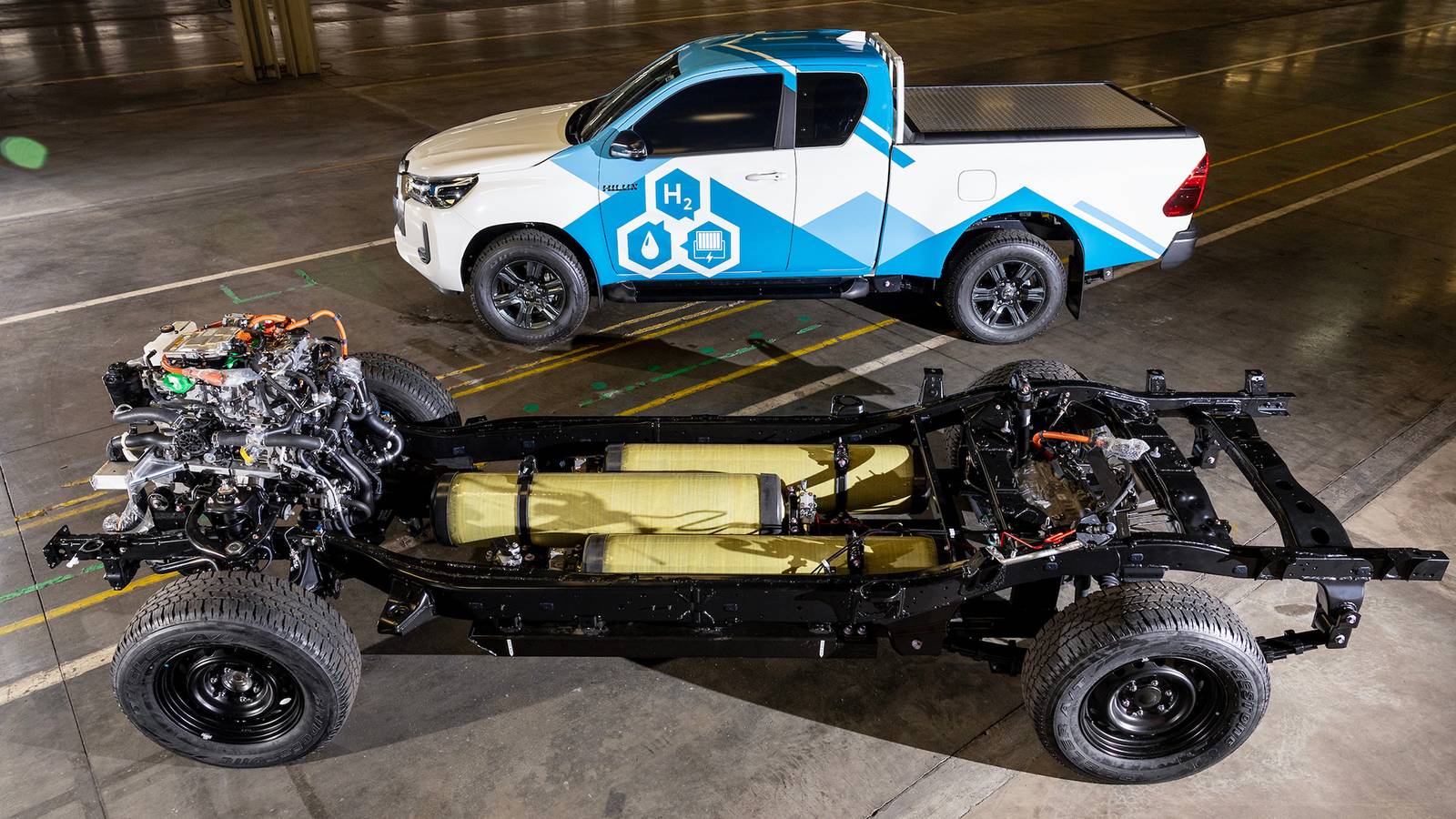
As time passes, there seems to be diminishing hope for the advent of hydrogen-powered cars, especially since hybrid cars and fully electric vehicles continue to gather more attention thanks to their better practicality and feasibility. Hydrogen may be the most eco-friendly fuel source that can be used for personal transportation, but it remains a complicated and expensive technology to develop. Toyota is one of the very few brands that remains committed to the technology, as it continues to view alternative fuels as critical to achieving net carbon neutrality.

Available Models
Toyota
- Founded
-
August 28, 1937
- Founder
-
Kiichiro Toyoda
- Headquarters
-
Aichi, Japan
- Owned By
-
Publicly Traded
- Current CEO
-
Koji Sato
A new venture with key partners, backed by a new investment strategy, offers renewed hope for the Japanese brand’s hydrogen aspirations . It’s highly improbable that we will see hydrogen take over as the next mainstream fuel source for future cars, but there will always be a place for the technology, especially in the commercial sector. Toyota has been in the hydrogen vehicle production industry for quite some time now, and it continues to refine and improve its technology, making it a much more appealing option. Time will tell whether these ventures will act as a noteworthy stepping stone for the future of hydrogen mobility.
Toyota’s Dedication To Hydrogen Technology

Toyota continues to follow its multi-pathway strategy that integrates hybrids, plug-in hybrids, battery EVs, and hydrogen fuel cells instead of relying on a single solution, unlike most automakers that are currently pushing fully toward battery-electric vehicles. The Japanese brand views hydrogen as essential for achieving zero emissions in sectors where batteries face limitations, such as heavy transport, industrial applications, and high-demand fleet operations.
It also expects hydrogen to start replacing diesel within the next decade, offering both environmental and economic benefits. Hydrogen’s main advantage lies in practicality, as refueling takes only minutes, and fuel cells provide consistent range without the weight and cost of large battery packs, making them well-suited for long-distance trucks, buses, and stationary power generation. However, the biggest barrier remains infrastructure, not vehicle technology.
The Energy Source Remains An Uphill Battle

Hydrogen will ultimately be overshadowed by fully electric vehicles in the years to come, because EVs have established a far stronger foundation in terms of infrastructure, efficiency, cost, and automaker commitment. This makes them a much more practical and scalable solution for decarbonizing transport. Battery-powered EVs can plug into a network of charging stations that now numbers in the tens of thousands across the U.S., while hydrogen refueling remains almost entirely confined to California, with no realistic path toward nationwide rollout due to the high expense of station construction and supply logistics.
EVs Maintain The Alternate Fuel Stronghold

From an energy efficiency standpoint, EVs hold a major advantage since electricity can power a car directly, whereas hydrogen requires additional energy-intensive steps of production, compression, storage, and transport that waste more than half of the input energy, making FCEVs inherently less efficient and more costly to operate. Automakers have recognized this disparity and have shifted investment away from hydrogen for passenger cars, with brands like Toyota and Hyundai scaling back U.S. hydrogen offerings while expanding EV lineups to meet consumer demand and regulatory targets.

Why Toyota’s Hydrogen Breakthrough Could Rival Battery EVs
Fuel cells aren’t quite ready for primetime, but they could be an excellent — and clean — alternative to EVs.
Toyota’s Key Partnership With Daimler And Volvo

In a major move to accelerate the decarbonization of heavy-duty transport, BMW Group and Toyota Motor Corporation have signed an agreement to strengthen collaboration in the hydrogen sector, focusing on joint development of fuel cell systems. By combining BMW’s expertise in electric drive technologies with Toyota’s three decades of experience in passenger car fuel cell development, the partners aim to co-develop, produce, and commercialize a third-generation fuel cell system for passenger cars, with BMW planning to launch its first mass-produced FCEV in 2028.
The collaboration will specifically focus on the joint development of unit cells, which are the core component of these systems. The goal is to create a competitive global center of competence for hydrogen systems while simultaneously advocating for the urgent expansion of global infrastructure.
Leaders Are Committed To Hydrogen

Daimler Truck CEO Karin Rådström and Board Member Andreas Gorbach emphasized that joining forces with the world’s largest automaker and a fuel cell pioneer is a game-changer for its operations. This is because it creates the necessary scale to make hydrogen a viable reality alongside battery-electric solutions, specifically for commercial applications.
Volvo Group President Martin Lundstedt highlighted that this collaboration provides the critical mass needed to signal confidence to the entire ecosystem, including customers and suppliers. Toyota President Koji Sato echoed this sentiment, noting that the synergy between Toyota’s 30 years of passenger car fuel cell expertise and Cellcentric’s deep commercial knowledge will deliver world-leading systems. Ultimately, Cellcentric leadership views the move as a profound vote of trust that will allow the company to optimize its technological advantage across the entire hydrogen value chain.

Hydrogen Is Sneaking Up As The EV Slayer
Hybrids, plug-in hybrids, and EVs are great, but hydrogen fuel cell vehicles like the Toyota Mira hold lots of promise for the future.
Fundamental Principles Of The New Partnership

While the collaboration unites three of the world’s largest automotive players, Cellcentric will continue to operate as an independent and autonomous entity, serving a diverse range of global customers in both on-road transport and stationary power applications. To establish the intended equal shareholding structure, Toyota will participate via a significant capital investment, while all three parent companies will continue to compete independently in all other business sectors.
This partnership is specifically designed to meet the ambitious climate targets of the European Green Deal and Japan’s Hydrogen Society Act by sharing the immense research and development costs and infrastructure challenges inherent in the hydrogen economy. With over 560 specialists and a portfolio of approximately 700 patents, Cellcentric aims to leverage this new triple-party scale to become a premier global Tier One supplier, transforming fuel cell technology from a niche innovation into a standardized, mass-market solution for sustainable heavy-duty transport.

Toyota has streamlined the hydrogen-powered Mirai for 2025
The top tier ‘Limited’ is gone for 2025; XLE available from $51K
The Toyota Mirai Remains A Challenging Ownership Experience

Hydrogen may seem like a promising means of propulsion, but adaptation for personal use remains a challenge. A prime example of this is the 2026 Toyota Mirai, which is an exceptional creation on paper, but its short-term advantages make it a considerably poor investment. According toiSeeCars, the Toyota Mirai will lose $27,018 or 52.2 percent of its initial $51,795 MSRP after five years or 60,000 miles, which is about 10 percent worse than its non-FCEV sedan equivalents.
Using CarEdge‘s intuitive valuation tool, we see that the base XLE model loses $40,079 of its initial purchase value within the first five years and 60,000 miles of ownership. J.D. Power indicates that a two-year-old model tends to sell for around $43,650 and $74,885, based on the specifications and condition.
Hydrogen Efficiency Remains The Most Appealing Factor

When it comes to efficiency, the Mirai reigns supreme within its very niche segment. The EPA estimates that the base XLE trim gets 74 MPGe or 1.4 kg of H2 per 100 miles while covering 402 miles in-between refuels. The Limited trim suffers from a slightly worse 65 MPGe or 1.6 kg H2 per 100 miles estimate because of the larger 20-inch wheels. It will only cover 357 miles on a single tank.