
The American automotive sector fundamentally reshaped car culture by popularizing the muscle car. This is a uniquely domestic formula that transformed the midsize sedan and coupe segment via raw and high-displacement V-8 power. Pioneers produced in the 1950s act as the foundation of the segment, but the 1960s are widely considered the Golden Era of muscle cars. Ford, Dodge, and Chevrolet are the most noteworthy brands that transformed the muscle car into a symbol of attainable performance and rebellious style.
However, this high-octane legacy has increasingly collided with modern realities. The industry is now navigating a definitive evolution of the traditional internal combustion muscle car. Stricter federal emissions regulations, such as the EPA’s Multi-Pollutant Standards, have made the thirsty, large-block V-8 difficult to justify, while volatile fuel prices and a shifting market preference for efficiency have dampened demand. This paves the way for a new type of engine that is redefining the next generation of muscle cars.
Dodge’s Contribution To The Muscle Car World

Dodge’s ascent to the pinnacle of the muscle car world began in the early 1960s when the brand pivoted from producing sensible family haulers to engineering high-performance road-legal machines. This reputation for unbridled power was cemented during the late 1960s and early 1970s with the release of the second-generation Charger, the aerodynamically radical Charger Daytona, and the quintessential pony car competitor, the Challenger.
At the heart of these legends were engines that have since become cultural icons. These include the torque-heavy and reliable 440 Magnum V-8 and the 426 Hemi, known more commonly as the Elephant Engine for its immense physical size and dominance in Nascar. While the original muscle era faded due to the 1970s fuel crisis, Dodge successfully reignited the flame in the 21st century by introducing the supercharged 6.2-liter Hellcat and the drag-focused Demon, pushrod V-8 powerhouses that delivered in the region of 700 to 1,025 horsepower, ensuring the brand’s legacy as the final champion of traditional American iron.
Dodge’s Most Potent Muscle V-8

The reintroduction of the supercharged Hellcat V-8 is currently taking place as a strategic pivot to satisfy die-hard enthusiasts who remain resistant to the industry’s shift toward smaller, turbocharged engines and electrification. While Dodge initially prioritized smaller engines and electrification for its 2024 and 2025 models, the brand has begun integrating the Hellcat back into the lineup, notably through high-margin halo models like the 2026 Durango SRT Hellcat and the much-anticipated 2026 Ram 1500 TRX.
This resurgence is driven primarily by overwhelming market demand for the V-formation engine’s unique sound and character, which the downsized engine range struggles to replicate. Furthermore, shifting regulatory landscapes and internal leadership changes at Stellantis have allowed for a temporary ramp-up in Hemi production, with goals to build upwards of 100,000 units to capitalize on the high profitability of these V-8 variants. By leveraging the modular STLA Large platform, Dodge is positioning the Hellcat as the ultimate performance tier for its 2028 roadmap, ensuring that the legendary nameplate serves as a final, high-octane celebration of traditional American power before full hybridization takes over.

The Last True American Muscle Car That Isn’t A Mustang
While many muscle car fans feel betrayed, the truth is that this household name may just spearhead the next wave of homegrown performance.
How The Hurricane Brings New Life To Muscle Cars

The twin-turbocharged 3.0-liter Hurricane straight-six represents a paradigm shift for Dodge’s muscle car catalog, effectively bridging the gap between traditional internal combustion and future electrification. Rebranded as the Sixpack for the 2026 Charger, this engine utilizes two low-inertia turbochargers and a high-pressure direct injection system, operating at 5,075 psi. This configuration means it delivers performance that frequently surpasses the outgoing naturally aspirated V-8s.
In its High Output configuration, the Hurricane produces 550 horsepower and 531 pound-feet of torque, allowing the Charger Sixpack to accelerate from 0 to 60 MPH in just 3.9 seconds. Beyond this impressive power output, the engine’s inline architecture provides a naturally balanced operation with fewer vibrations than a V-8, while advanced technologies like Plasma Transfer Wire Arc cylinder coatings reduce internal friction and can contribute to weight savings. These efficiencies contribute to a nearly 15 percent improvement in fuel economy and reduced tailpipe emissions, proving that the brand can maintain its street-rod DNA through a more compact, power-dense, and environmentally conscious powertrain.
Technical Designs Fit For The New World

The Hurricane engine represents a revolutionary step in modern internal combustion design for the American automotive industry. The unit features a deep-skirt cast-aluminum block reinforced with cross-bolted steel main bearing caps to handle extreme internal pressures. To eliminate the weight of traditional cast-iron liners, Dodge employs Plasma Transfer Wire Arc technology, which applies a microscopic steel-alloy coating directly onto the cylinder bores, resulting in a surface that is ten times more wear-resistant.
The forced induction system is equally sophisticated, featuring two high-flow, low-inertia Garrett GT2054 turbochargers on High Output variants. These utilize water-cooling and an electric after-run pump to maintain thermal integrity and feed into a water-to-air charge cooler integrated directly onto the engine to shorten the intake path and sharpen throttle response. A high-pressure direct injection system ensures precise fuel atomization, making it an advanced architecture, rounded out by high-strength materials such as a forged steel crankshaft, forged steel connecting rods, and forged aluminum pistons with a diamond-like coating on the pins. As a result, Hurricane-powered cars are lighter and more power-dense than the V-8-driven models they replace.

2026 Dodge Charger R/T First Drive: Part Muscle Car, Part Practical Sedan
The Dodge Charger R/T delivers muscle car power with the comfort to be an everyday driver.
The Hurricane Drives Stellantis’s Future

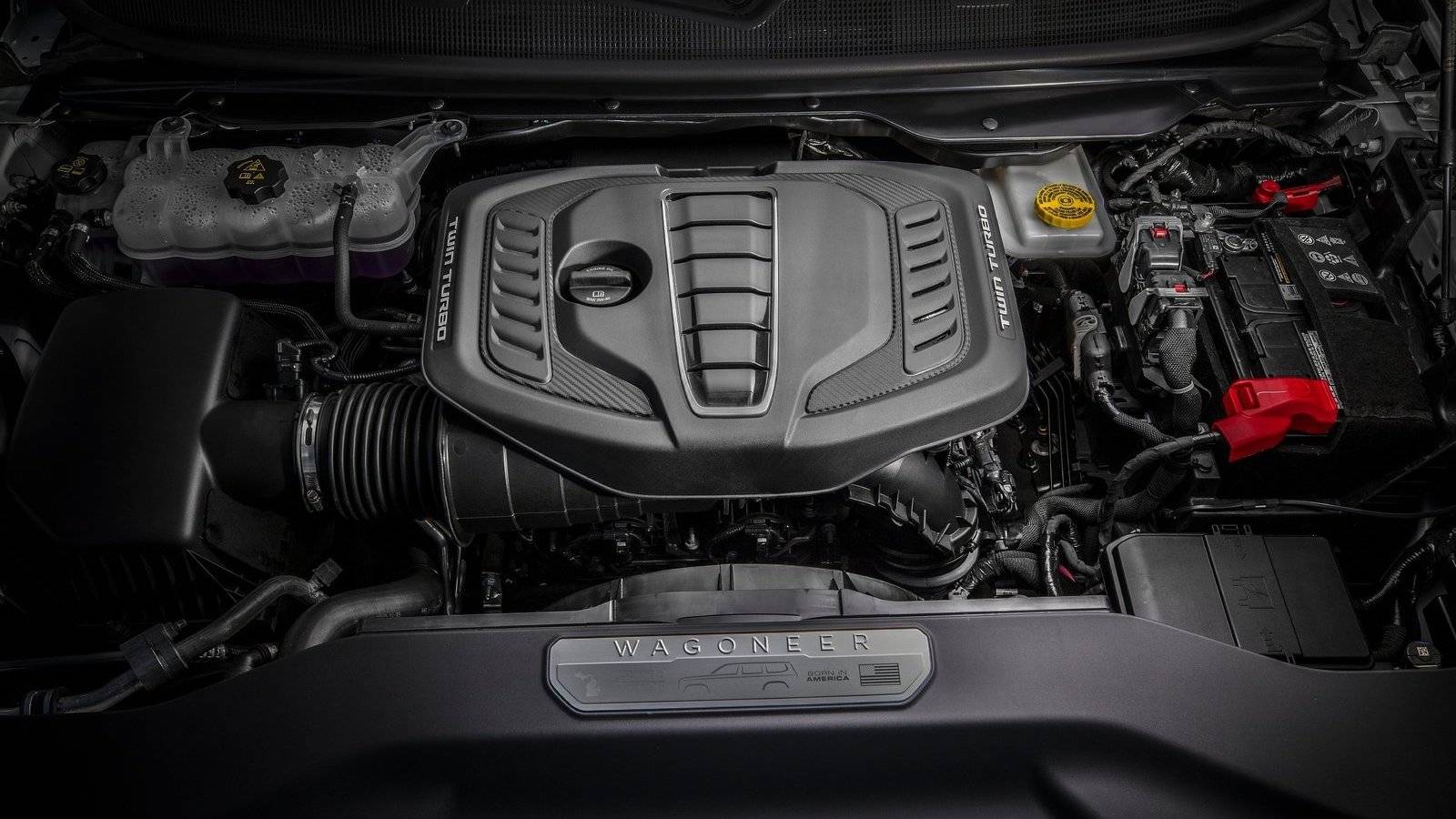
Dodge plans to use the Hurricane straight-six as a high-performance multi-energy bridge, ensuring that its future lineup remains rooted in combustion power even as the industry pivots toward electrification. This strategy is centered on the 2026 Charger, available as both the all-electric Daytona and the gas-powered Sixpack. Beyond the Charger, the Hurricane engine is already the flagship powerplant for the Ram 1500 RHO and the Jeep Grand Wagoneer, and it is expected to eventually migrate into a next-generation Durango replacement to provide a more efficient alternative to the aging Hemi V-8s.
This reliance on the Hurricane represents a significant deviation from Dodge’s initial all-in electrification goals. Fast-tracking the Hurricane’s rollout means that the brand is effectively hedging its bets against slower-than-expected EV adoption and intense customer demand for internal combustion. Ultimately, the Hurricane allows Dodge to maintain its gasoline-driven identity by offering a power-dense, twin-turbocharged option that delivers traditional muscle car acceleration while meeting increasingly stringent federal emissions standards.
Fans Still Want A Hemi

Despite its undeniable technical superiority, the Hurricane engine has struggled to gain the same cultural traction as its V-8 predecessors because muscle car enthusiasts often prioritize visceral emotion and aural heritage over raw performance statistics. While the twin-turbocharged inline-six is objectively faster and more efficient, it lacks the deep, rhythmic stride and thunderous exhaust note that defined the Mopar identity for decades.
Some submissions on the Edmunds consumer review portal have compared the Hurricane’s higher-pitched, smoother delivery to a vacuum cleaner rather than a drag-strip beast that Hemi-powered models are known for. This lack of popularity is further compounded by a perceived loss of character; for many, the physical presence of a large-displacement Hemi is an essential part of the muscle experience that a 3.0-liter engine cannot replicate, despite being so much more advanced. Consequently, sales data for 2026 indicates that many buyers are either holding onto their older V-8 models or specifically seeking out the limited-run Durango Hellcats and the returning 5.7-liter Hemi in the Ram 1500, proving that in this segment, the feeling of American Iron frequently outweighs the logic of modern engineering.

This Is The Most Affordable SUV You Can Buy With A V8
Want a throaty V-8, AWD, and three rows for as little money as possible? This is the answer.
Why Dodge Fans Will Never Accept A Non-V-8 Muscle Car

The Dodge Brotherhood remains fundamentally committed to the Hemi V-8 because the engine represents more than just a mechanical component. The Hemi is the spirit of the Mopar brand’s identity. For enthusiasts, the hemispherical combustion chamber design is inseparable from the golden era of 1960s drag racing and the modern resurgence of the Hellcat, creating a heritage built on a specific, rhythmic exhaust note and the shaking idle of a high-displacement pushrod engine.
This cultural attachment makes the transition to smaller-displacement, twin-turbocharged engines like the Hurricane feel like a departure from the brand’s core ethos of its “no replacement for displacement” philosophy. While a 3.0-liter inline-six might offer superior efficiency and technical sophistication, it lacks the visceral, low-end torque and historical lineage that define a true Dodge muscle car in the eyes of the community. Ultimately, for a fanbase that prioritizes the raw, unrefined character of American iron, any vehicle without a Hemi is often viewed as a compromise rather than a successor, ensuring that the V-8 remains the only universally accepted benchmark for the brand’s legacy.
Sources: Motor Reviewer and Edmunds