
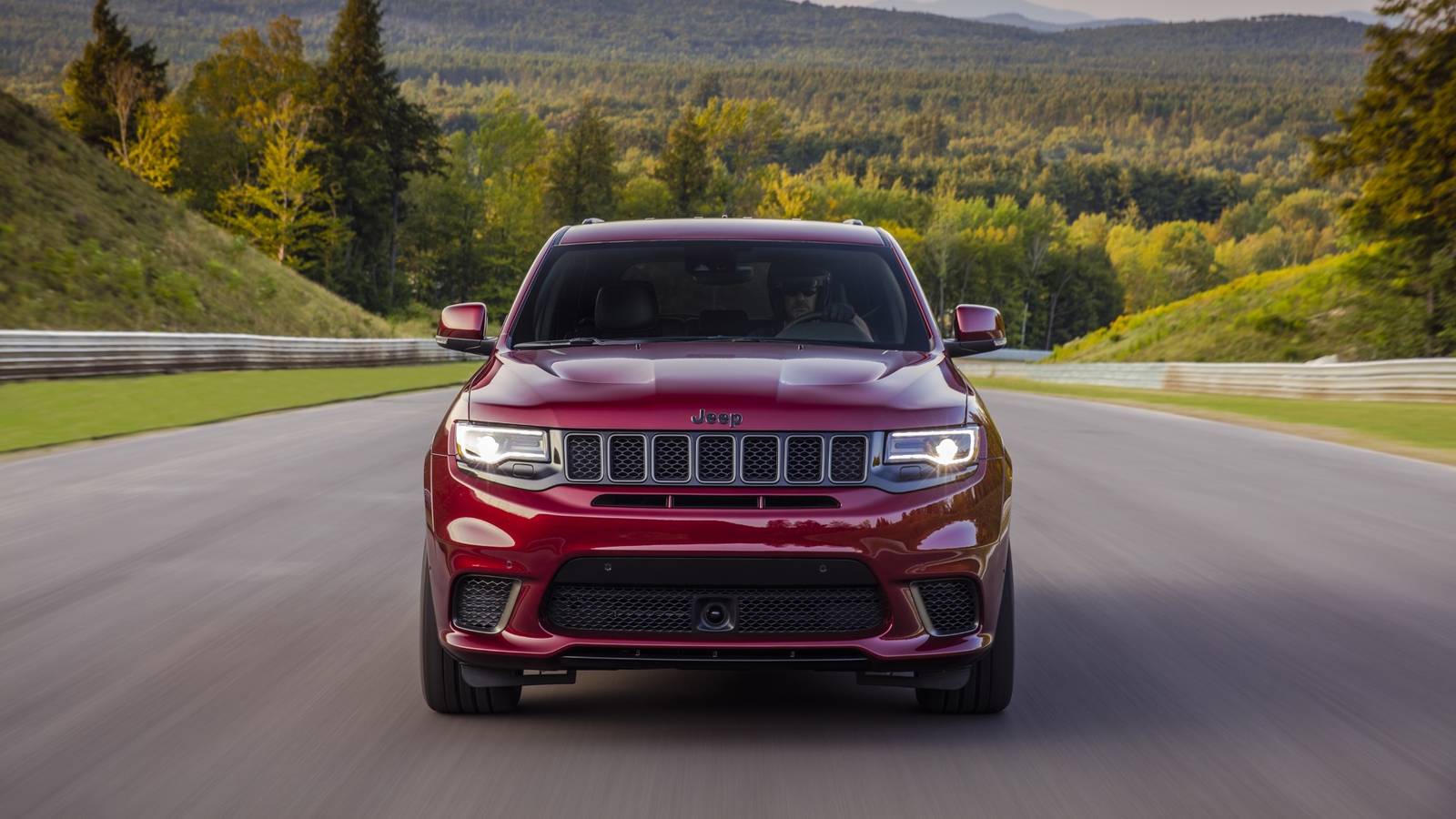
There was a time when SUVs were defined by practicality alone—tall driving positions, cavernous cargo areas, and the ability to tackle rough terrain without breaking a sweat. Performance, if it existed at all, was an afterthought. But over the past decade, the segment has undergone a dramatic transformation, evolving into one of the most hotly contested battlegrounds for speed, luxury, and technological dominance. Automakers now compete to build SUVs that can rival sports cars in a straight line while still carrying groceries and kids in comfort.


- Base Trim Engine
-
6.2L Supercharged V8 Gas
- Base Trim Transmission
-
8-Speed Automatic
- Base Trim Drivetrain
-
Four-Wheel Drive
- Base Trim Horsepower
-
707 hp
- Base Trim Torque
-
645 lb-ft @ 4800 rpm
- Fuel Economy
-
11/17 MPG
- Make
-
Jeep
- Model
-
Grand Cherokee Trackhawk
- Segment
-
Midsize SUV
Amid this evolution, one vehicle emerged that didn’t just push boundaries—it obliterated them. It didn’t try to be subtle, balanced, or even particularly logical. Instead, it leaned fully into excess, combining brute force with everyday usability in a way that felt almost rebellious. This was not a carefully calculated performance SUV designed to impress on paper—it was a machine built to shock, intimidate, and entertain. Years after its debut, the Jeep Grand Cherokee Trackhawk remains the benchmark for outrageousness, a vehicle that redefined what an SUV could be, and perhaps what it should never have been.
How Jeep Turned A Family SUV Into A 707-HP Supercharged Monster

At its core, the Trackhawk began life as something entirely ordinary—the Jeep Grand Cherokee, a midsize SUV known for its comfort, off-road capability, and family-friendly nature. In standard form, it’s a sensible choice, refined enough for daily commuting, rugged enough for weekend adventures. But Jeep’s performance division saw something else entirely—an opportunity to create chaos.
The transformation was nothing short of extraordinary. Under the hood, Jeep replaced the standard engines with a 6.2-liter supercharged HEMI V8 producing 707 horsepower and 645 pound-feet of torque. This wasn’t just a power upgrade—it was a complete personality transplant. The Trackhawk could launch from 0 to 60 mph in just 3.5 seconds, a figure that put it firmly in supercar territory.

Yet what made the Trackhawk truly remarkable wasn’t just its performance but the contrast. This was still a five-seat SUV with a usable trunk, a comfortable ride, and all the practicality you’d expect from a family vehicle. You could drop your kids off at school in the morning and outrun sports cars on the way home. That duality defined the Trackhawk. It didn’t sacrifice practicality for performance—it simply added an absurd level of power to an already versatile platform. The result was a machine that felt almost surreal, a family SUV that behaved like a drag strip weapon.

The Sports Car With Honda Reliability And Porsche-Level Handling
This American V8 sports car starts from $70,000 and even has models with over 1,000 horsepower, while being more reliable than Hondas and Toyotas.
Hellcat Power
Why Jeep Borrowed It To Create Something No One Asked For

The Jeep Trackhawk exists because Jeep had access to one of the most outrageous engines ever fitted to a production car: the supercharged Hellcat V8. Originally developed for muscle cars, this engine was never intended for an SUV. It was loud, aggressive, and unapologetically excessive, everything a practical vehicle typically avoids. But that’s precisely why Jeep used it.
At the time, the automotive world was shifting toward downsizing, electrification, and efficiency. Turbocharged V6 engines were replacing naturally aspirated V8s, and hybrid systems were becoming the norm. Against this backdrop, the idea of stuffing a 707-horsepower supercharged V8 into an SUV felt defiant.

Jeep wasn’t responding to consumer demand. No one was asking for a vehicle like this. Instead, the Trackhawk was a statement, a demonstration of what was possible when engineers were given the freedom to ignore convention. It also served a strategic purpose. By leveraging the Hellcat engine, Jeep could create a halo vehicle that elevated the entire Grand Cherokee lineup. The Trackhawk wasn’t meant to be a volume seller—it was meant to capture attention, generate headlines, and redefine expectations.
In doing so, Jeep tapped into something deeper than logic—emotion. The Trackhawk appealed to enthusiasts who wanted something outrageous, something that made no sense on paper but felt irresistible in practice. It was excess for the sake of excess—and that’s exactly why it worked.

Forget Efficiency: Here Are 10 High-Performance Mainstream SUVs
The world of high-performance SUVs has evolved, with automakers focusing on offering more power, better handling, and impressive capabilities.
Engineering Madness
Stuffing A 6.2-liter Supercharged HEMI V8 Into A SUV Body

Fitting a Hellcat engine into an SUV wasn’t as simple as dropping it under the hood. The Trackhawk required extensive engineering changes to handle the immense power and torque generated by the supercharged V8. First, there was the issue of cooling. A high-output engine like this generates enormous heat, especially under sustained acceleration. Jeep had to redesign the front fascia to accommodate larger air intakes, ensuring sufficient airflow to the radiator, intercooler, and other critical components. The Trackhawk’s aggressive front end wasn’t just for show—it was a functional necessity.
Then came the drivetrain. To manage 707 horsepower, Jeep equipped the Trackhawk with a reinforced eight-speed automatic transmission and a robust all-wheel-drive system. Unlike traditional rear-wheel-drive muscle cars, the Trackhawk needed to distribute power effectively to all four wheels to maintain traction. This system allowed it to launch with incredible force while remaining controllable.

The suspension and braking systems also underwent significant upgrades. Adaptive dampers helped balance comfort and performance, while massive Brembo brakes provided the stopping power needed to rein in the SUV’s speed.
Even the chassis had to be strengthened to handle the additional stress. The result was a vehicle that felt surprisingly composed despite its immense power. It wasn’t just fast in a straight line; it was engineered to handle the demands of high-performance driving. This level of engineering commitment is what set the Trackhawk apart. It wasn’t a gimmick—it was a fully realized performance machine built on a foundation of serious mechanical expertise.

Why The Most Powerful Jeep Ever Built Is Already A Collector’s Item
While there have been a handful of powerful Jeeps, this particular model is the most sought after and is starting to grow in value.
How The Trackhawk Embarrasses Sports Cars

Numbers alone don’t tell the full story of the Jeep Trackhawk’s performance, but they do provide a compelling starting point. A 0-60 mph time of 3.5 seconds and a quarter-mile run in the low 11-second range put it in direct competition with high-end sports cars and even some supercars. But what makes the Trackhawk truly remarkable is how it achieves these figures. Thanks to its all-wheel-drive system, the Trackhawk can deploy its power with brutal efficiency. Launch control ensures optimal traction, allowing the SUV to rocket off the line with minimal wheelspin. In real-world conditions, this gives it a significant advantage over rear-wheel-drive sports cars, which often struggle for grip.

The result is a vehicle that can consistently out-accelerate machines that, on paper, should be faster. At a drag strip, the Trackhawk becomes a giant killer, capable of surprising drivers of far more expensive and exotic cars. And then there’s the psychological factor. There’s something inherently shocking about seeing a large SUV outrun a sleek sports car. It challenges expectations, forcing onlookers to reconsider what performance looks like.
Even at higher speeds, the Trackhawk remains competitive. Its supercharged engine delivers relentless acceleration, pulling strongly well into triple-digit territory. While it may not match the top-end finesse of a purpose-built sports car, its sheer power ensures it’s never far behind. In many ways, the Trackhawk redefined the concept of performance. It proved that speed isn’t limited to low-slung coupes and lightweight roadsters—it can exist in a vehicle that’s tall and heavy.
Why Nothing Since Has Matched The Raw Chaos Of The Trackhawk

In the years since the Trackhawk’s debut, the performance SUV segment has continued to evolve. New models have emerged with more advanced technology, hybrid powertrains, and even greater horsepower figures. On paper, some of these vehicles surpass the Trackhawk in certain metrics. But none of them capture its spirit. Modern performance SUVs tend to prioritize refinement and efficiency alongside speed. They’re engineered to be well-rounded, offering a blend of performance, comfort, and sustainability. While this approach makes sense, it often comes at the expense of raw character.
The Trackhawk, by contrast, was unapologetically excessive. It didn’t try to be efficient or environmentally friendly. It didn’t aim for perfect balance. Instead, it embraced chaos, delivering an experience that felt visceral and unpredictable. Part of this is due to its engine. The supercharged V8 produces a soundtrack and a level of immediacy that’s difficult to replicate with turbocharged or electrified powertrains. There’s a sense of drama every time you press the accelerator, a feeling that something wild is happening beneath the hood.

Another factor is timing. The Trackhawk arrived at a moment when regulations were less restrictive, allowing automakers to experiment with high-displacement engines and extreme performance. Today, stricter emissions standards and the push toward electrification make it unlikely that a vehicle like the Trackhawk will be built again. This gives the Trackhawk a unique place in automotive history. It represents the end of an era, a final expression of unfiltered internal combustion excess before the industry shifts toward a more restrained future.
Ultimately, what makes the Trackhawk special isn’t just its performance or its engineering. It’s the attitude it embodies. It’s a vehicle that exists purely because it can, not because it should. And that’s why, even years later, it remains the craziest SUV ever built.
Sources: Jeep U.S.