
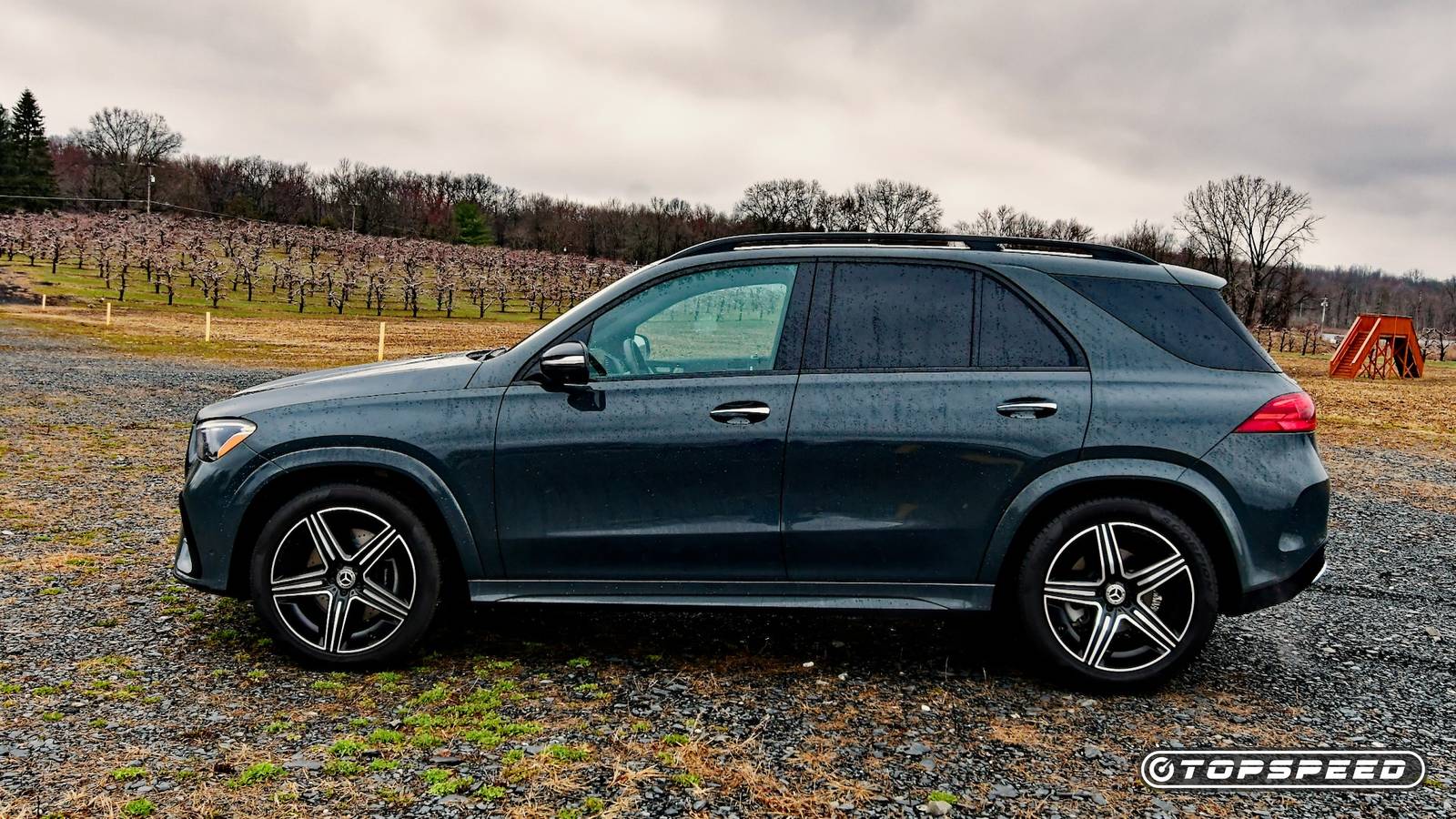
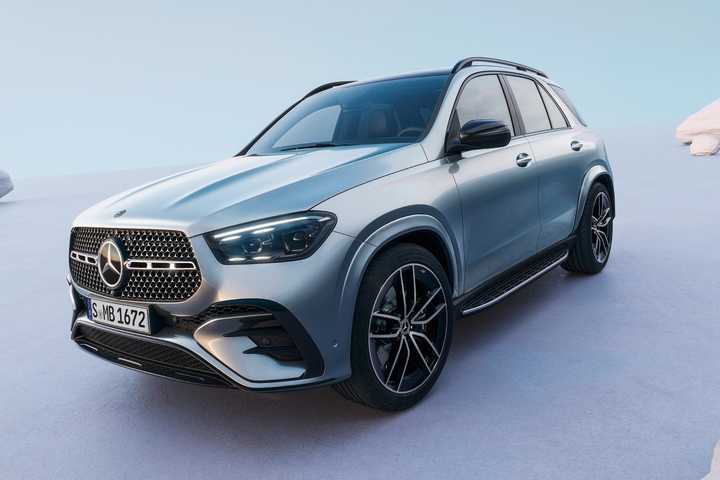
The Mercedes-Benz GLE mid-size crossover comes in a mesmerizing eight flavors. Actually, that’s an undercount. Mercedes-Benz also makes a hybrid, called the GLE 450e, and two grades of AMG variants, with the latter aimed directly at exotic crossovers from the likes of Lamborghini, Ferrari, and Aston Martin.
The AMGs are amazing, but in case you don’t have $131,800 to spend on the GLE 63, the GLE class starts at roughly half that price, with the $63,600 GLE 350 powered by a turbocharged, 2.0-liter four. If you’re ogling more modest grades of luxury crossovers, like the superb Genesis GV80 or the BMW X5, your Benz cross-shop should be the GLE 350 or the GLE 450 4MATIC, reviewed here.
The argument in Mercedes’ favor isn’t just its blingy star on the grille. It’s that Mercedes knows how to meet many different kinds of customers where they are. Eleven varieties of GLE speak to that extensive Rorschach of personality types, since you can have yours loud and brawling, in AMG trim, or understated and sumptuous. Here’s why the GLE 450 hits the latter sweet spot—with a hint of menace, too, when you want it.

- Base Trim Engine
-
2L I4 Hybrid
- Base Trim Transmission
-
9-speed automatic
- Base Trim Drivetrain
-
Rear-Wheel Drive
- Base Trim Horsepower
-
255 HP @5800 RPM
- Base Trim Torque
-
295 lb.-ft. @ 1800 RPM
- Base Trim Fuel Economy (city/highway/combined)
-
19/26/22 MPG
- Base Trim Battery Type
-
Lead acid battery
- Make
-
Mercedes-Benz
- Model
-
GLE-Class SUV
It’s All About Your Hindquarters

There’s a certain era of German luxury cars that weren’t actually luxurious. It was just Teutonic. Meaning: Mercedes, BMW, Porsche, and Audi all took their respective sporting pedigrees so seriously that no matter what they built, their interiors were all business first, and all pleasure…somewhere far lower on the priority list. Mercedes has learned not to do that as a baseline, and that shows especially well in crossovers like this rig. It’s not an AMG version, and that means it’s less restrained in its comforts. Sure, the black-on-black-furnishings could use more warmth, but the open-pore wood across the dash and within the door cards is quite gorgeous, and the seats are ridiculously supportive and comfortable. Only Volvo (and Bentley) do seating better, and this is sans any massaging extras.
The Tech Mostly Works
This isn’t the latest MB.OS that’s on the new CLA, and my hope is that’s an improvement to what you see here, ye olde MBUX. Mind you, this system isn’t terrible, and certainly, its settings structure is reasonably intuitive. Want mapping? Tap the giant icon for that. Want entertainment? That’s clearly labeled, too. Two overlapping, 12.3-inch screens serve as the interface, and they’re nestled within the frame of the dash, with venting below. Visually, this is a relatively elegant layout, and it manages not to be too overwhelming, either. MB.OS in some guises will stretch the width of the dash, which could be a lot.
Such Tiny Mouses

My one beef with Mercedes is that they overload the driver with controls. Carmakers keep thinking we watch Drive to Survive because we want to play video games behind the wheel. No, actually, we don’t. Luxury is the opposite of labor. We don’t want to twiddle buttons. We want the “work” of driving to be pleasurable, not distracting.
With MBUX, anyway, two haptic (i.e., not physical, but touch-sensitive) “mouse pads” at the 3 and 9 spokes of the steering wheel, enable changing the car’s settings. The left switchgear lets you toggle through the controls and settings visible within the instrument cluster. The right pad lets you mouse through the settings on the infotainment screen. But all of the functions accessible via that right steering wheel touchpad can also be adjusted via a larger touchpad below the center console. And you can also adjust all of that by simply tapping on the screen. Why do we need three interfaces? Oh, I forgot, you can also say, “Hey Mercedes,” and, on occasion, the car will deign to call up mapping or your preferred audio source. Sometimes, less really is more.

Mercedes GLE vs. Lexus RX: Which Luxury SUV Holds Up Better?
In this comparison, we’ll look beyond raw badge appeal and dig into how each SUV holds up over time: performance and capability.
Just Use The Buttons

As a reminder to Mercedes and to other carmakers, you invented a more elegant interface about a century ago. The GLE has a string of IRL (in real life!) toggles just below the quad vents, and these adjust climate function. They work beautifully, and there are additional shortcut switches for inputting sound, car, and other settings, too. All of these work quickly and readily—and also have the solidity that “haptic” interfaces never will. Memo to Mercedes-Benz: You have an enviable history. Lean on that tangible, analogue solidity, please.
Maybe Get The Bling Suspension?

One of the best values in Mercedes’ menu of options is the AIRMATIC suspension package. It’s a worthwhile upgrade. While my test GLE 450 had stock, non-adaptive springs, AIRMATIC, for a mere $1,710 more, brings adaptive air, and that would tune out the chunder of the crappiest road surfaces—A.K.A., every road in America.
The Smooth Ride You Expect From a Mercedes-Benz

Not that the stock dampers are a problem. With the GLE 450, Mercedes strikes the happy middle space between American-boat, under-sprung, and its AMG-sports-car rigid brethren. The steering is wonderfully weighted, and despite its bulk, the Benz seldom bobs or waddles. It’s on the softer side of firm, and while the BMW X5 would probably out-corner the Benz, the Mercedes never feels uncomfortably stiff.
Buyers often forget that when you’re seated two feet higher than a sports car, every input gets magnified; your passengers getting seasick has everything to do with that longer lever from the ground to their heads. If you (and only you) want a sportier ride, then the AIRMATIC system would enable that when you’re piloting sans passengers—and to soften the dampers when you’re playing parent. Also, AIRMATIC-equipped GLE 450s can be dropped for easier loading, and can be raised for churning through snow.
The Optional Third Row Is Tight

You can spend an extra $2,100 for an optional third row. Do that only if you think you’ll have to cram some very small humans in that third row, because legroom and headroom will be exceptionally limited. Mercedes is kind to offer the option—and BMW’s X5 doesn’t. But most Mercedes buyers will step up to the larger GLS. Sticking with the GLE, vs, the BMW X5, second-row legroom and total cargo volume are right about on par, with excellent second-row comfort. Also, the split 40/20/40 seating is ideal for tossing through skis or fishing poles and still having the ability to carry four adult passengers.

Finally, The Mercedes-AMG GLC 53 Coupe Delivers Six-Cylinder Power
This new powertrain offering should be the just-right option for customers looking for a little more than the 416-horsepower GLC 43.
The Sweet Spot Engine

With so many choices, Mercedes-Benz makes it hard to decide on the ideal powertrain. My argument for the 3.0-liter in-line six has everything to do with fitting the mission of the GLE. Its 375 horses can’t be unleashed until a pretty screaming 5,500 RPM, but peak torque, of 369 pound-feet, pops at only 1600 RPM. Acceleration is darn near EV smooth, and vs. the base, 2.0-liter turbocharged four, you’re literally looking at almost identical fuel economy—while getting 25 percent more horsepower from the bigger motor. Meanwhile, to step up to the V-8-powered GLE 580 will cost you an extra 20 grand, and you’ll see significantly worse fuel economy.
EPA Fuel Economy Mercedes-Benz GLE 350 4MATIC vs. GLE 450 4MATIC
|
City EPA |
Hwy EPA |
|
|
GLE 350 4MATIC |
19 MPG |
26 MPG |
|
GLE 450 4MATIC |
19 MPG |
25 MPG |
|
GLE 580 |
18 MPG |
21 MPG |
TopSpeed’s Take

The GLE 450 is by no means “affordable” in a conventional sense. You could argue that the Genesis GV80 undercuts the Benz on price, but if you’re not looking at the respective brands’ four-cylinder base models, then that point is a wash, since the 3.5-liter V-6 Genesis will run you $77,000, and the base price of the GLE 450 is $73,500, which includes destination.
Throw $85,750 at the formula, and Genesis will sell you their hotter, GV80 Coupe 3.5T e-SC AWD, with a 409-horsepower, supercharged motor that’ll out-race this Benz (and the equivalent-tier, BMW X5). At that nosebleed sticker, you can argue that Genesis is offering a relative “bargain” vs. all the Germans. And Genesis is going to push this needle harder, too, with forthcoming Magma products that will no doubt undercut the Europeans at this very high end.
Buy A Mercedes—Buy American!

But for now, until Genesis (perhaps) starts assembling cars at a joint Hyundai-owned plant in Georgia, there’s one final reason to buy the GLE—it’s assembled in Alabama, which means by buying from Mercedes-Benz you’re supporting American jobs. You want a kicker? Per the U.S. DOT’s annual stats sheet of cars imported to and assembled in the U.S., there are as many “domestic” parts in a GLE as in a Cadillac XT6. So, buy a Mercedes (well, this Mercedes), and you’re buying American!