
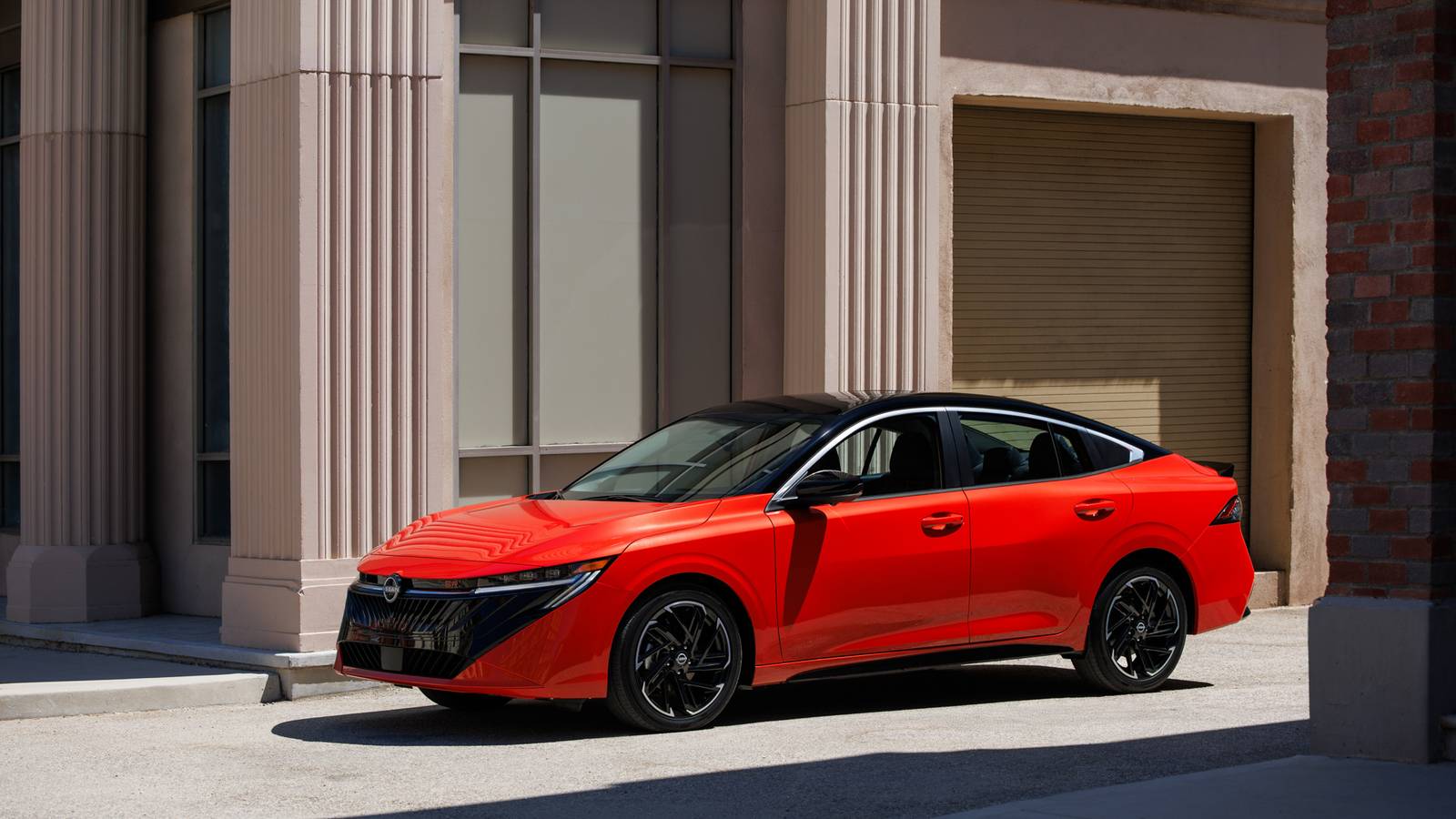
The new-generation 2026 Nissan Sentra has been available in the U.S. for a couple of months now. Despite introducing a host of visual and technical upgrades and more competitive pricing, it continues to trail behind its main rivals in terms of volume sales. The Honda Civic and Toyota Corolla remain the benchmarks of the compact sedan segment. It’s worth looking into why the Sentra just can’t seem to break their dominance, regardless of how hard it tries.


- Base Trim Engine
-
2.0-liter Four-Cylinder
- Base Trim Transmission
-
CVT
- Base Trim Drivetrain
-
Front-Wheel Drive
- Base Trim Horsepower
-
149 HP
- Base Trim Torque
-
146 lb-ft
- Make
-
Nissan
- Model
-
Sentra
- Segment
-
Compact Sedan
The 2026 Sentra moves further into the premium market, with a visually striking exterior redesign and digital-centric interior. The brand also applies key refinements to the drivetrain and suspension to make it more comfortable and engaging from the driver’s seat.

10 Reliable Cars That Make Great Daily Drivers For 2025
Are there any good cars left? These ten reliable cars can be great daily drivers and are part of the 2025 model year lineup.
Nissan’s Unbeatable Pricing Strategy

One area where Nissan continues to outperform its key rivals is in the starting price point for the 2026 Sentra. The range starts at $22,400 for the base S trim, followed by the $23,170 SV, $25,000 SR, and flagship $27,990 SL. Toyota kicks off pricing for the Corolla at $22,925, while the Civic’s range starts at $24,695.

The 2026 Nissan Sentra has undergone a significant refresh that standardizes high-end technology across the lineup, starting with the base S trim. The entry-level variant features a 12.3-inch NissanConnect touchscreen as standard, which includes wireless Apple CarPlay and Android Auto. Opting for the base S adds charcoal cloth upholstery and a 7.0-inch multi-information display for the driver. It also features remote keyless entry, push-button ignition, and the Nissan Safety Shield 360 suite. Entertainment is provided through a four-speaker audio system, and the cabin maintains a practical focus with a 60/40-split folding rear seat and multiple USB-C charging ports for modern devices.

Stepping up to the SV trim adds a 12.3-inch digital instrument cluster, premium cloth upholstery, and the Nissan Intelligent Key system with front-door hands-free entry. There’s also an optional All-Weather Package that adds dual-zone automatic climate control, heated front seats, a heated leather-wrapped steering wheel, and remote engine start with intelligent climate control. Additionally, a six-speaker audio system becomes available at this level, while a wireless smartphone charger can be added as an option to reduce cable clutter.

The SR trim features unique sport cloth seating with orange contrast stitching and ambient interior lighting. While it shares many of the SV’s tech features, the SR comes standard with a leather-wrapped steering wheel and heated outside mirrors with LED turn signals. Convenience is further enhanced by an approach unlock and walk-away locking system, and the infotainment system gains NissanConnect Services and Wi-Fi hotspot capability. The SR Premium Package includes a power-sliding glass sunroof, a six-way power driver’s seat with two-way power lumbar support, and the option for TailorFit sport leatherette seating.

The newly reintroduced flagship SL trim standardizes many features that are optional on lower grades. It comes equipped with heated TailorFit soft-touch quilted leatherette seats and a heated steering wheel as standard. The entertainment experience is significantly upgraded with an eight-speaker Bose Premium Audio system, which is paired with active noise cancellation to maintain a quiet cabin environment. This trim also focuses heavily on driver convenience and safety, including the ProPilot Assist system, an HD intelligent around view monitor with moving object detection, and a standard power sunroof. A HomeLink garage door opener and an auto-dimming rearview mirror round out the SL’s comprehensive features list.
Impressive Interior Dimensions

The 2026 Nissan Sentra offers a total passenger volume of 96.1 cubic feet, which the brand has designed to prioritize front-row comfort. The driver and front passenger benefit from a class-leading 43.8 inches of legroom and up to 38.9 inches of headroom. Rear passengers are provided with 34.9 inches of legroom and 36.7 inches of headroom, while the trunk features 14.3 cubic feet of cargo capacity with a notably low liftover height for easier loading.
When compared to its primary segment rivals, the Sentra’s interior dimensions present mixed results. It significantly outperforms the Toyota Corolla in both front legroom and trunk space, but it falls behind the Honda Civic in almost every key metric, as the Civic offers a more spacious 14.8-cubic-foot trunk, superior rear legroom, and better total passenger volume at 99.0 cubic feet. Consequently, while the Sentra is a better choice than the Corolla for driver legroom and storage, it remains less commodious overall than the benchmark-setting Civic.

Why The 2026 Nissan Sentra Feels Pricier Than It Is
The redesigned 2026 Nissan Sentra combines comfort, technology, and performance to prove a compact sedan can still feel like something special.
Nissan’s Comparatively Simple Engine

The 2026 Nissan Sentra features the same powertrain across all four trims, consisting of a 2.0-liter dual overhead cam four-cylinder engine known internally as the MR20DD. This naturally aspirated power unit utilizes direct fuel injection to produce 149 horsepower at 6,000 RPM and 146 pound-feet of torque at 4,400 RPM.
Nissan took pains to make the Sentra cabin quieter. In combination with the smoother operation of the CVT, the Sentra is now a more refined commuter car. Whether at 75 MPH on the highway or around town, or on country roads, there was just less tire roar and less noise coming through the floor. – TopSpeed
The unit sends power exclusively to the front wheels through a refined continuously variable transmission (CVT), which has been retuned to provide more natural-feeling gear ratio transitions and improved responsiveness under heavy acceleration. In terms of performance, the Sentra delivers a 0 to 60 MPH acceleration time of 8.3 seconds, before hitting an electronically limited top speed of 115 MPH.
Appropriate Fuel Consumption Estimates

The 2026 Nissan Sentra offers two distinct fuel economy profiles depending on the chosen trim, both of which feature a standard 12.4-gallon fuel tank. The S and SV trims are the most efficient, delivering an EPA-estimated 31/39/34 MPG on the city/highway/combined cycle, while covering 471 miles of range on the highway or 372 miles in combined driving. The sportier SR and premium SL trims achieve a 30/37/33 MPG estimate, resulting in a maximum highway range of 446 miles.
Based on a national average fuel price, filling the tank completely would cost $42.16. For a 25-mile trip, the cost to drive would be about $2.58 in the S and SV or $2.66 in the SR and SL. Over a five-year period, assuming 15,000 miles driven annually, the Sentra is estimated to save the average owner between $750 and $1,250 in fuel costs compared to the average new vehicle, with a total five-year fuel expenditure of $7,727 for the most efficient models.

2026 Nissan Sentra First Drive: America’s Cheapest Car Just Got A Lot Better
The Nissan Sentra stays affordable—but now it’s far more refined, handles better, and is more stylish, too
Reasonably Impressive Reliability Standards

Reliability and value retention are two core areas where the Sentra tends to perform well. iSeeCars indicates that the model will cover an average of 125,063 miles, but it only holds a 4.6 percent probability of reaching 200,000 miles. It also suggests that the model will lose $7,522 or 33.3 percent of its initial purchase value after five years of ownership, which is a bit worse than the Corolla and Civic, likely contributing to its lower sales volume.
The Nissan Sentra maintained a steady presence in the compact sedan market throughout 2025, selling 134,250 units in the U.S., which represented a slight 2.4 percent increase over its 2024 performance. This momentum carried into the first two months of 2026, with January seeing a 4.9 percent year-over-year rise in North American deliveries.

Despite this growth, the Sentra continues to trail its primary Japanese rivals in total sales volume. The Toyota Corolla led the segment with 248,088 units sold in 2025, including a 6.5 percent growth in its hybrid and GR performance variants. The Honda Civic secured the second-place spot with 172,800 units. The Sentra competes effectively on a value-for-money basis with its lower entry price, but the Civic and Corolla maintain a sales advantage through more diverse powertrain lineups, including the high-demand hybrid options that accounted for over 34 percent of Civic sales and 20 percent of Corolla sales in the past year.

2026 Nissan Sentra Interior And Exterior Picture Gallery
The 2026 Sentra brings an updated exterior and interior look, retuned CVT, Sport Mode, improved rigidity, and enhanced efficiency.
Outstanding Standard Safety Features

The 2026 Nissan Sentra prioritizes occupant protection through a robust suite of passive safety equipment, including a comprehensive ten-airbag system featuring dual-stage supplemental front airbags, knee airbags for both front occupants, and roof-mounted curtain side-impact airbags with rollover sensors. This foundation is reinforced by active safety tech categorized under the standard Nissan Safety Shield 360, which provides 360 degrees of coverage via automatic emergency braking with pedestrian detection, rear automatic braking, blind spot warning, rear cross traffic alert, lane departure warning, and high beam assist.
For 2026, the Sentra further elevates its driver-assistance profile by offering ProPilot Assist for the first time on the compact sedan, which is standard on the SL trim and available on the SV and SR grades. This advanced system combines adaptive cruise control with steering assist to help maintain lane centering and a preset following distance during highway travel, while additional technologies like the intelligent around view monitor and intelligent driver alertness provide enhanced situational awareness for a more confident commuting experience.
Sources: The EPA, iSeeCars, and J.D. Power.