
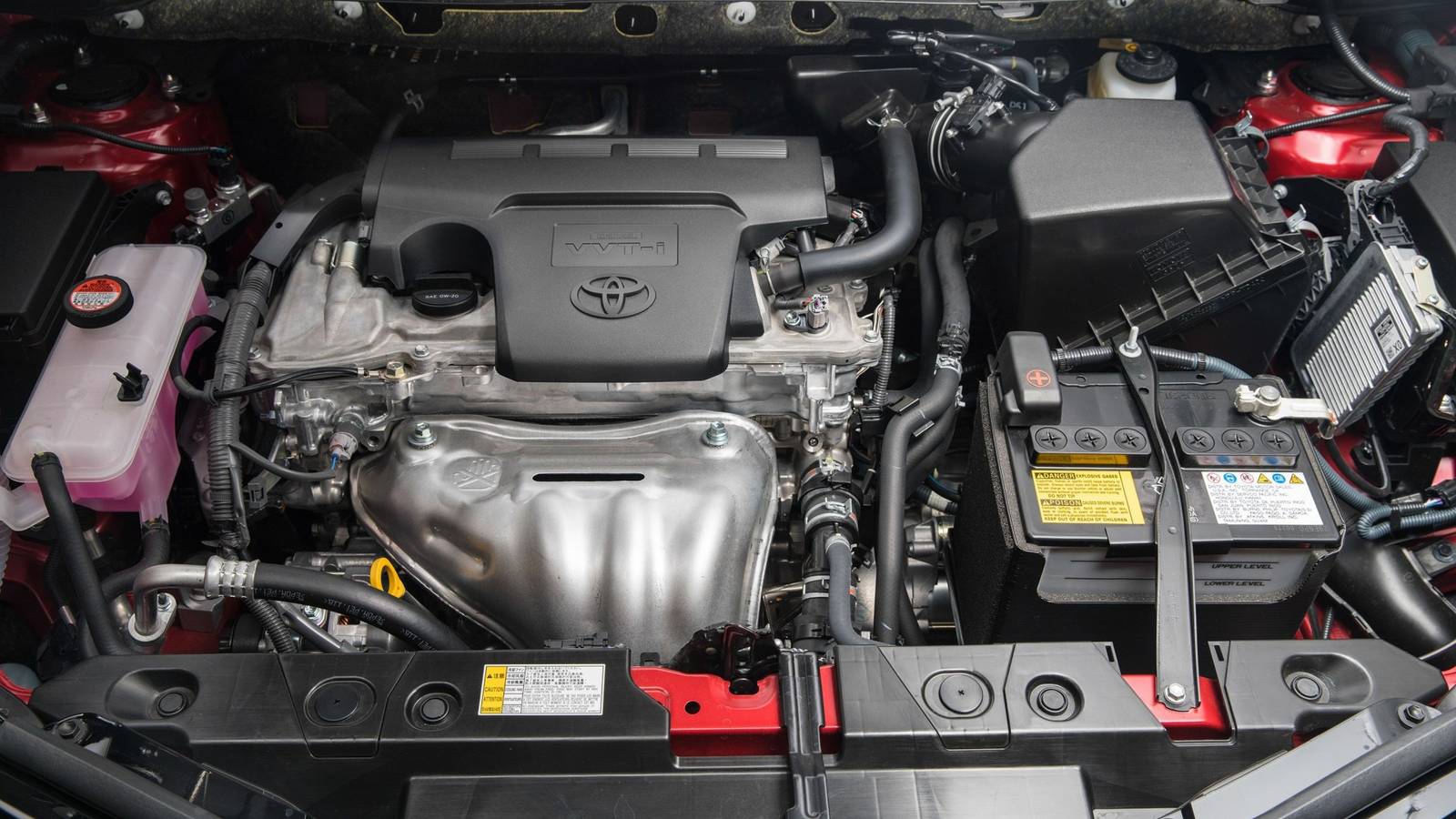
Remember when they said hybrids and PHEVs could never last 200,000 miles? That didn’t age well. Nowadays, decades of proven consistency have demonstrated that certain hybrid powertrains are amongst the most reliable options available. What still doesn’t get enough credit for making hybrids so reliable? The combustion engines that power them.
A common misconception based on conventional understanding was that combustion engines would have to work harder to keep up with the increased demands of a hybrid system. For most automakers, that was true. In many cases, the fundamental flaws of combustion engineering were exposed. Yet, there was one outlier that broke the mold. How this brand managed this feat comes down to one engineering decision that changed the future of hybrid powertrains.
The Success Of Hybrids Was Never A Guarantee

Once upon a time, hybrids did not dominate the American market. The debut of hybrids at the turn of the millennium brought an initial wave of optimism. Sadly, early examples were rudimentary at best. The largest doubt was always the combustion side of the problem because we just didn’t know how these engines would handle the new demand.
The Start-Stop Conundrum

If you look at a conventional gasoline engine, it’s designed to do one thing: keep running until you decide to turn it off. These engines are built to handle long sustained stretches where all the relevant fluids, like oil and coolant, can normalize and work within their ideal operating range. Cold starts are where the majority of engine damage occurs because the engine almost needs to break free from its slumber. There is a brief window where oil has not fully circulated in the upper valvetrain areas, and clearances still aren’t to spec, and you get some metal-on-metal contact. Conventional engineering agrees that minimizing the number of engine starts is a way to mitigate damage.

Hybrid powertrains took that idea and said, “We don’t need you anymore.” Hybrids make the combustion engine shut down when you come to a full stop, at low speeds, during deceleration, and anytime that the battery has enough juice to handle the thrust you need. By design, hybrids are constantly cycling the engine.

On a combustion engine car, you might start up the engine once or twice a day, completely cold. A hybrid might start and stop a dozen times within a single section of a short commute. This constant start-stop cycle creates a specific wear pattern that is something completely foreign to standard combustion engines. Early adopters of hybrid technology quickly revealed which engines were built for this new challenge and which ones were destined to fail.
The Major Influence Of Fleet Data

Who provided the strongest proof of concept for the validation of early hybrid technology? The taxi and rideshare industry. Early adopters took a risk, and it paid off as hybrid vehicles began accumulating mileage records that shattered any preconceived notion of what was possible. 250,000 miles wasn’t exceptional; it was the expectation for the original engine.

Despite reaching these incredible figures, powertrain warranties were often unnecessary. These hybrids simply… worked. With incredibly low maintenance costs and stellar fuel economy, hybrid vehicles were severely undercutting conventional competitors. At first, the margins seemed too good to be true. That was until their legitimacy was verified with years’ worth of data from sources across the aisle.

The mileage alone does not tell the full story. What was truly remarkable was the duty cycle these hybrids could handle. Fleet vehicles rarely sit and cruise the highway at a steady pace like standard commuters. They spend hours idling, use full acceleration to merge, and brake hard when they don’t make a light. Within a single shift, the engine starts and stops maybe a couple of hundred times.

In any case, this environment should theoretically be the most grueling challenge imaginable for a combustion engine. Yet, the data from millions of hybrid vehicles as part of rideshare and taxi services demonstrates otherwise. This endorsement took the emerging technologies’ legitimacy to unprecedented heights. The only question that remains is how?

This Was The First Mass-Produced Lexus Hybrid Vehicle
This hybrid SUV helped pave the path for Lexus’ success in the hybrid industry.
Not All Engines Are Made Equal

You may assume that the most complicated part of a hybrid system is the battery pack or the inverter. Yet, in reality, those electrical units are relatively simple compared to the complexity of what is going on within a combustion engine. One of the most critical factors in how a combustion engine will run is its thermodynamic cycle. One day in a Toyota engineering facility, one team’s decision regarding a choice of thermodynamic cycle would effectively change the future of hybrid technology forever.
Why The Atkinson Cycle Changed Everything

When you think of a conventional gasoline engine, you are thinking of an Otto cycle engine — intake, compression, combustion, exhaust. These four fundamental principles have been the focus of automotive engineering for over a century. In the Otto cycle, compression and expansion strokes are almost equal in length. This design optimizes power output and has been the go-to method for its effectiveness, as it also offers a broad torque band and high-RPM responsiveness.

The Atkinson cycle is an entirely different approach. During the compression stroke, the intake valves stay open slightly, and a portion of the air-fuel charge is pushed back before compression occurs. This results in a shorter effective compression stroke paired with a longer expansion stroke — the fundamental difference between Otto and Atkinson.

The engine extracts more work from each combustion event while generating less heat and pumping losses in the process. Thermal efficiency is everything in combustion engineering, and this process increases it. The sacrifice is peak power, which would be unacceptable in a conventional car. Yet, the magic of hybrid powertrains is that the electric motor covers the low-speed torque that the Atkinson sacrifices. The result is near-perfect engineering: less stress is placed on the engine’s internals with every single firing event, allowing for systems like start-stop to be seamlessly integrated.
The Engine That Led The Atkinson Charge

Many automakers quickly began to explore different approaches to capitalize on the revolution. Some attempted to fit conventional engines with hybrid assistance, and others attempted to utilize continuously variable architectures. Yet, it was one automaker alone, Toyota, who committed to a combustion engine that was designed specifically for use in hybrid powertrains.

Its engine was not a modified version of a pre-existing unit. It was purpose-built for hybrid duty and offered high thermal efficiency along with the tolerance required for repeated cold starts. These are not things you would notice a year or two into ownership. However, after widespread acclaim of 10 years of stress-free service, the difference was apparent. The engine in question is Toyota’s 2AR-FXE, one of the most successful production hybrid power units ever produced.

This Toyota Hybrid Regularly Hits 300,000 Miles With Almost No Repairs
Toyota’s focus on efficient, smooth, and durable hybrid systems contributes to their reputation for lasting over 300,000 miles with minimal repairs.
The 2AR-FXE: Toyota’s Greatest Engine Nobody Talks About

Introduced in 2009, this 2.5-liter Atkinson cycle inline-four has served as the engine of choice across a variety of Toyota and Lexus hybrid products. Some of the best-selling hybrids ever built utilize this engine, but it is rarely ever mentioned among the greatest Toyota engines in history.
Why The 2AR-FXE Succeeded Where Others Failed

The 2AR-FXE engine operates at an unusually high compression ratio of 12.5:1. This is made possible by the Atkinson cycle’s late intake valve actuation, which reduces the effective compression enough to prevent detonation while extracting the maximum potential from the expansion stroke. The intake valves are controlled by VVT-i, which means that the behavior of the Atkinson cycle can be modulated depending on load conditions. This is especially important on initial startup when the engine is cold and thermal management is the most critical.

Several measures were undertaken to reduce engine component friction. This includes roller rocker arms, low-tension piston rings, and an electric water pump — all designed to reduce parasitic losses. The electric water pump specifically ensured that the engine could get to the optimal temperature as quickly as possible, minimizing the small zone where lubrication is still outside the ideal range. All of these engineering decisions targeted the same objective: handling the start-stop duty cycle that destroys conventional engines.
A Stellar Real-World Track Record

The 2AR-FXE powered the Camry Hybrid, RAV4 Hybrid, Avalon Hybrid, and the Lexus ES 300h, among other models. These are not low-volume vehicles that only sell a couple of thousand units a year. The Camry remains one of the best-selling production cars of all time, and the RAV4 SUV has been topping bestseller leaderboards for years now. If you want a hybrid vehicle that makes 250,000 miles feel like an expectation and not a miracle, it is likely powered by the 2AR-FXE. Rideshare drivers regularly drive Camry Hybrids to mileage figures that would mean an engine replacement or two for most other vehicles. There are reliable powertrains, then there is the 2AR-FXE — a purpose-built leader of hybrid technology.

Toyota’s Hottest Hybrid Of 2026 Is Flying Off Dealer Lots
Toyota’s midsize sedan continues to set the sales charts ablaze.
Why This Engine Still Matters Today

In Toyota’s current engine line-up, the 2AR-FXE was replaced by the A25A-FXS, introduced in 2017. Despite this, the engineering philosophy that defined the 2AR-FXE lives on in the current generation of Toyota hybrid products.
A Solid Foundation For The Future

The A25A-FXS is part of Toyota’s Dynamic Force engine family, which targets thermal efficiency figures above 40 percent. These figures were made possible by the 2AR-FXE’s contributions, such as the expansion of the Atkinson cycle, friction reduction strategies, and fast-warmup architecture. These new engines are more efficient and powerful than their predecessors, but they are more evolution than revolution. The 2AR-FXE validated that this technology was the future through over a decade of consistency that no other automaker could have replicated.
Consistency Is Key

The current automotive industry follows trends and emulates successful strategies. With every new model, the expectation is that the next generation will always be a complete revolution, or else people will lose interest. The 2AR-FXE achieved greatness by following an alternate strategy: create a solid foundation, refine it incrementally, and let the results speak for themselves.

The success of the Camry Hybrid for over a decade served as proof. Now that the Toyota Camry is hybrid-only, the validation has only increased. These results weren’t achieved by clever marketing, but rather, key engineering tenets that ensured the highest quality result possible. This decades-old engine may be out of production now, but its undeniable foundation has kept modern hybrids reliable since.
Sources: Toyota, Lexus, iSeeCars