
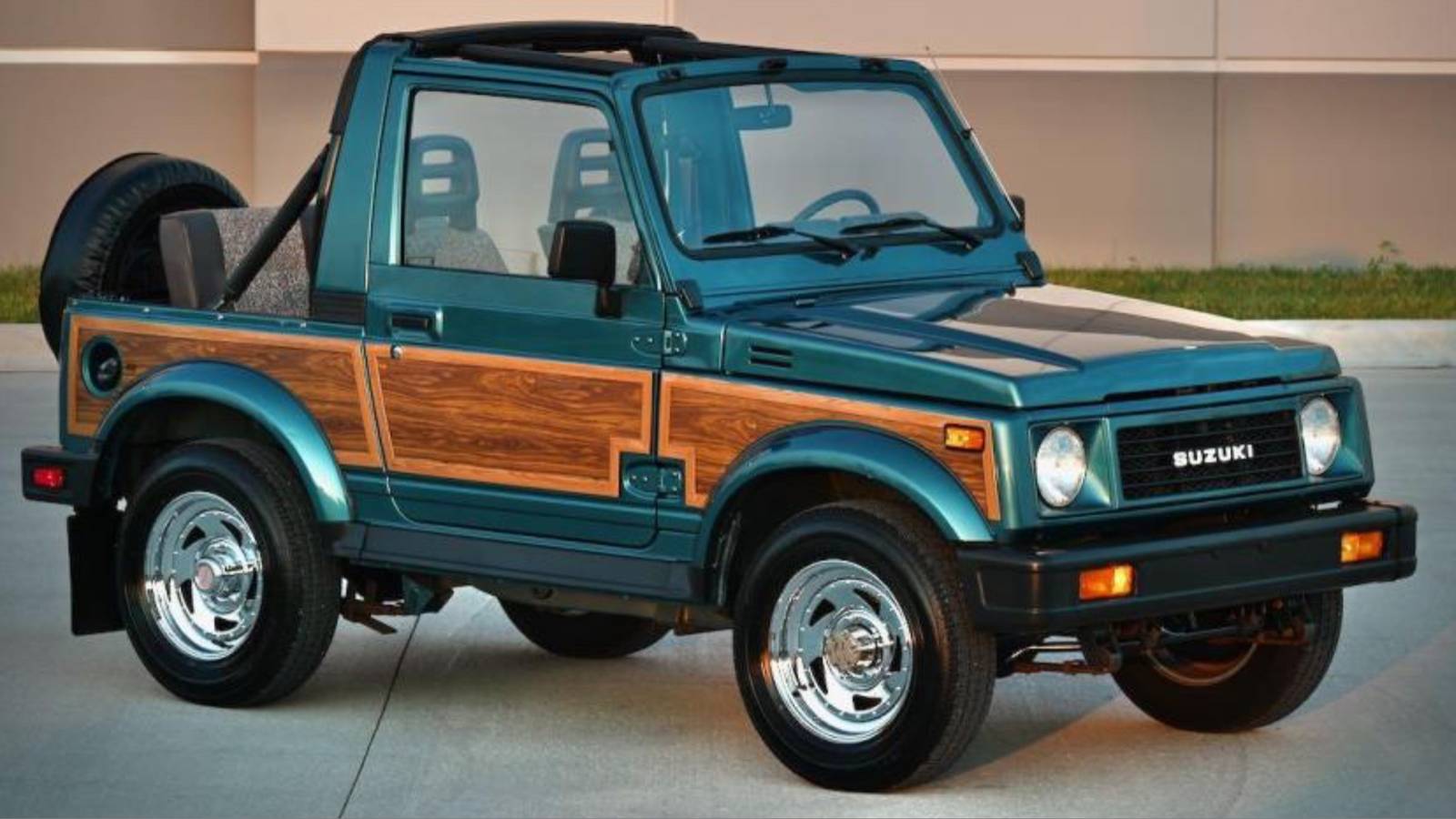
Forty years ago, America was full of V8-powered SUVs, trucks and sedans the length of a cruise ship. A land much like today’s, with the “bigger is better” mantra defining the fabric of car culture. With that in mind, Suzuki had the ambitious plan of bringing an American version of the plucky Jimny to the States, called the Samurai. Though the Suzuki Jimny had been conquering the rest of the world for 15 years, it was still an enormous risk – a car that seemed to break all conventions of what makes something successful in the West.
It made its debut in the U.S. in 1986 with humble aspirations of success in a location overrun with cars twice its size. The Samurai didn’t just sell well; it was a phenomenon. A vehicle that proved to citizens that sometimes, a smaller, cheaper vehicle can be just as capable as its larger counterparts.

A Six-Wheeled Suzuki Jimny Exists And It’s As Crazy As You’d Expect
The Suzuki Jimny is a well-loved SUV, in large part due to its tiny footprint. Someone decided to build the biggest Jimny ever, and it’s for sale.
The Suzuki Samurai, A Cultural Revolution

The Suzuki Samurai was a cultural awakening in an era that revolved around excess. The minimalism and rugged loyalty that the Samurai oozed, combined with its $6,550 starting price, meant that it was an instant success, selling an impressive 47,000 in the first year. Although all logic would dictate it wasn’t a recipe for a U.S. market, sometimes there is a hunger for something which the masses don’t even know they wanted, and the Samurai captures that lightning in a bottle.
It was a perfect storm: its cute face and accessible dimensions, paired with the adorable “Beep, Beep, hi!” commercials, made the Samurai seem like a plucky soldier, a loyal companion. Perhaps even encapsulating the same sort of emotional response we have to a pet, there was just something endlessly lovable about this little vehicle. By mid-1988, the steam was not wearing off, with American sales alone reaching 8,000 per month.
The Suzuki Samurai Was A Giant Killer

Despite its sweet little looks, the Samurai became a go-to choice for rock crawling. Though it didn’t have the outright grunt of a Wrangler, its 2,100-pound body and short wheelbase allowed it to climb and crawl in ways that large SUVs simply couldn’t. It would also squeeze through tight chicanes and narrow passes far easier than any full-size truck that would get stuck and have to retreat. The Samurai used its simplicity to its advantage; with leaf springs and solid axles, it could be fixed incredibly easily, meaning basic equipment could go a long way.
Killing Giants With Tiny Specifications
|
1986 Suzuki Samurai |
|
|
Powertrain |
1.3-liter inline-4 |
|
Transmission |
5-speed manual |
|
Horsepower |
63 hp |
|
Torque |
74 Ib-ft |
The defining moment for its giant-slaying capability came in 2007. Two weeks after a high-altitude world record had been set by a Jeep Wrangler on the Ojos del Salado volcano in Chile, two local residents drove a modified 1986 Samurai up the same volcano. They reached a remarkable 21,942 feet, once again setting a new world record and showing people everywhere just how incredible a tiny Suzuki could be.

Mid-Engine Marvel: Japan’s Lost Sports Car Concept
This lost concept’s performance and technology may have been a real threat to European and American sports cars, but it never got a chance.
Harmful Controversies Of Rolling Samurais

In 1988, Consumer Reports deemed the Samurai unacceptable. They released a video of one tipping over from their double lane change scenario, a test that was supposed to simulate a driver swerving to avoid an obstacle. This mounted huge pressure on Suzuki and saw sales figures dropping by 70 percent going into 1989, skewing public perception overnight from a fun car you could trust into a rolling deathtrap. The stigma was so strong that it bled into other models in Suzuki’s lineup, including even larger SUVs, like the Sidekick.
However, interesting revelations about the situation were emerging. The Samurai had already passed the same test without tipping, putting question marks around Consumer Reports’ methodology. Evidence suggested that testers had tightened up the course to make the turns sharper to encourage a roll. In 2004, the dispute was settled, with the Samurai being seen as perfectly safe under standard conditions. Unfortunately, the world had moved on, and it was too late. While the company was harmed by this entanglement, eventually they got a public clarification of their innocence.
Should You Buy A Suzuki Samurai In 2026?

To buy a pristine example now, you are looking at parting with around $20,000. The Samurai has gone far past its budget-beater days and now mainly serves as a collectible item which feels like a sincerely significant piece of Suzuki’s history. There are also some modified Samurais which have been engine swapped to a 1.6-liter. These are more usable but less collectible, fetching around $11,000 now and serving as enjoyable adventure cars to experience a more primitive method of off-roading. Anything under $7,500 is likely a bit of a rust box.
Buyers’ Tips In 2026
The Samurai was known for having a hilariously thin steel body, so rust is one of your main concerns. It may be lingering under carpet or starting in the footwells. Check behind the fender flares.
- Famously temperamental starter motor
The ignition often sends enough power to click the solenoid but not turn the starter motor. Installing a relay kit puts the old wiring into retirement and bypasses it, giving the motor the required amount of power.
It’s always the same, but it’s an important reminder: replace your timing belt at the correct interval. The belt is due to be changed every 60,000 miles and should be done in tandem with the water pump and front crank seal.

Some Of The Fastest Cars You Could Buy In The ’80s Weren’t Even Supercars
These two non-supercar beasts are well-equipped to go toe-to-toe with some of the quickest supercars of the 1980s in serious style.
The Legacy And Evolution Of The Samurai

The legacy of the Samurai is one that Suzuki should be proud of. It really was one of the most capable, durable, simplistic and happy-go-lucky vehicles ever to grace the U.S. Even in 2026, parts are cheap, and owners’ groups are incredibly dedicated to sharing knowledge and offering advice.
Samurai Model Breakdown
- 1986 to 1988 original which featured a truly utilitarian interior and stiffer suspension
- 1988 to 1990 saw improved stability, softened leaf springs and a new aluminum radiator.
- 1990 to 1995 saw the Samurai moving away from carburetors and saw more durability at high altitudes
Ultimately, the Samurai was slowly going out of fashion going into the mid-1990s, and by 1995, Suzuki had ended its production. The Consumer Reports rollover headlines were perhaps the main reason for this, as once sales plummeted because of instant reactions, the Samurai could never truly recover. Suzuki also had a partnership with GM, and once Chevrolet began selling the GEO Tracker (which was a rebadged Suzuki Sidekick), it convinced people to turn away from the tiny Samurai. The 1990s saw a return to comfort and practicality, and people aspired for something more refined.
The More Grown-Up Alternative, The Suzuki Sidekick

The mission for the Sidekick was to capture the same spirit of the Samurai in a vehicle which inspired more confidence in safety. It managed to combine the utility of the Samurai whilst capturing the heart of the “lifestyle SUV” genre in America – a vehicle you could drive to work in, but ultimately, a hobby, a fashion choice and an experience.
Suzuki also introduced a more capable 1.6-liter inline-four to the Sidekick, which gave a 20-horsepower increase, making highway driving slightly less strenuous. To stretch the appeal of a lifestyle-focused SUV, Suzuki introduced a four-door version. Giving it a longer wheelbase, more trunk space and a place for four adults created the perfect balance of spirit and practicality.
The Verdict: A Legend That Refused To Die

All the Samurai ever wanted to be was a fun-loving, innocent expression of freedom and driving simplicity. It ended up living an extremely challenging life. Starting with the monumental challenge of convincing Americans that sometimes smaller was better, the Samurai truly felt like an unknown in a world dominated by V8 pickups and SUVs. Even once Suzuki had conquered, the hardest was yet to come. A controversial and questionable Consumer Reports test which could only be settled over a decade and a half later scarred the Samurai and started the chain of events that would lead to its inevitable demise.
Despite the challenging life of the vehicle, the Samurai taught the industry and consumers alike a valuable lesson: never judge a car by its size or its price. Sometimes cheaper is better, and no matter what hardships a model may face, if the vehicle’s heart is greater than its rivals’ horsepower, people will cherish and remember it. In 2026, the Samurai is a survivor, proof that the plucky little car could tackle mountains, serve the masses and become a collectible piece of automotive history.