
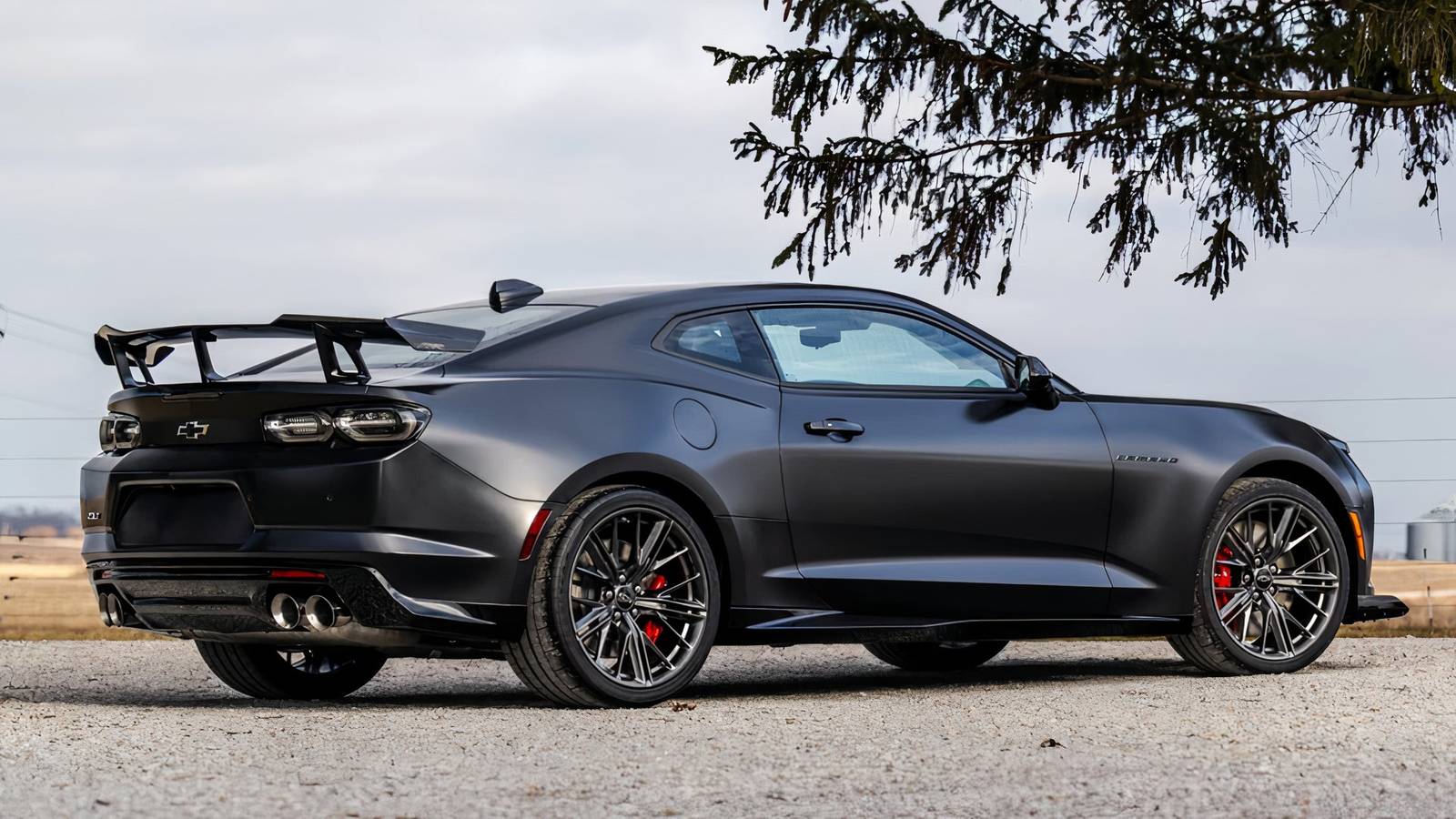
There are a few things the good ol’ US of A does better than any other country in the world. Up until recently, that included the country’s star-spangled proclivity for rolling out big, heavy, up-muscled two-doors with no shortage of eight-cylinder character. However, even after several fan-favorite chapters of the horsepower wars, the muscle car era has all but come to an end.
Granted, it’s not completely curtains for the V8-powered domestic coupe. The Ford Mustang lives on, as does the record-breaking Chevrolet Corvette. But the noticeable absence of a few eight-cylinder, rear-wheel drive staples all but marks the end of the modern muscle car age. And one nameplate in particular served as a fitting final chapter in the book of brawn.
A Dwindling Landscape Of Modern American Muscle

In 2020, you could choose from a library of naturally aspirated or, even wilder, factory supercharged V8 coupes with domestic badges. At the top of the food chain, the Dodge Challenger SRT Hellcat Redeye and S550 Ford Mustang Shelby GT500 pumped out 797 horsepower and 760 horsepower, respectively. Devoid of forced induction, the flat-plane V8-powered Mustang Shelby GT350 screamed up the rev range to a potent 526 horsepower. It was a good time for V8-powered, rear-wheel-drive American muscle. But all things must end, and so too did the modern age of muscle and pony cars. Well, mostly.
An End To The Horsepower Wars

Fast-forward to today. The Chevrolet Camaro, Dodge Challenger, and the LD-platform Dodge Charger are long gone. The Ford Mustang lineup is left without a factory Shelby option. The Dodge Charger is back, and wearing a retro aesthetic. But you won’t find a V8 in the Dodge Charger these days. In short, while you can still get plenty of muscle in the Ford Mustang GT, Dark Horse, or Dark Horse SC, the era of mainstream American automakers shamelessly one-upping each other for the highest possible horsepower output is over. But, while the Challenger and four-door Charger bowed out after the 2023 model year, the Bow Tie’s resident muscle car stuck around for one more year.

5 Cars To Drive If You Miss The Chevy Camaro
The roar of the Camaro may be silenced, but these five thrilling alternatives are ready to ignite your passion for power and performance.
Thanks, Six: The Chevrolet Camaro Was A Final Chapter For American Muscle

The Chevrolet Camaro. Chevy intended for the “small, vicious animal that eats Mustangs” to do just that: take on the Ford Mustang’s seemingly unstoppable sales success. Unfortunately for GM, the Camaro didn’t come close to the first-generation Mustang’s dealership heroics. In fact, it wasn’t until 1977, 10 years after its first model year, that the Chevrolet Camaro outsold the Ford Mustang over the course of a year.

Fortunately, however, the Camaro didn’t pack it in, sticking around for six generations. Only recently, after the 2024 model year, did General Motors and Chevrolet close the book on the Camaro. That move left the Ford Mustang as the sole four-seater, two-door, front-engine V8 muscle car (ok, pony car, calm down) from a domestic marque. It was the end of the modern automaker-versus-automaker muscle car era. The Camaro was done. But to the Camaro’s credit, Chevrolet nailed it with the final generation.

Tenured General Motors engineer and “Mr. Camaro,” Al Oppenheiser, said it best. “We literally designed the sixth-generation Camaro while we were reading about the faults of the fifth generation in the enthusiast media,” Oppenheiser said of the final Camaro. The sixth-gen Camaro borrowed its bones from the Cadillac ATS and CTS. As a result, the Alpha-platform Camaro was much more athletic than the previous generation’s Zeta application. “With the fifth gen, the driver learns how to drive the car,” Oppenheiser told interviewers. “With the sixth gen, the car responds to the driver’s input. It was a completely different philosophy.”
No Replacement For Displacement

The sixth-generation Chevrolet Camaro did more than take away the Ford Mustang’s last remaining direct competitor; it took its big-displacement bragging rights with it. Since 2011, the Ford Mustang GT’s grunt has been courtesy of the 5.0-liter “Coyote” V8. Even specialty S550 models, like the Bullitt, Mach 1, and Dark Horse pack versions of the Coyote engine.

The Camaro 1SS, on the other hand, produced 455 horsepower and the same number in torque using a naturally aspirated 6.2-liter LT1 V8. Of course, the Mustang’s Coyote is a dual-overhead cam application with four valves per cylinder– a bit grown up for a muscle car. The Alpha-platform Camaro’s LT1, on the other hand, is a cam-in-block, two-valve, pushrod V8. Yet another way that the Camaro took that much more of the old-school muscle car formula with it when Chevrolet pulled the plug. But the naturally aspirated heart wasn’t the most ferocious spec for the sixth-generation Chevy Camaro. Far from it.
2024 Chevrolet Camaro 1SS Specs
|
Engine |
Naturally Aspirated 6.2-Liter LT1 V8 |
|
Transmission |
6-Speed Manual, 10-Speed Automatic |
|
Horsepower, Torque |
455 HP At 6,000 RPM, 455 LB-FT At 4,400 RPM |
|
Curb Weight |
3,685 LBS |
|
0-60 MPH |
3.9 Seconds |
|
Quarter Mile |
12.2 Seconds |

15 Modern Muscle Cars That You Shouldn’t Overlook
Here’s a comprehensive list of models that perfectly capture the essence of old-school muscle, and blend them with modern-day conveniences
A Record-Breaking Supercharged Version

The sixth-generation Chevrolet Camaro ran from 2016 to 2024, a total of nine model years, before GM discontinued it. During that time, you could get the Camaro with a 2.0-liter inline four, a 3.6-liter V6, or the potent 6.2-liter LT1 V8. It doesn’t stop there, though. As part of the sixth-generation lineup, Chevy offered the Camaro ZL1 with a supercharged 6.2-liter V8. Mind you, with 650 horsepower and 650 pound-feet of torque on tap, the 2017 Chevrolet Camaro ZL1 doesn’t outmuscle a Dodge Challenger SRT Hellcat of the day. What it did do, however, was prove that muscle cars can handle themselves well enough on a world-class circuit with the right performance touches.

Speed-obsessed engineers gave the ZL1 an arsenal of go-fast goodies, including magnetorheological dampers, an electronic limited-slip differential, and a lightning-fast 10-speed automatic gearbox. The result? The ZL1 isn’t just a straight-line weapon; it’s a track star, too. When GM pitted the 2018 Chevrolet Camaro ZL1 1LE against the famed Nürburgring Nordschleife, the super Camaro returned a lap time of 7:16.04, one of the fastest-ever laps for an American production car.
How Much Are They Worth Today?

Depending on which variant you’re after, a sixth-generation Chevrolet Camaro in good condition with average mileage can cost between $15,000 and well over $100,000. As you might imagine, going the eight-cylinder route means a higher cost of entry. For instance, a 2016 Chevrolet Camaro 1SS has an average value of around $25,600, depending on factors like location, condition, mileage, and title status.
Want the bleeding-edge ZL1? You’re going to pay for it, even as a used car purchase. Over the last year, the average 2024 Chevrolet Camaro ZL1 sale crossed the six-figure mark, ringing in at an eye-watering $103,751.

Mustang Vs. Camaro: We Compared Performance, Features, And Fun
Few rivalries in automotive history have burned as brightly as the one between the Ford Mustang and the Chevrolet Camaro.
American Muscle Lives On (Sort Of)

Chevrolet sent the Camaro out to pasture after the 2024 model year, marking the first time the Camaro left production since the fifth generation rolled off the line as a 2010 model. After its departure, the modern muscle segment has but one name left: Mustang. Fortunately, Ford CEO Jim Farley reassured V8 fans that the eight-cylinder Mustang isn’t going anywhere anytime soon. “If we’re the only ones on the planet making a V8 affordable sports car for everyone in the world, so be it,” Farley said.

The Dodge Charger also made a return, this time as a coupe or sedan with gas-powered engine offerings. That said, some die-hard Mopar fanatics refuse to call the new gasoline-drinking Charger a muscle car because it has a twin-turbocharged Hurricane inline-six, rather than a HEMI V8.