
Luxury cars have long lived in their own carefully curated universe — a place defined by prestige, engineering excellence, and traditions that seemed untouchable. For years, the recipe hardly changed: soft leather, thick carpets, big engines, and styling meant to signal importance before the car even rolled past. Yet the machines that truly reshaped the luxury world rarely followed that formula. They challenged their eras, tore up expectations, and forced the industry to rethink what luxury could be.
Some did it through engineering bravery. Others, through bold design or by redefining luxury for a changing audience. But all seven vehicles below share one thing in common: they refused to play by the rules. Instead, they wrote new ones. These are the cars that shifted the meaning of luxury — not just for their own time, but for every generation that came after.
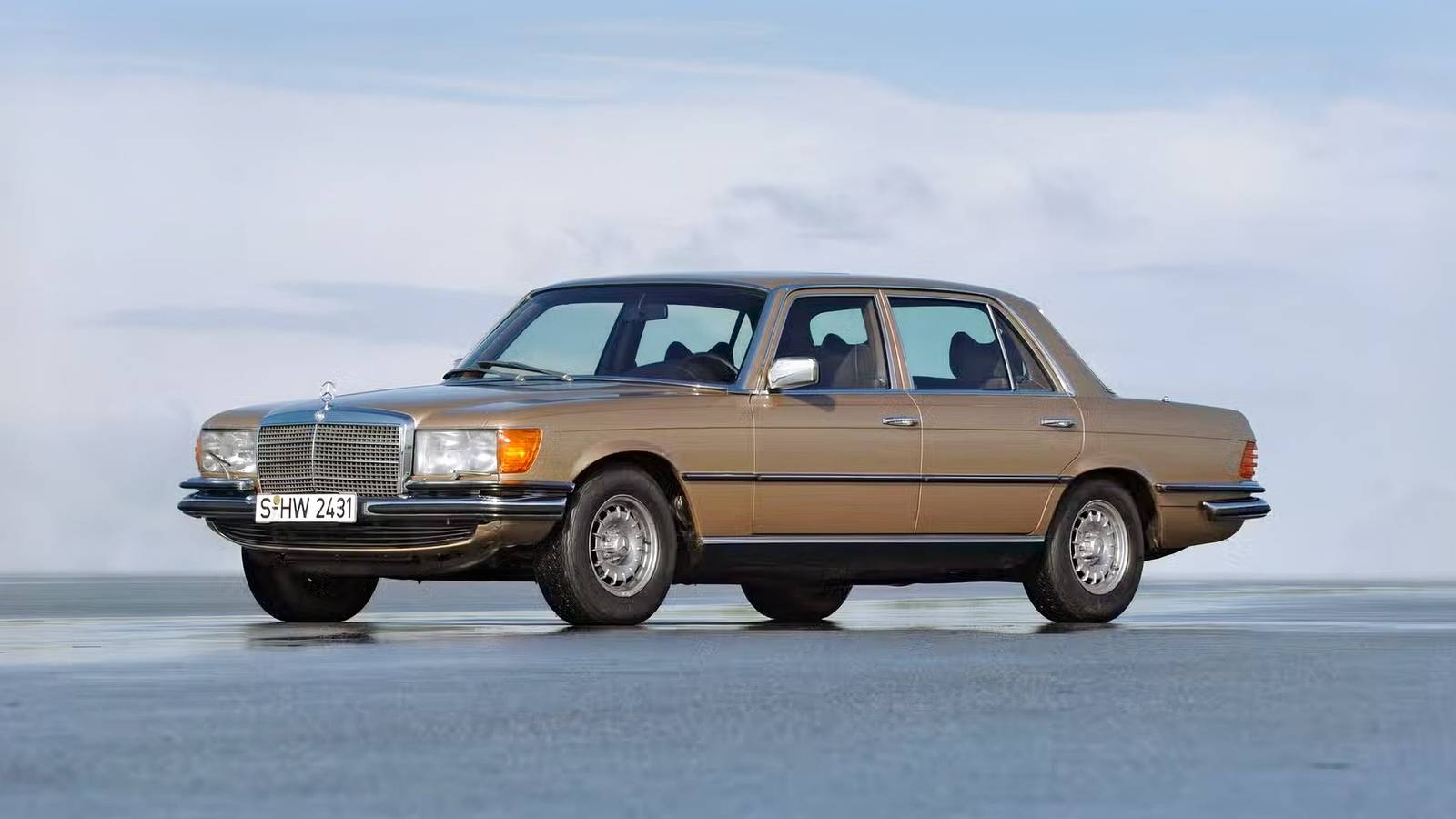
1972 Mercedes-Benz S-Class (W116)
When Safety Became Luxury

By the early ’70s, luxury cars were basically rolling lounges — thick carpeting, heavy doors, chrome everywhere, and enough wood trim to make a furniture maker blush. Comfort mattered most, while safety barely made the conversation. That changed in 1972, when Mercedes-Benz unveiled the W116 S-Class. Mercedes treated safety as a luxury feature in its own right, not a checklist item. This thinking was radical back then. The W116 became the first production car to offer Bosch ABS, a system that changed emergency braking forever. It also adopted crumple zones, a reinforced passenger cell, a collapsible steering column, and an overall philosophy that prioritized crash performance as much as comfort and refinement.

Even the design showcased this intent. The W116 wasn’t simply styled; it was engineered from the ground up to withstand impacts in ways rivals hadn’t yet considered. Mercedes didn’t whisper this message — it broadcast it loudly. And the industry listened. Within a decade, every major luxury manufacturer had begun to integrate safety as a key selling point. The W116 didn’t just set a benchmark; it shifted the entire definition of luxury. Safety wasn’t optional anymore. It was a status symbol.
Notable Innovations And Aspects
- The W116 was the first Mercedes officially called “S-Class”, establishing the nameplate that defines luxury sedans today.
- Early crash-test prototypes were so overbuilt that engineers joked they were “too safe to fail” during development.
- The optional ABS was so groundbreaking that Bosch could barely keep up with demand after launch.
1965 Rolls-Royce Silver Shadow
When The Old Guard Embraced Modernity

Rolls-Royce had long been the guardian of tradition, building cars that felt hand-crafted rather than manufactured. But by the mid-1960s, the world around it was shifting fast. Enter the 1965 Rolls-Royce Silver Shadow, a car many consider one of the most important in the brand’s history. It marked a decisive break from decades of engineering philosophy by adopting monocoque construction, abandoning the body-on-frame architecture that had defined Rolls-Royce vehicles since the early days of motoring.

This wasn’t a small shift. It fundamentally changed how the car rode, handled, and responded. It allowed Rolls-Royce to build a vehicle that was significantly more modern in proportion, lighter, and more suited to the increasingly urban environments its buyers occupied. The Silver Shadow also gained hydropneumatic suspension, licensed from Citroën, delivering a ride that became almost legendary for its smoothness. Suddenly, Rolls-Royce wasn’t just building the most prestigious cars; it was building some of the most technically advanced. Traditionalists grumbled. Customers didn’t. The Silver Shadow went on to become one of the brand’s most successful models, proving that even the most heritage-rich manufacturers occasionally need to blink — and innovate.
Notable Innovations And Aspects
- It was the first Rolls-Royce built with unibody construction, a move some traditionalists compared to “heresy.”
- The Silver Shadow became the best-selling Rolls-Royce of its time, outselling its predecessors by a massive margin.
- Rolls tested the suspension so thoroughly that early journalists described the ride as “magic carpet–like” — a phrase Rolls still uses today.
1989 Lexus LS400
The Precision Strike That Shook Germany

When Toyota announced plans for a new luxury brand in the ’80s, German manufacturers barely raised an eyebrow. But Toyota wasn’t looking to compete — it intended to upend expectations entirely. When Toyota announced its intention to launch a luxury brand in the 1980s, the German establishment barely reacted. The idea that Japan — known primarily for affordable, reliable economy cars — could meaningfully challenge Mercedes or BMW seemed far-fetched. But Toyota wasn’t aiming to compete. It was aiming to dismantle assumptions. The 1989 Lexus LS400 arrived after an enormous investment and a mission to redefine what refinement and quality truly looked like. Its V8 engine was engineered to such an exacting level that journalists balanced coins on the intake manifold while the car idled — and the coins didn’t fall.

The build quality bordered on obsessive. Panel gaps were uniform in ways European brands could only admire from afar. The cabin materials weren’t just premium; they were meticulously selected and assembled. And despite all the engineering ambition, Lexus priced the LS400 significantly below its German rivals. This was more than a smart strategy. It was a disruption. Customers noticed. So did competitors. The LS400 forced established luxury brands to revisit their pricing, improve reliability, and rethink their engineering methods. Critics accused the car of being “emotionless” — but the market rewarded its precision. The LS400 proved that luxury didn’t belong to Europe by default. It belonged to whoever executed it best.
Notable Innovations And Aspects
- Lexus invested over $1 billion into the LS400’s development — an unheard-of figure for a newcomer brand.
- More than 450 prototypes and 60 designers were involved in perfecting panel gaps and NVH levels.
- During its launch drive in the U.S., Lexus famously placed champagne glasses on the hood to demonstrate engine smoothness.
1999 BMW X5 (E53)
The SUV That Reimagined Its Identity

Before the late 1990s, SUVs were utilitarian machines built with ladder frames, stiff suspensions, and driving dynamics that resembled slow-moving trucks more than passenger cars. BMW looked at that market and saw an opening for something different. The 1999 BMW X5 (E53) wasn’t the first luxury SUV, but it was the first one engineered primarily for on-road performance. BMW even avoided calling it an SUV altogether, opting for the term “Sports Activity Vehicle.”

That wasn’t marketing fluff. The X5 E53 took BMW’s reputation for handling and steering precision and applied it to a segment where neither quality was expected. It lacked low-range gearing. It wasn’t designed for hardcore off-roading. Instead, it was built to offer sedan-like behavior at a higher seating position — something consumers quickly realized they wanted more than rock-crawling ability. The gamble worked. The X5 became a commercial success and, more importantly, set the blueprint for modern luxury SUVs. Today, nearly every premium brand from Porsche to Maserati to Lamborghini sells performance-oriented SUVs. That movement traces directly back to BMW’s willingness to ignore tradition and reimagine what an SUV could be.
Notable Innovations And Aspects
- The X5 was nicknamed the “BMW that could climb a mountain but preferred the autobahn.”
- Land Rover and BMW shared tech at the time, so the first X5 quietly benefitted from Range Rover off-road research.
- It was the first BMW built in the U.S., making Spartanburg a major global hub for the brand.
2012 Tesla Model S
The Electric Shockwave

When the Tesla Model S arrived, most people still saw electric cars as quirky commuter tools meant for short trips and patient drivers. Tesla took that perception and shattered it. Few cars in the past 20 years have had as much influence — or generated as much conversation — as the Tesla Model S. When it launched in 2012, electric vehicles were widely dismissed as impractical science experiments suited mainly for short commutes and eco-conscious drivers willing to sacrifice performance and comfort. Tesla’s response was simple: Make an EV that doesn’t just match traditional luxury cars — make one that outperforms them. The Model S’s clean-sheet architecture eliminated many of the compromises inherent in internal combustion design.

With batteries under the floor and no engine up front, the car achieved impressive rigidity, interior space efficiency, and an ultra-low center of gravity. Acceleration figures bordered on unbelievable. Technology integration set new expectations, thanks largely to the massive central touchscreen that replaced most conventional controls. And with long-range capability, the Model S dismantled the belief that EVs couldn’t handle real-world driving needs. More importantly, it forced the rest of the industry to accelerate its electrification plans dramatically. Whether one supports Tesla or not, the Model S acted as a catalyst for change that even the largest legacy automakers couldn’t ignore.
Notable Innovations And Aspects
- The Model S broke Consumer Reports’ rating scale, earning a 103/100 score, the highest ever recorded.
- Its “frunk” (front trunk) wasn’t an EV invention — Tesla revived the concept from old rear-engine sports cars.
- The car’s Ludicrous Mode was almost named “Warp Speed,” but licensing from Star Trek would have been too expensive.
2009 Porsche Panamera
When Practicality Joined the Performance Equation

By the 2000s, Porsche had already proven that it could expand beyond the 911 with the Cayenne SUV. But a four-door Porsche sedan remained a controversial idea, especially among enthusiasts who viewed the brand’s heritage as sacrosanct. Yet Porsche recognized a reality: many of its customers needed a car that could carry more than two people without sacrificing the driving experience the brand was known for. So in 2009, the Porsche Panamera debuted — a car that challenged expectations before the first test drive even happened. The design divided opinion, but once behind the wheel, doubts tended to fade.

The first-gen Panamera delivered the steering feel, chassis balance, and performance DNA that defined Porsche, now wrapped in a body that could genuinely serve as a family or executive vehicle. Beyond its technical achievements, the Panamera helped secure Porsche’s financial future. It broadened the brand’s audience and paved the way for further innovations, including the Taycan — Porsche’s first electric vehicle. Its impact is clear today: Porsche’s lineup is more diverse than ever, and much of that evolution began with the moment the brand dared to build a four-door. They dared to try something different and ultimately achieved positive results from Stuttgart.
Notable Innovations And Aspects
- Porsche originally considered a station wagon design decades before unveiling the Sport Turismo.
- The Panamera’s debut color, “Porsche Aqua Blue,” became unexpectedly iconic after its appearance in early reviews.
- Ferry Porsche once said Porsche would “never build a sedan” — yet the Panamera became a financial powerhouse.
1970 Range Rover Classic
When Utility Discovered Luxury

When the original Range Rover launched in 1970, it introduced an idea the industry hadn’t imagined: that a rugged off-roader could also deliver genuine comfort. It replaced the bone-shaking character of traditional 4x4s with long-travel coil suspension, a more civilized interior, and far better on-road composure than anything in its class.

Buyers quickly realized they could have capability without giving up refinement, and the luxury SUV was born. The Range Rover didn’t follow a trend — it created one, and every premium SUV on the road today owes something to that first breakthrough.
Notable Innovations And Aspects
- The original Range Rover was displayed at the Louvre Museum as an example of “exemplary industrial design.”
- Early prototypes used the code name “Velar,” a badge later revived on the modern Range Rover Velar.
- The first-generation Range Rover famously came with vinyl seats and hose-down floors — despite being the pioneer of luxury SUVs.
Each of these seven vehicles didn’t merely innovate; they challenged assumptions about what luxury should represent. Mercedes-Benz showed that safety could be aspirational. Rolls-Royce proved that even the most tradition-heavy brands must evolve. Lexus disrupted the establishment with precision and reliability. BMW redefined the SUV’s purpose. Tesla made electrification exciting instead of compromising. Porsche blended performance with practicality, and Range Rover carved the path for the modern luxury SUV. As the industry moves toward electrification, autonomy, and software-driven design, these cars remain milestones — reminders that luxury progresses only when someone is willing to question the rulebook and write a new one.
Sources: Classic.com, Hemmings, Bring a Trailer