
Motorcycle engines follow a few good layouts, and that choice has been made over a century of trial and error. Anything from one to four cylinders, and we’re used to seeing them. However, there are some layouts that haven’t made the cut, like the V3 engine (although Honda has something to say about that now) and any longitudinal inline three or four-cylinder engine. Curiously, there have been a few motorcycles powered by six cylinders as well, although they are so rare that there are only two models in production right now.
One format that has never been popular with motorcycles is the five-cylinder engine. There have been many cars that have used it, some of them performance icons as well, but by and large, turbocharging in cars has negated the need for the extra cylinder and all the complications that come along with it. However, forced induction in motorcycles isn’t common, and given that we have seen six cylinders here, it is quite surprising that we haven’t seen more five-cylinder motorcycles. With a manufacturer announcing that there will be a new five-cylinder motorcycle engine on the way, we thought it would be a good idea to look back at all such bikes that you may not have heard about.
Honda RC148

The ‘60s were a mad time for a lot of things, but nothing embodied this madcap spirit more than racing during that time. There wasn’t a big rulebook like there is today; there were merely suggestions as to what you should do. At the time, two-stroke ruled the Grand Prix paddock, but Honda always had faith in four-stroke. The NR750 is proof of how hard it tried to get four strokes to work in racing well before they became the default choice.
The RC148 was born of that same stubbornness to prove that four strokes were the future, but their having half as many power strokes per revolution was a problem against the two-stroke machines. Honda’s solution was simple – theoretically – make it rev twice as high. An extra cylinder was added as well. This resulted in an inline five cylinder layout that displaced a grand total of 125 cc (that’s a neat 25 cc per cylinder), and revved to 21,500 RPM. Oh, and you could get to 22,000 RPM just once, for the last sprint to the finish line.

How The Odd-Number Five-Cylinder Engine Became An Icon
Five cylinders are the magical point between four and six, where an engine is balanced, powerful, and sounds like music to the ears of enthusiasts.
This engine generated 34 horsepower, which, if you do the math, turns out to be 272 HP/liter. For reference, modern MotoGP bikes make around 300 HP/liter, a mere 60 years later. You needed to keep it on the boil quite like a two-stroke to get the performance out of it, which is why it had an eight-speed gearbox.
Some of the parts were so small that tweezers were needed to handle them! This was a featherweight motorcycle, too, with a curb weight of 187 pounds. The RC148 was a success, with Luigi Taveri winning the championship on one. It was his third championship with Honda. Having proved its point, Honda moved on to other engine configurations after the 1966 season. To the best of our knowledge, the RC148 is the only five-cylinder motorcycle built by a manufacturer with carburetion as a fuel delivery system – and will hold that title forever.
Millyard Kawasaki H2 1250
If that name sounds familiar, it is because it belongs to Allen Millyard, the same gentleman who shoehorned a Dodge Viper V10 engine into a motorcycle chassis. Oh, and unlike the Dodge Tomahawk, the Millyard Viper V10 is street legal. The Kawasaki H2 1250 was a one-off Frankenstein build from Millyard. It had the H2 Mach IV ‘Widowmaker’ as a base, and added two more cylinders for a total of around 1,200 cc from an inline five-cylinder configuration.
The result was around 120 horsepower. Remember that the stock H2 Mach IV made around 74 horsepower from its 748 cc engine and could run a quarter mile of under 12 seconds, hoist the front wheel easily in first gear, and go on to 120 miles an hour. It was rumored to be able to get to over 140 MPH! To put it into context, on a good day, its top speed would have been enough for it to get and retain the production bike top speed record until the 150 MPH, fully-faired Honda VF1000R came along in 1984.
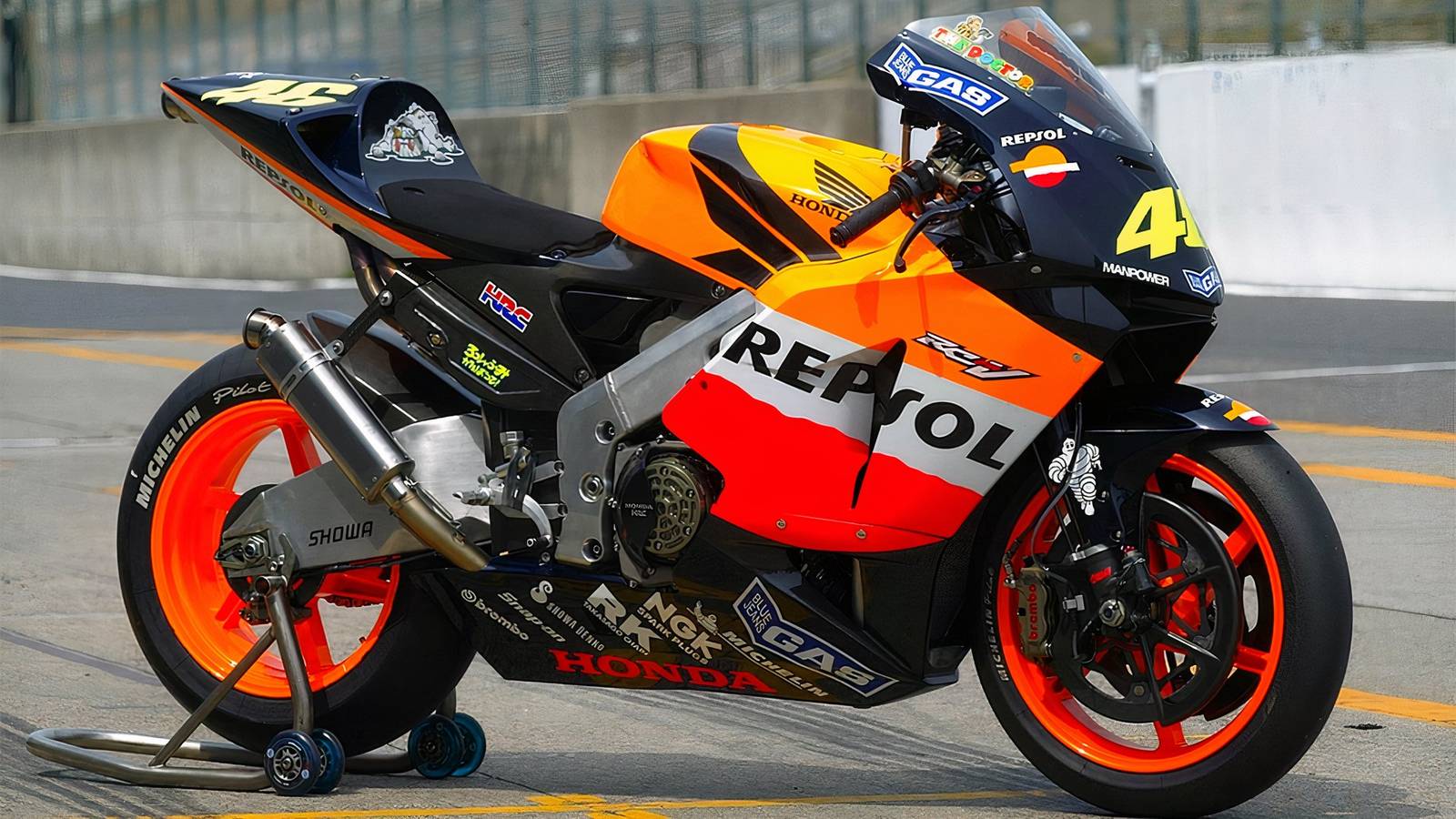
Honda RC211V MotoGP Bike

Honda has had quite a few experiments with four-stroke racing machines. We’ve already discussed the RC148 and its success, and Honda tried repeating that with the NR500. The roadgoing version was called the NR750 or just plain ‘NR’, and we’re not likely to see its level of complexity in any roadgoing motorcycle ever again. Honda then went back to two-stroke racing bikes and was very successful with the NSR500. Mick Doohan was the most successful, and Valentino Rossi won his last title in the last year.

8 Six-Cylinder Motorcycles That You Shouldn’t Ignore In 2025
Although it’s a dying engine breed, these bikes all make a case for themselves with some solid USPs
2002 saw a shift in the rules, favoring 990 cc four-stroke bikes. The RC211V was born with a V5 engine. This engine had a 75.5-degree bank angle and generated its peak torque at 15,000 RPM. Power was in excess of 230 horsepower (without traction control in 2002!). The 211 won titles with Valentino Rossi and Nicky Hayden, and the V5 layout was discontinued in favor of a 90-degree V4 when the rules changed to allow only 800 cc bikes in 2007. Since then, all MotoGP participants have only run four-cylinder engines.
MV Agusta Cinque Cilindri Models (Upcoming)

MV Agusta seems to be on its way to becoming the first motorcycle manufacturer to produce a motorcycle with a five-cylinder engine. It calls it the “Cinque Cilindri” engine, which is Italian for ‘five cylinders’. The Italians have been known to give creative names to their automobiles sometimes, like the Maserati Quattroporte, which was a four-door sedan. Seriously, though, MV Agusta calls it the Quadrato engine platform, which is Italian for ‘square’.
There are a few extremely interesting facts about this new five-cylinder MV engine. It has two banks, with three cylinders facing in the front and two at the rear. It will have two crankshafts in a U configuration but only a single cylinder head. There will be no variable valve timing, since it doesn’t need it to comply with emission norms. There are some real benefits when it comes to size: these engines will be narrower than an inline four, shorter than a V4, and weigh under 132 pounds.

10 Automakers That Had An Intimate Relationship With Inline-Five Engines
Rare, powerful and sonorous, five-cylinder engines are now a dying breed. These are the brands that kept this engine’s legacy alive.
The MV Quadrato engines will have a range of displacements from 850 cc to 1150 cc. In its highest state of tune, it will generate 240 horsepower at over 16,000 RPM and nearly 100 pound-feet of torque at 8,500 RPM, which signifies an amazingly flexible engine. That means we will see it in everything from power cruisers (should MV make one) to supersport liter bikes (which MV will most definitely make).
MV Agusta has said that the engine will debut in a model that is currently no longer in the lineup. Our money is on the F4 making a return to the lineup with the full 240 horsepower and a world-beating top speed – and of course, the title of the world’s first production five-cylinder motorcycle.