
Ford has the F-Series, Chevrolet has the Silverado, and Toyota has the Tundra. As one of America’s favorite full-size pickup trucks, the Toyota Tundra has been a mainstay in our market for just over 25 years. Over that time, it has seen many faces and has moved with the times to stay a relevant and useful companion.

- Base Trim Engine
-
3.4L [NA] ICE
- Base Trim Transmission
-
10-speed automatic
- Base Trim Drivetrain
-
Four-Wheel Drive
- Base Trim Horsepower
-
358 HP @5200 RPM
- Base Trim Torque
-
406 lb.-ft. @ 2000 RPM
- Base Trim Fuel Economy (city/highway/combined)
-
17/23/19 MPG
- Base Trim Battery Type
-
Lead acid battery
- Make
-
Toyota
- Model
-
Tundra
Boasting Toyota’s bulletproof reputation, oodles of versatility and usability, and a nameplate that carries a lot of weight, from the first Tundra in 2000 to the present-day models, there is a lot to love about this humble full-size pickup truck. We are exploring the evolution of the Toyota Tundra over the last 25 years, and have brought you all the information you need to know about the different Toyota Tundra generations, styles, and what they can offer.
The Birth Of The Toyota Tundra: Full-Size Pickup Enters The Scene

While it may be difficult to remember a U.S. pickup truck market without the Toyota Tundra, it has only been on our roads for a minimal amount of time compared to the likes of the Ford F-Series, which has been in production since 1948. However, the Tundra is one of the legendary Japanese pickup trucks that has carved out a heck of a reputation for itself in just over a quarter of a decade, selling close to 3 million models in that time.
There have been just three generations of the Tundra, but in that time, they have broken the mold for full-size pickup trucks. Toyota Tundra generations are as follows:
- Toyota Tundra First Generation. 2000–2006 (XK30 & XK40).
- Toyota Tundra Second Generation. 2007–2021 (XK50).
- Toyota Tundra Third Generation. 2022–Present (XK70).


Find 2025 Toyota Tundra and more cars for sale on our Marketplace
2000 Launch: How Toyota Shook Up The Pickup Market

When Toyota launched the Tundra in 2000, it marked a pivotal moment in the full-size pickup market. It replaced the smaller T100 and was Toyota’s first serious attempt to compete with the likes of the F-Series and the Silverado (which launched as a truck in 1999). Built in Indiana and designed with American drivers in mind, the Tundra hit the market with the grit and capability of an American model with the reliability of a Japanese model. What else can you ask for?
What really shook the full-size segment, though, was how refined the Tundra was compared to many competitors of the time. While competitors were focused heavily on raw towing figures, Toyota wove in build quality, comfort, and long-term dependability. The original Tundra’s car-like driving feel, solid interior, and reputation for reliability earned it a top spot in the segment. Toyota designed the Tundra as a workhorse that fits into everyday life.
Classic Features That Made The First Tundra A Hit

The introduction of the Toyota Tundra in 2000 didn’t just enter the full-size truck market; it changed the expectations for a Japanese truck. The Tundra was originally equipped with two engine options: a 3.4-liter DOHC V6 good for 190 horsepower, and a 4.7-liter 2UZ-FE V8 good for 245 horsepower and 315 pound-feet of torque. Both engines are paired with a four-speed auto, and the V8 became the go-to for those of us who need smooth towing power and durability. The 2UZ-FE V8, in particular, is one of Toyota’s finest and most reliable engines (with proper maintenance).
You also get a versatile ride from the original Tundra, with regular, Access, and Double Cab layouts all available, while short or long beds mean both work and personal use are well within its wheelhouse. A maximum towing capacity of 7,200 pounds, a hardy ladder frame, and a reputation for reliability, with owners on Kelley Blue Book (KBB) rating the 2000 Tundra 4.9 out of 5 and 4.8 out of 5 overall, solidifies the launch MY of the Tundra as a very useful full-size truck.

Toyota Makes The Most Reliable Pickup Truck, Louisiana Man Proves It
Sheppard’s story started with a 2007 Tundra, which he drove relentlessly for work—averaging a staggering 125,000 miles per year.
Tundra In The 2000s: Rising Popularity And Power

Between 2000 and 2006, the Toyota Tundra was available in two separate model families: the original XK30 (2000–2003) and the facelifted XK40 (2004–2006). The Tundra XK30 boasts a somewhat boxy and conventional design with a high hood line, simple front grille, and squared-off headlights. Plainly put, it does what it says on the tin and is utilitarian and rugged-looking. Featuring a traditional step-side or long-bed layout, it is instantly recognizable as Toyota’s first full-size crack of the whip.
The XK40 facelift brought along more refinement without losing the rugged edge. The front fascia was redesigned with more aerodynamic curves, larger headlights, and a bolder, chrome grille that gave it a more modern touch. Wheel arches are slightly flared, and bed rails and tailgate styling were updated for a slightly cleaner look.

Alongside a slightly more refined design, the XK40 also brought along minor but significant tweaks in the cabin. These include better seating, optional premium audio rigs, and a more functional dashboard layout compared to what is equipped in the XK30. You also get better towing gear in the shape of a tow/haul mode and a standard 2-inch receiver on V8-equipped models in the XK40 generation. This first of three generations of the Toyota Tundra can be seen to set the scene for what full-size pickup trucks were to become later in the 2000s and 2010s: versatile and useful status symbols.
Torquier Engines, Better Performance, More Fans

The 2000 Toyota Tundra boasts a base-level NA V6 good for 190 horsepower and 220 pound-feet of torque; the optional V8 has been mentioned above. As the first-gen Tundra progressed, Toyota saw that an increase in horsepower was in order. So, they kept with the ‘Vs’ but upped the juice, which in turn improved drivability and off-roading potential (especially the models with an increase in torque).
|
First-Generation Toyota Tundra |
2000–2004 |
2000–2004 |
2005–2006 |
2005 |
2006 |
|---|---|---|---|---|---|
|
Engine |
3.4-Liter 5VZ-FE V6 |
4.7-Liter 2UZ-FE V8 |
4.0-Liter 1GR-FE V6 |
4.7-Liter 2UZ-FE VVT-i V8 |
4.7-Liter 2UZ-FE VVT-i V8 |
|
Transmission |
Four-Speed Automatic |
Four-Speed Automatic |
Five-Speed Automatic |
Five-Speed Automatic |
Five-Speed Automatic |
|
Horsepower |
190 Horsepower |
245 Horsepower |
236 Horsepower |
282 Horsepower |
271 Horsepower |
|
Torque |
220 LB-FT |
315 LB-FT |
325 LB-FT |
325 LB-FT |
313 LB-FT |
|
Maximum Towing Capacity |
5,000 Pounds |
7,200 Pounds |
5,500 LBS |
7,200 Pounds |
7,200 Pounds |
As standard, the first-gen XK30 Tundra hit the scene as a pickup truck you can take off-road. Featured is a high ground clearance of 10.4–11.2 inches on 4×4 models, and solid approach/departure angles of 26° and 21° mean you can hit the gravel trails and moderate trails with ease. It also comes equipped with skid plates under the front suspension, transfer case, and fuel tank on 4×4 models. A solid rear axle with leaf springs and a double wishbone front suspension offers a balanced combination for hitting the rough stuff.
Toyota refined the off-roading and work-ready platform for the XK40 Tundra. Ground clearance was slightly increased to just over 11 inches, and the widened wheel arches and suspension tuning allow for larger off-road tires to be fitted. Also, with the tow/haul mode added, and higher torque from the VVT-i V8s, slow inclines and low-traction driving are a lot more manageable.
Standout Models Of The First-Generation Toyota Tundra
According to Classic.com, today, you can pick up a first-gen Toyota Tundra for the average auction price of $19,273. In typical Toyota fashion, even 25-year-old Tundras can hold their value well. While they hit the scene and shook it up, there are some specific models from the first generation that are more highly regarded than others.
The highest price paid via auction in the last five years was $43,000 for a highly original 4×4 2004 Toyota Tundra SR5 with just 13,000 miles on the clock. Back when it was released, the SR5 was highly praised by owners for its blend of affordability, dependability, and ruggedness; it hit the sweet spot.

It comes equipped with power windows and locks, cruise control, premium cloth upholstery, 16-inch alloys, and a stereo system. Some of these features were optional extras for the Tundra’s competitors, and they came as standard for the Tundra. If you choose to go for a four-wheel-drive Tundra SR5, you also get a rear limited-slip differential to improve off-roading and towing a little.
Models like the Tundra Limited originally offered even more in the way of luxury combined with decent work rates. Featured are chrome exterior trim, color-keyed bumpers, upgraded seats with lumbar support, and interior carpeting. Today, low-mileage Tundra Limited models from the first generation can fetch up to $38,000 at auction. They are a very good combination of Toyota reliability and everyday, comfortable usability.

How Much Should You Pay for A 5-Year-Old Full-Size Pickup?
The most popular vehicles in America are full-size pickups, including the Ford F-Series and Silverado, though that doesn’t mean you have to overpay.
Second Generation Tundra: Bold, Tough, And Modern

The second generation of the Toyota Tundra kicked off in 2007 and lasted a full 14 years until 2021. All models of the second generation are the XK50. There are two distinct periods of the second generation: the XK50 (2007–2013) and the X50 Facelift (2014–2021). With a new generation came a new set of engines for the Tundra, which includes the following:
- 2007–2009 Toyota Tundra. 4.0-Liter NA 1GR-FE V6 (236–270 Horsepower/266–278 LB-FT).
- 2007–2009 Toyota Tundra. 4.7-Liter NA 2UZ-FE V8 (276 Horsepower/315 LB-FT).
- 2010–2021 Toyota Tundra. 4.6-Liter NA 1UR-FE V8 (310 Horsepower/327 LB-FT).
- 2007–2021 Toyota Tundra. 5.7-Liter NA 3UR-FE V8 (381 Horsepower/401 LB-FT).
With the second-gen Tundra, Toyota also upped its game on the design front, especially with the facelifted models from 2014 onward.
Eye-Catching Redesigns That Turned Heads

With the release of the second-gen Tundra in 2007 came a clear redesign that took the Tundra away from its conservative look. Compared to the boxier, utilitarian look of the original generation, the second-gen models arrived with a larger stance, wider track, and a noticeably more aggressive front end. A taller hood and a bolder grille finished off the new design, while a new body style was also introduced: the CrewMax. This new body style nearly instantly made it feel more in line with American full-size pickup trucks.
Toyota also doubled down in 2014 with the facelifted XK50 models, when they released a pretty conclusive mid-cycle redesign. Nearly every exterior panel except the cab was refreshed, bringing a massive grille, sharper headlights and headlight housings, beefier fenders, and redesigned taillights that look far more modern than anything in the Tundra catalog before it.
Inside, the second generation also got a big overhaul, with a wider, more driver-focused dash, larger screens, and tougher switchgear. To top it all off, the cabin was made to feel even less like a work truck, and even more everyday friendly. The latter half of the second-gen Toyota Tundra brought the nameplate right into the modern era.
Advanced Safety And Tech That Set New Standards
It’s not just the face of the Tundra that changed with the second generation iterations, but also in terms of tech and safety equipment. Early second-generation models (2007 to 2013) are equipped with standard ABS, brake assist, stability and traction control, and front and side-impact airbags.
These features are a notable upgrade compared to the first-gen Tundra models that rely more heavily on your inputs and mechanical grip. The cab tech also got fancier, with early infotainment screens measuring around 6.1 inches, offering decent connectivity options, and navigation; they are certainly a big jump forward compared to the radio and CD player setups you get in the first-gen.
“Best and most comfortable truck. I won’t buy another. This low maintenance, very low, has never let me down. I added aftermarket parts, and I instantly fell in love. Handled the snow like no other.”
Owner review of their 2015 Toyota Tundra on Kelley Blue Book
Things got even more modern from 2014 onward, when Toyota introduced larger 7-inch touchscreens with improved graphics and a faster system response. Higher trims boast reversing cameras, parking sensors, blind-spot monitoring, and push-button start, making the Tundra a very easy truck to live with. Most importantly here, though, is that all this new tech didn’t negate how the Tundra worked as a full-size pickup truck. Models that boast the 5.7-liter V8 can still tow up to 10,200 pounds, while still being a safe and comfortable truck to be in every day.

10 Pickup Trucks That Hold Their Value Best Over Time
If you want your pickup truck to be an investment and bring you a high resale price, which one should you buy? These ten have the desired value.
The Third-Generation Toyota Tundra: 2022 To Present

The end of the second-gen Toyota Tundra models also signified the end of the use of V8s under the hood for the almighty Japanese pickup truck. When the third and current-generation Tundra launched in 2022, the V8 was shelved in favor of a twin-turbocharged V6 option and a hybrid V6 option. While full-size pickup truck purists may begrudge Toyota for dropping the best engine configuration, there is no arguing with what they achieved with what they currently offer.
|
Spec |
2022–Current Toyota Tundra |
2022–Current Toyota Tundra i-FORCE MAX Models |
|---|---|---|
|
Engine |
3.5-Liter Twin-Turbocharged i-FORCE V6 |
3.5-Liter Twin-Turbocharged i-FORCE HYBRID MAX V6 Hybrid |
|
Horsepower |
348–389 Horsepower |
437 Horsepower |
|
Torque |
406–479 LB-FT |
583 LB-FT |
|
Towing Capacity |
12,000 LBS |
11,450 LBS |
Even with the shift away from the V8, Toyota has still made its full-size pickup truck a force to be reckoned with, and as a bonus, it can achieve not-so-terrible combined mpg figures to really bring the very clearly modern build and looks up to scratch with some of the most versatile pickups on the market.
A Fresher Look, More Eco-Friendly, And Next-Level Performance

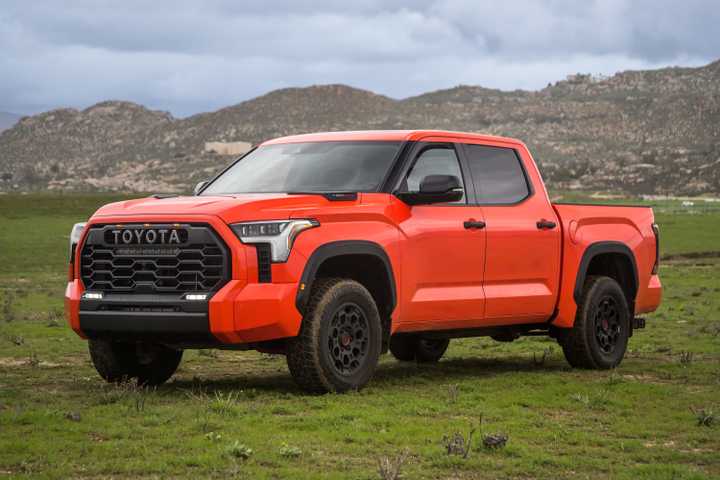
The third-gen Tundra is another evolution of exterior design from Toyota; if you compare it with the first-gen models, they don’t look like the same truck family. Again, the build has gotten bigger; a more sculpted hood sits up front; sharper body lines run down the side, and a larger grille makes it stand out even further. What Toyota has done, though, is design a very usable truck that wouldn’t look out of place ferrying things around a city as well as churning up mud on the back roads.
There are currently seven main trims available for the 2026 Toyota Tundra: the SR, the SR5, the Limited, the Platinum, the 1794 Edition, the TRD Pro, and the Capstone, with the Limited, the Platinum, the 1794 Edition, the TRD Pro, and the Capstone all available with the i-FORCE MAX engine. As standard, most grades of the ’26 Tundra are rear-wheel drive trucks, with four-wheel drive available as an option. Considering the Tundra tips the scales at between 5,205 and 6,230 pounds, we don’t think the combined mpg ratings are so bad. EPA fuel estimates for the current MY of the third-generation Toyota Tundra are as follows:
- 2026 Tundra SR (RWD). 18 mpg city/24 mpg highway/20 mpg combined.
- 2026 Tundra SR5, Limited, Platinum & 1794 Edition (RWD). 17 mpg city/23 mpg highway/19 mpg combined.
- 2026 Tundra SR, SR5, Limited, Platinum & 1794 Edition (4WD). 17 mpg city/23 mpg highway/19 mpg combined.
- 2026 Tundra Limited, Platinum & 1794 Edition i-FORCE MAX Hybrid (RWD). 20 city/24 highway/22 combined.
- 2026 Tundra Limited, Platinum, 1794 Edition & Capstone i-FORCE MAX Hybrid (4WD). 19 mpg city/22 mpg highway/21 mpg combined.
- 2026 Tundra TRD Pro (4WD). 18 mpg city/20 mpg highway/19 mpg combined.
To put that into perspective, the 2021 Toyota Tundra, boasting a 5.7-liter V8, can tow up to 10,200 pounds and muster an EPA-estimated combined mpg rating of 15 mpg.

Alongside balancing relative fuel efficiency and work rate, the latest generation of the Toyota Tundra is a force to be reckoned with out on the trails. At base level, the Tundra SR is off-road capable but is very basic.
Standard 4WD is available on the SR and the SR5, but there is no dedicated off-road hardware unless you opt for the TRD Off-Road Package. There is no locking differential, nor crawl control or multi-terrain traction option. It’s rugged and work-ready; great for forest roads and mild trails, but serious features aren’t included.

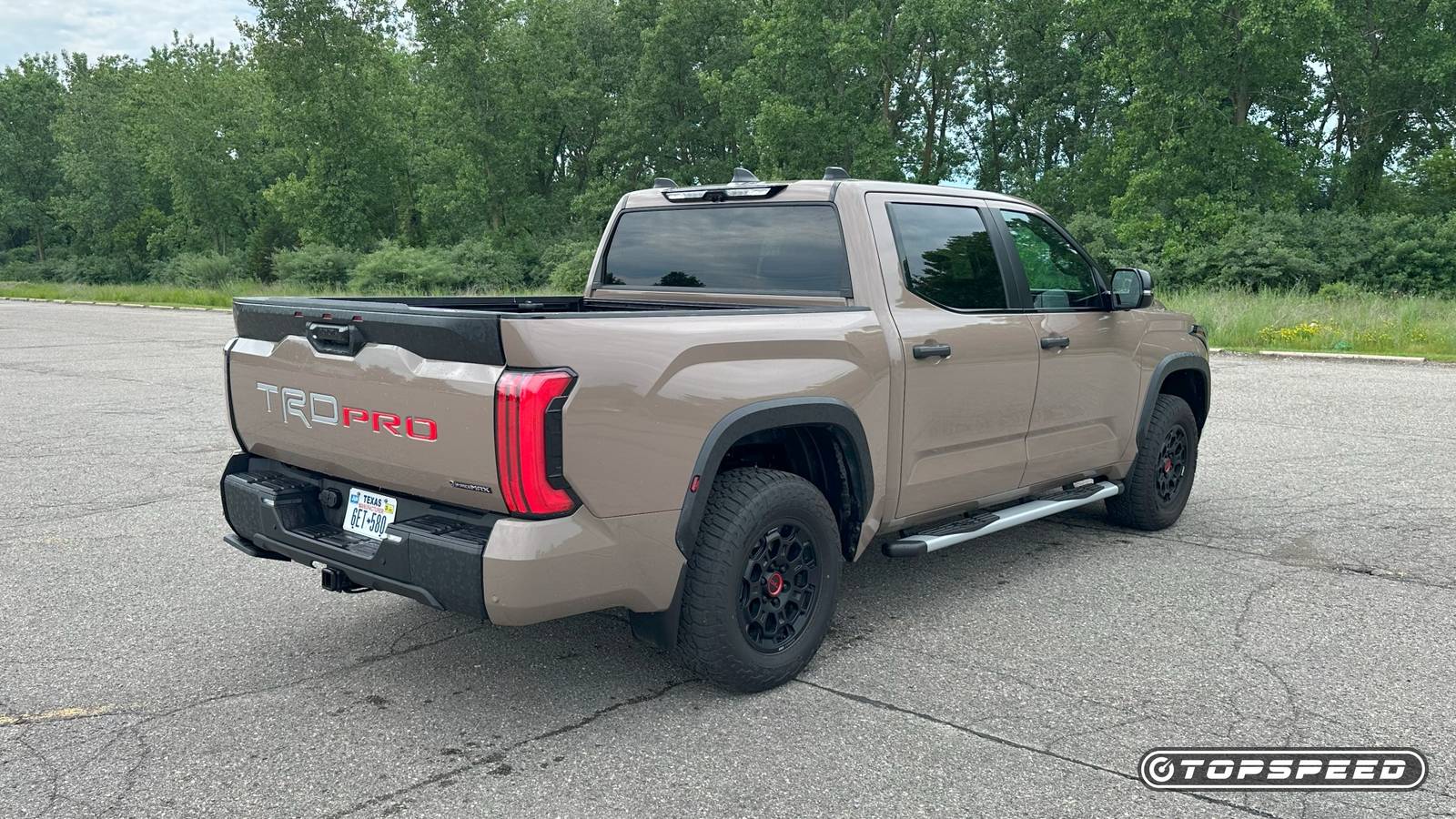
Along with a meaty engine and respectable towing capacities, it is the Toyota Tundra TRD Pro that shows how far the model line has evolved. You get TRD-tuned off-road suspension with FOX internal bypass shocks and front lift, heavy-duty underbody protection, electronically locking rear differential, Multi-Terrain Select, Crawl Control, and Downhill Assist Control.
In essence, the top rugged trim is the accumulation of 25 years of work on the Tundra; it has evolved into a full-size pickup truck that is exceptionally comfortable, relatively frugal with gas, very useful in the mud, and won’t shy away from the worksite.
Sources: Toyota, FuelEconomy.gov, J.D. Power, Kelley Blue Book, and Classic.com.