
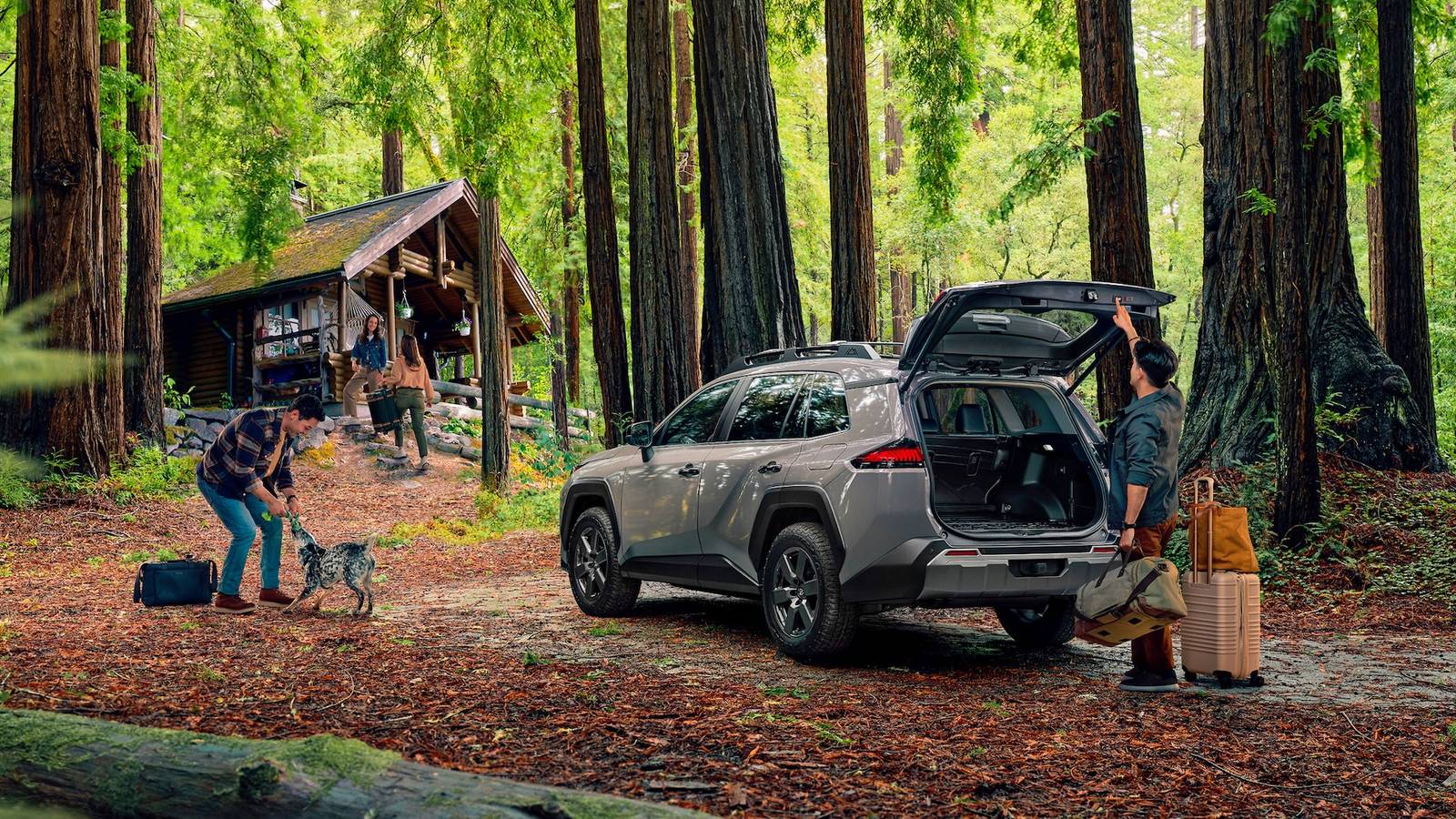
Since its introduction in the mid-1990s, the Toyota RAV4 has defined what a compact SUV should be: efficient, family-friendly, versatile, and dependable. Buyers were warming up to the SUV bodystyle, but SUVs of the day were bulky, truck-derived vehicles, and Toyota saw the opportunity for a lighter, more car-like, city-friendly conveyance that offered what buyers were looking for in a package they could live with, and the Recreational Active Vehicle (RAV) was born.
As a new generation Toyota RAV4 sets off on our roads, it does so with the same hopes and aspirations of its ancestors—offering the capabilities of an SUV and the practicalities of a family sedan in an affordable, comfortable, and practical package. Toyota has continuously refined the RAV4 to keep it ahead of its segment, including its main competitors—the Honda CR-V and Hyundai Tucson—and the new 2026 model falls in step with some new traits and notable improvements.
Hybrid-Only Lineup
FWD Back In The Hybrid Mix

For 2026, Toyota makes electrification the baseline for the RAV4 in the U.S., with every 2026 Toyota RAV4 now only available as a hybrid or a plug-in hybrid (PHEV). The decision acknowledges two things: fuel efficiency and emissions control are now central to purchase decisions in this segment, and that electrification is an efficient way to boost power without energy-sapping displacement increases or forced-induction.

The Honda CR-V (the RAV4’s prime competitor since its inception, at roughly the same time) continues in gasoline and hybrid models available in FWD and AWD, and the Hyundai Tucson (which joined the other two about a decade later) offers a gas-only model, as well as a hybrid and PHEV, all available in FWD and AWD. For buyers intending to keep their 2026 Toyota RAV4 for years, its electrification baseline positions it as an efficient, more forward-looking choice.
2026 Toyota RAV4 GR SPORT
Unique Sporty Performance Model

Toyota split the new-gen RAV4 into distinct Core (runabout), Woodland (rugged off-road), and Sport (which is capped by a new GR SPORT) models. With input from Gazoo Racing, the 2026 Toyota RAV4 GR SPORT is the athlete of the family, built around Toyota’s 2.5-liter plug-in hybrid powertrain, and tuned for sharper throttle response and chassis dynamics. Sporting unique exterior and interior cues, it shares the same electrified architecture as other RAV4 PHEVs but emphasizes sportier power calibration and suspension tweaks.

Equipment in the 2026 Toyota RAV4 GR SPORT includes a sport-tuned suspension, upgraded brakes, unique wheels and performance tires, and reworked bumpers. The interior houses sport-bolstered seats, a large 12.3-inch screen, and advanced Arene software (Toyota’s new systems platform that you’ll read about later). The GR SPORT aims at buyers who want a more dynamic feel and has no equals in the compact SUV segment, outside of maybe the BMW X3 M50.
Balanced Pricing And Higher Standard Content
Significantly Improved From 2025 Gas Models And 2025 Hybrids

Toyota naturally revamped the RAV4’s complete price structure for 2026 from 2025, with the base model (now a hybrid FWD model) rising by $3,000 (the base 2025 RAV4 was a FWD gasoline model). However, it held the line on the base hybrid model (even though it is now a FWD model and last year’s was AWD). Year-over-year increases for like models are about 4.4 percent for HEV models and 2.2 percent for PHEVs, with extensive equipment additions and upgrades.
|
Toyota RAV4 MSRP |
2026 |
2025 |
|
Gasoline |
N/A |
$28,850 |
|
Hybrid FWD |
$31,900 |
N/A |
|
Hybrid AWD |
$33,300 |
$31,900 |
|
PHEV |
$44,815 |
$43,865 |
Beyond the 2026 Toyota RAV4’s new looks inside and out, there isn’t much difference in terms of equipment content, but there are significant equipment upgrades. For minimal price increases over equivalent 2025 models, 2026 Toyota RAV4 buyers get more power from the hybrid powertrain, larger instrument cluster and instrument panel digital screens, advanced handling and safety tech, and the newest Toyota Safety Suite and new user interface that can now include dual Bluetooth connections.
Redesigned Sixth-Generation Platform
Improved Stability, Reduced NVH, Enhanced Dynamism

The 2026 Toyota RAV4 sits on a new foundation. The redesigned platform uses higher-strength steels and optimized mounts to improve body rigidity, reduce NVH (noise/vibration/harshness), and enhance dynamic stability. That means it feels more composed at highway speeds and better controlled in quick directional changes. The RAV4 has never been bad in either of those situations, but now it’s better.

The Toyota RAV4 has historically trailed its Honda and Hyundai rivals in ride and handling, mostly due to its emphasis on maintaining a semblance of SUV ruggedness. The Hyundai Tucson has bested the Toyota in dynamic handling, based mostly on its reduced overall size, and the Honda has always maintained an edge on everyday urban and suburban refinement. In day-to-day use, the 2026 Toyota RAV4 feels less like an upgrade and more like an overhaul.
Upgraded Ride & Handling
Buyers Can Choose Smoothness, Ruggedness, Or Sportiness

Each 2026 Toyota RAV4 dynamic (Core, Off-Road, or Sport) delivers a composed and confident ride that balances everyday comfort with its intended handling necessities. Lower and mid-level trims emphasize smoothness and predictable response, with suspension tuning equally adept at absorbing urban potholes, rock crawling, or switchback leveling. All-wheel drive adds confidence in all situations, and the new RAV4 maintains its composure better.

The Honda CR-V has long prioritized everyday comfort, and the 2026 model continues with a softer suspension bias, but the 2026 Toyota RAV4 leans into the comfortable control that makes it especially important in the spring thaw/refreeze conditions that foster pothole growth. For everyday running around, the new RAV4’s blend of comfort and composure brings it closer to the advantages of, and in some cases broadens its superiority to, its competitors in past generations.
Strong Towing Ability
Maximum Towing Up To 3,500 Pounds, Properly Equipped

Towing capacity is often overlooked in compact SUV purchases, but the 2026 Toyota RAV4 doesn’t gloss over buyers who occasionally haul trailers, personal watercraft, or small campers, it matters. Just about any vehicle can haul 1,500 pounds, but the new RAV4 PHEV (and properly equipped HEV AWD trims) more than doubles that, which means you not only have the ability to take the family away for an extended wilderness getaway, but save some fueling costs at the same time.
|
2026 Toyota RAV4 |
FWD |
AWD |
PHEV |
|
Curb Weight |
3,640 pounds |
3,865–3,920 pounds |
4,435–4,540 pounds |
|
GVWR |
4,920 pounds |
4,920 pounds |
5,530 pounds |
|
Payload Capacity |
1,280 pounds |
1,000–1,055 pounds |
1,250–1,340 pounds |
|
Towing Capacity |
1,750 pounds |
1,750–3,500 pounds |
3,500 pounds |
As for the 2026 Toyota RAV4’s prime compact SUV competitors, the 2026 Honda CR-V (gasoline and hybrid, only) is rated at 1,000–1,500 pounds for towing applications, while the 2026 Hyundai Tucson is rated at 2,000–2,750 pounds, when properly equipped. This goes back to how you intend to use your 2026 RAV4—it will be more than up to mild towing for things like weekend DIY projects, but you won’t have to leave anything behind (or rent a bigger SUV) for an extended family getaway.
Interior And Cargo Volume
Comfortable Space For People, Versatile Space For Cargo

Toyota didn’t just revamp the 2026 Toyota RAV4’s exterior and drivetrain; it also optimized the interior for practical everyday use and extended journey needs. Cargo volume remains generous for the class (with the PHEV being more constricted), employing a wide load floor and low liftover height that makes loading up and unloading easy on the back. Rear seats fold nearly flat for cargo-carrying versatility, and clever storage nooks throughout the cabin make it livable for extended trips.
|
2026 |
Toyota RAV4 |
Honda CR-V |
Hyundai Tucson |
|
Passenger Volume |
98.9–101.3 cubic feet |
103.5–106 cubic feet |
105.9–108.2 cubic feet |
|
Cargo Volume Behind Rear Seats |
33.5–37.8 cubic feet |
34.7–39.3 cubic feet |
31.9–38.7 cubic feet |
|
Cargo Volume Behind Front Seats |
63.5–70.4 cubic feet |
71.8–76.5 cubic feet |
66.3–74.8 cubic feet |
When it comes to interior size and usability, the 2026 Toyota RAV4 inches closer to the 2026 Honda CR-V, which has been historically strong in cargo volume, thanks to its blockier cabin over the years. The 2026 Hyundai Tucson continues to be a segment leader in its ability to combine people space and cargo versatility, thanks to Hyundai’s clever space utilization and manipulation. For families, outdoor enthusiasts, or anyone who frequently hauls supplies or equipment, the new RAV4 considers every chore.
Improved Hybrid Efficiency And Power
Up To 44 MPG Combined In FWD Model; 324 HP In PHEV Model

The new hybrid system in the 2026 Toyota RAV4 offers a better balance between power and fuel savings than in previous generations. With Toyota’s revered 2.5-liter Atkinson cycle hybrid system (using two or three electric motors, depending on drive configuration), the RAV4 delivers usable power in FWD and impressive power in the PHEV model. Perhaps more importantly, the system smooths out throttle response and enhances low-speed torque.
|
2026 Toyota RAV4 |
FWD |
AWD |
PHEV |
|
Powertrain |
2.5-liter inline-4 + 2 motors |
2.5-liter inline-4 + 3 motors |
2.5L I-4 + 22.7-kWh battery + 3 motors |
|
Transmission |
Continuously variable |
Continuously variable |
Continuously variable |
|
Power |
226 hp |
236 hp |
324 hp |
|
Torque |
163 lb-ft |
163 lb-ft |
172 lb-ft |
|
Range |
Est. 638 miles |
Est. 565–609 miles |
Est. 536–594 miles (48–52 Electric) |
|
Reported Efficiency City |
48 mpg |
41–45 mpg |
41–44 mpg |
|
Reported Efficiency Hwy |
42 mpg |
36–39 mpg |
34–38 mpg |
|
Reported Efficiency Comb |
44 mpg |
39–42 mpg |
37–41 mpg (98–107 MPGe) |
The 2026 Toyota RAV4 feels stronger against the 2026 Honda CR-V—190 horsepower from a 1.5-liter turbo four-cylinder or 204 horsepower with a dual-motor hybrid 2.0-liter “four”—and the 2026 Hyundai Tucson (187 horsepower with a 2.5-liter “four,” 231 horsepower with the hybrid 1.6-liter turbocharged four-cylinder, or 268 for the plug-in hybrid using the same engine). The Toyota hybrid system is also more refined and offers typically quieter performance.
Toyota Safety Sense 4.0
Extensive Suite Of Advanced Driving Technologies Includes Standard Dash Cam

With the IIHS recognizing technological initiatives and federal regulations increasingly demanding high-end technology in lower-end vehicles, active safety tech is no longer an optional luxury. The 2026 Toyota RAV4 is fitted with the latest Toyota Safety Sense 4.0, enhanced from the previous generation’s 3.0, and now comes standard with adaptive cruise control, lane tracking, automatic emergency braking, and a Drive Recorder (dash cam), among others.

The 2026 Honda CR-V also offers a robust safety suite, but Toyota’s latest iteration adds refinements in predictive features that testers note provide smoother transitions between the various technologies. The 2026 Hyundai Tucson uses Hyundai’s SmartSense, which is comparable in scope to the Toyota Safety Sense, with the only difference being the optional dash cam (which is standard on the 2026 RAV4).
Toyota Arene
Umbrella Software Platform Controls Vehicle Systems, Upgrades Seamlessly

Toyota’s new Arene software platform isn’t just a faster infotainment processor; it’s also an umbrella over vehicle systems, voice control, navigation, over-the-air updates, and flexibility for future connected services. The payoff for the consumer is a more responsive interface and a foundation for technology that rapidly improves over time (without requiring user interference). In practical terms, it means fewer freezes, faster mapping, and longer-lasting architecture.

Buyers increasingly judge vehicles on their digital performance, and Toyota has often been criticized for dragging its heels on technology that is proliferating throughout the industry and even its closest competitors, such as the Hyundai Tucson (with its robust control over dual displays). Arene’s unified under-the-hood approach gives Toyota a modern platform that’s easier to update and may prove to be more robust in future connected services.