
Porsche ownership comes with a certain… uniform. There’s the crest hat. The branded quarter-zip. Maybe even a set of Porsche driving shoes that have never actually seen a track. But beneath the lifestyle accessories lives a manufacturer that, when it’s firing on all cylinders (usually six of them, laid flat), builds cars that age with uncommon grace.
Not every Porsche deserves a pedestal. Some were experimental detours. Others were corporate necessities. But a select few have proven themselves over decades, stacking miles, collecting stories, and reminding the rest of the industry what durability plus driver engagement really looks like.

Every Porsche SUV You Can Buy Today: A Complete Guide
Porsche has earned global acclaim for their performance vehicles, though their SUV line-up also delivers quality ability and refinement.
1955 Porsche 550 Spyder
The Original Porsche Icon That Defined Lightweight Performance And The Price Of Going Fast

The 550 Spyder is where Porsche stopped being seen as the cars that scary Germans drove and became a motoring icon. Built in the mid-1950s with a mid-mounted flat-four making around 110 horsepower, the 550 weighed barely 1,200 pounds. That power-to-weight ratio turned it into a giant killer, winning its class at Le Mans and embarrassing much larger competitors on road courses across Europe.

It’s also the car forever linked to James Dean, which cemented its mythology. But beyond its tragic cloak, the 550 introduced Porsche’s core philosophy: lightness first, power second. The tubular space frame chassis, minimalist cockpit, and purposeful aerodynamics weren’t about luxury or really anything at all, other than speed. Today, original examples trade in the millions, and it’s safe to say nobody really drives them anymore. Still, every modern GT car owes something to this tiny silver roadster. Without the 550, there’s no 911, no GT3, no Porsche clothing section at Nordstrom Rack.
(1967–1968) Porsche 911 R
One Of The Best Porsche Models Ever Built

Only 20 factory 911 Rs were produced, making this one of the most elusive Porsches ever. As we well know, the best way to make Porsche people care about a Porsche is to make an impossibly small number of them. Aside from its rarity, since it was a homologation special, the R stripped weight wherever possible, replacing steel with fiberglass and ditching rear seats, sound deadening, and even door handles. Under the little decklid sat a 2.0-liter flat-six producing roughly 210 horsepower, good for a sub-5-second sprint to 60 mph. In 1967, that was absurd. The R proved that the 911 platform could be turned into a proper race weapon, laying the groundwork for decades of RS and GT variants.

Collectors now treat the 911 R like a holy book, to be studied and revered. But its real legacy is philosophical: it showed Porsche could turn a road car into a war machine. Everything from the GT3 Touring to modern lightweight packages traces back to this experiment. This little baddie ain’t goin’ nowhere.
1963 Porsche 911 (First Year)
Where The Best Porsche 911 Story Actually Begins

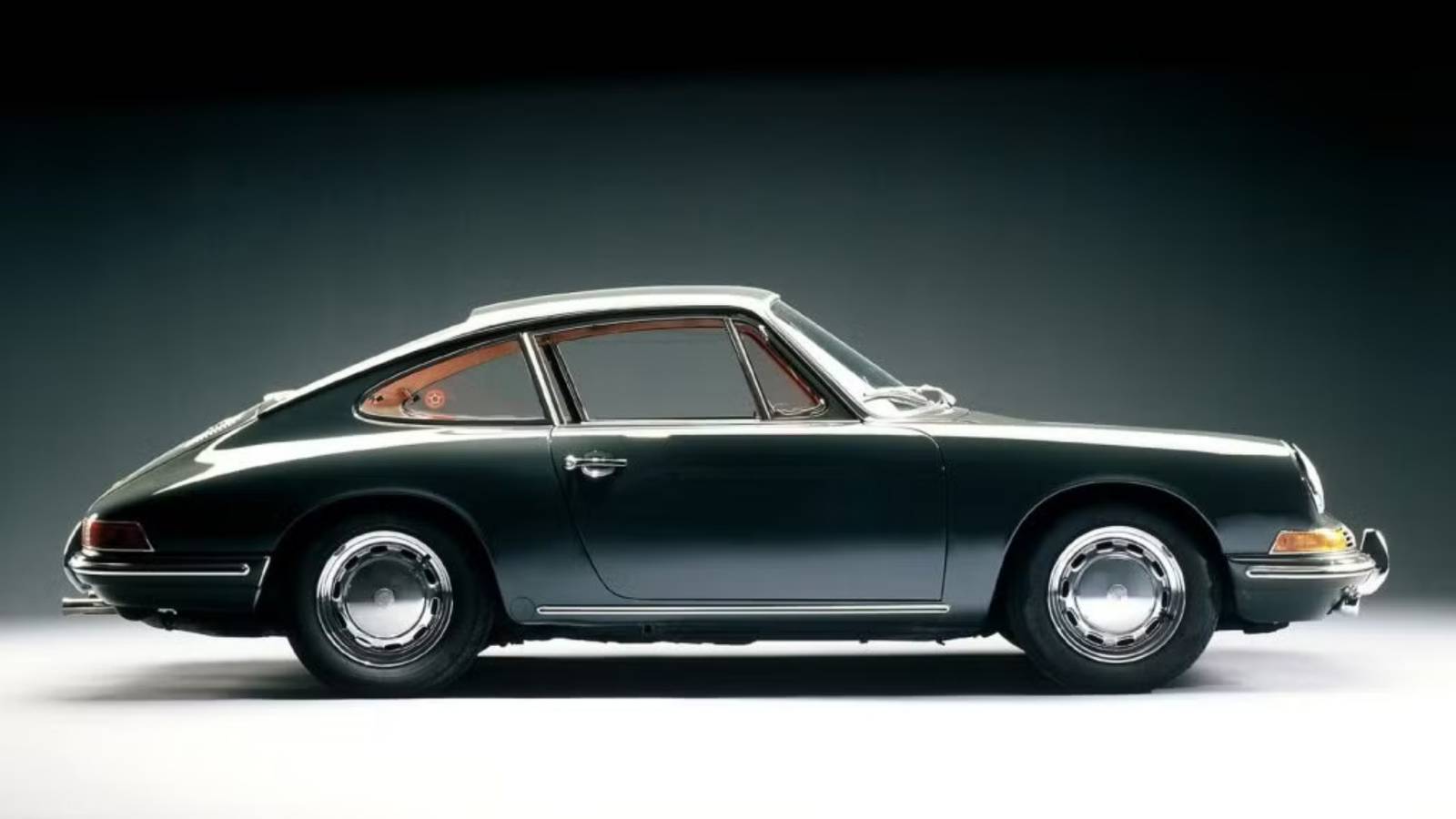
The original 911 debuted in 1963 with a 2.0-liter air-cooled flat-six making 130 horsepower. It wasn’t immediately loved. Early critics found it expensive and strange-looking compared to the 356. And, of course, they were wrong. That first-year car introduced the rear-engine layout, timeless silhouette, and mechanical honesty that still defines Porsche today. Torsion bar suspension, unassisted steering, and a curb weight under 2,400 pounds created a driving experience that modern cars simply can’t replicate.

Every best Porsche model conversation starts here. Without this awkward, brilliant archetype of a sports car, Porsche wouldn’t exist as we know it.

This Is The Rarest Manual Transmission Porsche Ever Produced
Manual transmissions belong in Porsche models, and though there are a lot of Porsches roaming the roads, this model is the rarest Porsche ever made.
1992 Porsche 911 Carrera RS (964)
Peak Analog Porsche

Built in tiny numbers, the 964 RS is what happens when engineers stop caring about market research. The naturally aspirated 3.6-liter flat-six made 260 horsepower, routed through a five-speed manual to the rear wheels. No traction control. No stability management. Just you and physics.

The widened bodywork, fixed rear wing, and stripped interior made it visually unforgettable. It’s also one of the best Porsche colors canvases ever offered, from Riviera Blue to Rubystone Red, giving collectors plenty of material for heated internet arguments. This car sits at the intersection of race car and road car, and prices reflect that. Expect seven figures. These will be relevant for a long time to come.
1999 911 GT3 (996)
The Track Monster That Saved The Water-Cooled 911 Era

The 996 generation remains controversial because of its headlights, but the GT3 variant redeemed the entire platform. Powered by the Mezger 3.6-liter flat-six producing up to 381 horsepower, the GT3 delivered race-car bang with street legality. Unlike standard 996 models, it avoided IMS bearing issues thanks to its motorsport-derived engine. Adjustable suspension, massive brakes, and razor-sharp steering made it a weapon on track days.

It also introduced the GT3 badge as something sacred. Today, this generation is finally getting the respect it deserves, especially among buyers who care more about lap times than Instagram aesthetics.
2013 Porsche Cayenne
The Porsche SUV That Saved The Brand

Purists hated the Cayenne until they realized Porsche might not be here today without it. By 2013, the second-generation Cayenne had matured into a genuinely excellent luxury SUV, offering V6, V8, diesel, and hybrid options.

The Turbo model delivered 500 horsepower, adaptive air suspension, and real towing capability. Meanwhile, base trims still drove better than most sports sedans. This is the moment Porsche proved it could build family vehicles without losing its appeal to the people in the hats and jackets. Also, yes, it floated the bills for Stuttgart.

Best Of The Best: Greatest Porsche 911 Models Of All Time
Within the 911 lineage, certain models stand out as definitive highlights with milestones that pushed the boundaries of design, technology, and speed.
2018 Porsche Macan
The Best Porsche SUV For Daily Driving

The 2018 Macan proves you can have a compact SUV that still drives like a Porsche. Turbocharged four-cylinder and V6 engines push up to 400 horsepower in the GTS, delivering sharp steering, precise brakes, and a balanced chassis. It handles grocery runs, carpooling, or weekend trips without losing its sporty character—no bloated SUV feel here.

Inside, the cabin pairs high-end materials with practical tech. The infotainment screen is responsive, the seats are comfortable, and the rear hatch swallows luggage or gear with ease.
Reliability is a strong suit. Well-maintained Macans from 2018 show durable suspension, turbo engines, and electronics. For anyone seeking a compact SUV with real Porsche DNA but not a stratospheric price, the Macan is a smart choice that will be with us a while.
2014 Porsche Cayman
The Mid-Engine Secret Weapon Of Porsche Reliability

The 2014 Cayman brought sharper styling and improved chassis tuning. Engines ranged from a 2.7-liter flat-six to a 3.4-liter in the S, producing up to 325 horsepower. Mid-engine balance allowed Porsche people to fight in its corner as being better than contemporary 911s in real-world driving. Less weight, lower center of gravity, and fewer electronic layers created something simpler than a lot of drivers really respond to. For drivers who don’t need rear seats or bragging rights, or the endless car payments, this might be peak Porsche.
2015 Porsche 911 (991)
The Best Modern Porsche 911 For Reliability

The 991 generation marked a huge leap forward in build quality. The 2015 model year, in particular, earned unusually high reliability scores thanks to refined electronics and durable drivetrains. Available with naturally aspirated engines before turbocharging fully took over, it blends modern tech with the old-school raspy character of the old karts. Power ranged from 350 to 560 horsepower, depending on trim. It’s the sweet spot between analog and daily usability, which is why values are holding strong.

The Sports Car With Toyota Reliability And Ferrari-Level Speed
Discover the engineering marvel that delivers Ferrari-like performance without the fuss of a supercar.
2003 Porsche Carrera GT
The V10 Hypercar That Still Terrifies Supercars

The Carrera GT is the kind of car that makes even the most stoic Porsche enthusiasts sweat through their logo t-shirt. Its 5.7-liter V10 makes a colossal 603 horsepower and 435 pound-feet of torque, driving the rear wheels through a six-speed manual. Top speed nudges 205 mph, and the carbon-fiber monocoque chassis should keep things orderly, but it is infamous for getting the better of many drivers. Unlike many modern hypercars, the Carrera GT demands focus—it’s analog in the best (scariest) way, giving you a visceral connection to the car and the road.

Inside, it’s raw but purposeful. Lightweight bucket seats, minimal tech, and controls that aren’t hiding behind multiple menus make it a car for purists. Visibility is surprisingly decent for a mid-engine monster, and the cabin still feels civilized enough to endure longer drives without frying your nerves. It’s not a daily driver, but it’s the kind of car you dream of taking out on the weekend.
Beyond the specs, the Carrera GT has proven durable for a limited-production supercar. Its combination of raw beef, engineering precision, and pure skill thrill makes it a modern classic—a Porsche you can appreciate both on paper and in person. While most Porsches endure due to their engineering excellence and poise, the Carrera GT will endure for its strangeness as a Porsche that very much would like to kill its driver.
Sources: Porsche, J.D. Power